

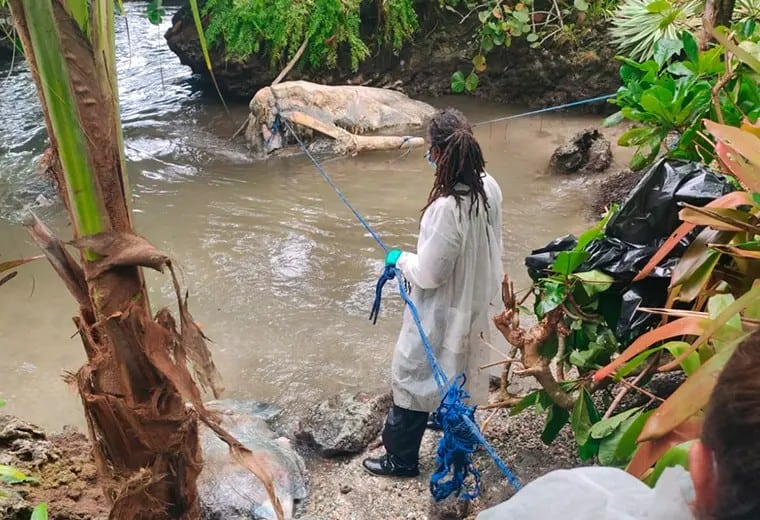
A sperm whale measuring between eight and nine meters (26 to 30 feet) was found dead in a natural pool near Cahuita, on Costa Rica’s southern Caribbean coast, drawing a multi-agency response to remove the remains from a site that heavy machinery could not reach.
The animal — a sperm whale, Physeter macrocephalus, the largest of the toothed whales — was already in an advanced state of decomposition when it was discovered. Officials from the National System of Conservation Areas (SINAC), acting through the La Amistad Caribe Conservation Area (ACLAC), attended the scene and coordinated the response.
Because the pool lies in a difficult-to-access location, crews were unable to bring in heavy machinery to complete the removal. Technical staff instead carried out the work by hand, using protective equipment and following technical guidance issued by the National Animal Health Service (SENASA).
Workers removed and properly disposed of a significant portion of the skeletal remains, including segments of the spinal column and ribs, in an effort to limit the environmental and public health impacts in the area, according to the Ministry of Environment and Energy (MINAE).
The operation brought together SENASA, the Ministry of Health, the Municipality of Talamanca, the Cahuita Local Council, the Turtle Rescue Cahuita project and a group of volunteers. Maylin Mora Arias, regional director of ACLAC, said the incident called for a coordinated and timely response and thanked the institutions, organizations and volunteers who took part, adding that SINAC would continue strengthening its response capacity and interinstitutional coordination for events of this kind. The cause of the whale’s death has not been established.
A carcass of that size presents a real hazard as it breaks down. Decomposing marine mammals release fluids and gases that can foul the surrounding water, draw scavengers and create a lingering sanitary problem — which is why the teams prioritized removing bone and tissue and disposing of it correctly rather than leaving the remains to decay in place. The isolated setting made that far harder, ruling out the machinery that would normally handle a carcass this heavy and forcing the crews to work manually in protective gear.
Cahuita sits on the southern Caribbean coast in Limón province and is best known to visitors for Cahuita National Park, whose coral reef, rainforest trails and coastal wildlife make it one of the region’s most-visited protected areas. Sperm whales are deep-diving, open-ocean animals rarely seen close to shore, and strandings of large cetaceans in Costa Rica are uncommon enough to draw attention when they occur. Without a determined cause of death, it remains unclear how or why the animal ended up in the pool where it was found.





