

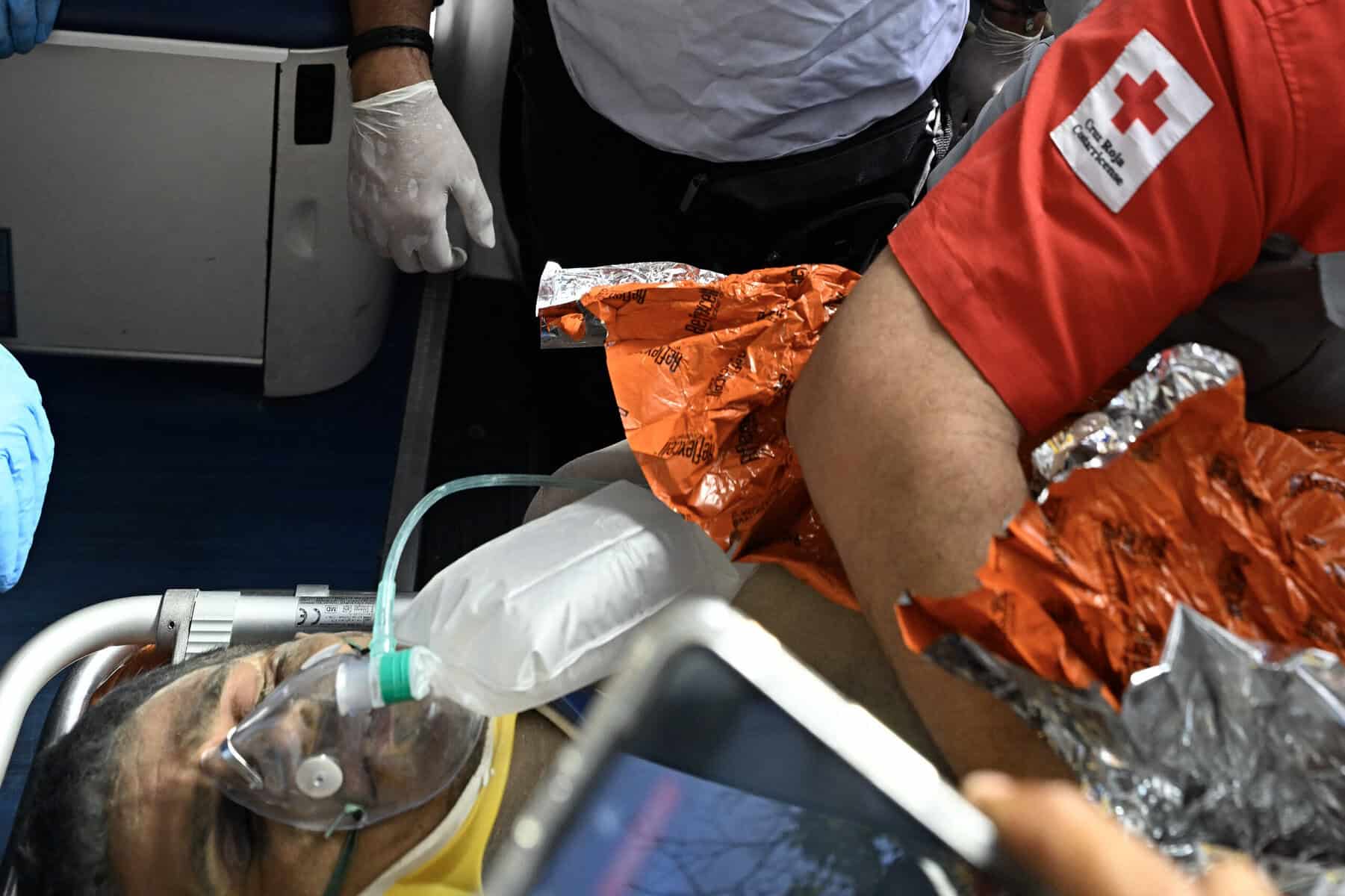
A Venezuelan security guard found alive by Costa Rican rescuers after last week’s deadly earthquakes has been pulled from the rubble after eight days trapped beneath a collapsed building, marking one of the most dramatic rescues of the disaster.
Hernán Alberto Gil Flores, 43, had been trapped since June 24 in the basement area of the Galerías Playa Grande shopping center in Catia La Mar, in Venezuela’s coastal La Guaira state. Rescue teams brought him out alive early Thursday after a long and dangerous operation involving crews from several countries.
The rescue is a follow-up to the survivor Costa Rican emergency crews located earlier this week, when The Tico Times reported that Costa Rican rescuers had detected signs of life under the rubble as the earthquake toll continued to climb.
Costa Rican Red Cross rescuers were among the first to establish contact with Gil while searching the collapsed structure. The discovery shifted the operation from recovery work to a rescue mission and drew international attention as crews raced to reach him through unstable concrete, debris and underground access points.
Gil had been working as a security guard when the twin earthquakes struck northern Venezuela. He was reportedly inside a small security booth when the building collapsed around him. That space appears to have protected him from being crushed and created enough room for him to survive while rescuers tried to reach him.
The operation was slow and dangerous. Rescue workers had to dig through unstable rubble while trying to prevent new collapses. Access routes built by the teams reportedly gave way several times, forcing crews to adjust their strategy and continue working by hand in confined spaces.
Before Gil was removed, rescuers were able to communicate with him and later establish visual contact using a small camera inserted into the rubble. They provided him with water, hydration support, a mask and goggles as they worked through dust and concrete to clear a path.
Costa Rican Red Cross personnel said during the rescue effort that Gil was stable and conscious despite spending more than a week underground. His survival quickly became a symbol of hope in a disaster zone where rescue teams have faced rising death tolls, damaged infrastructure and thousands of families still searching for missing relatives.
Teams from Venezuela, Costa Rica, Chile, El Salvador, Mexico, Portugal and the United States took part in the effort to free him. The scene drew cheers and relief when Gil was finally carried out alive and placed into an ambulance for medical evaluation.
For Costa Rica, the rescue became one of the most visible moments of its humanitarian mission in Venezuela. The country had already sent specialized search-and-rescue personnel, emergency workers and supplies after the earthquakes, with Costa Rican teams assigned to some of the hardest-hit areas.
The June 24 earthquakes, recorded at magnitudes 7.2 and 7.5, caused severe damage across northern Venezuela. La Guaira, north of Caracas, has been among the worst-affected areas, with collapsed buildings, displaced residents and rescue teams continuing to search through debris.
Gil’s rescue does not erase the scale of the disaster, but it gave emergency workers and families a rare moment of relief after days of grim work. For the Costa Rican teams on the ground, it also confirmed the value of the slow, technical search methods that first detected him beneath the rubble.





