

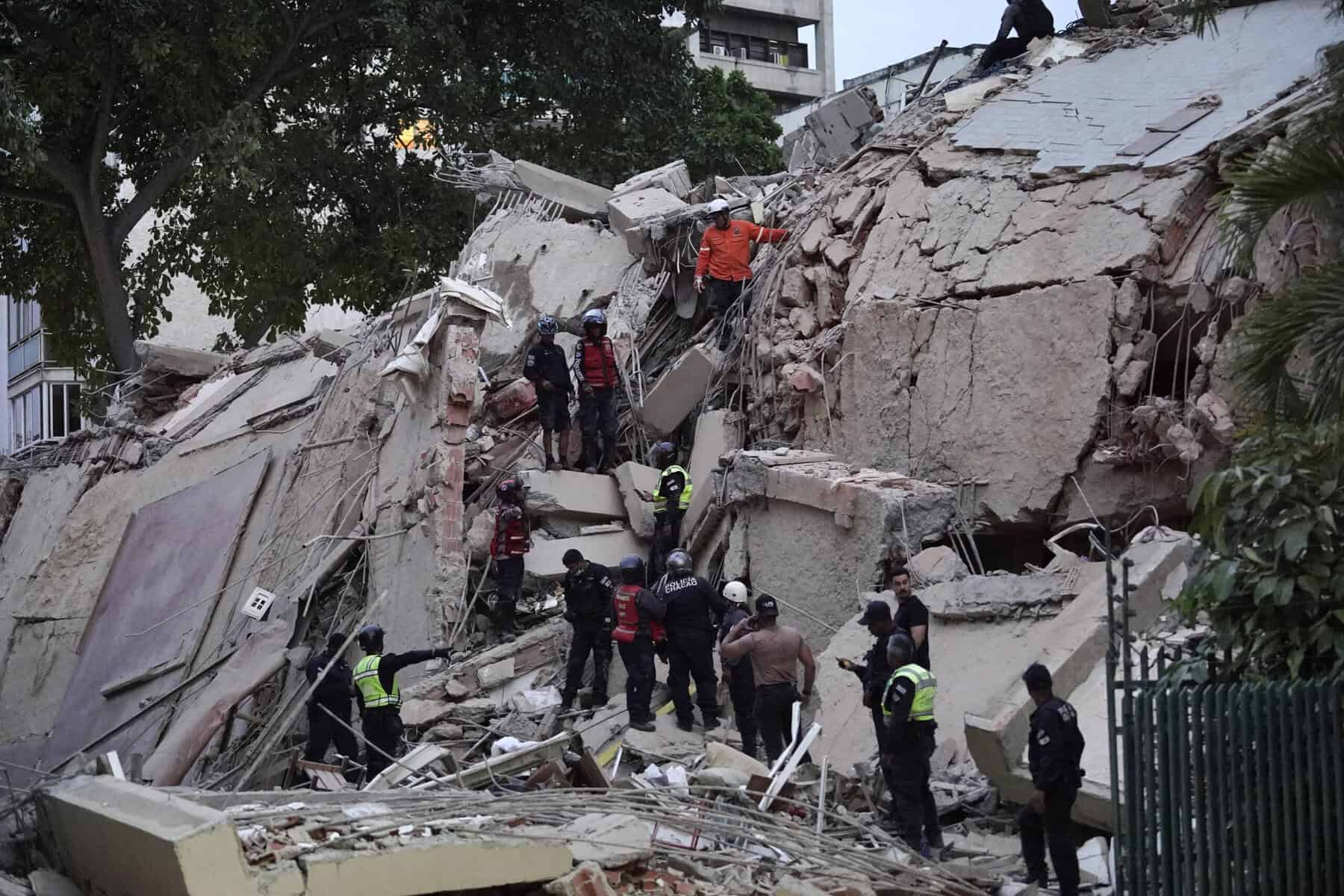
A powerful earthquake struck north-central Venezuela this afternoon, collapsing buildings in the capital, Caracas, knocking out power in parts of the city and prompting tsunami advisories across the Caribbean.
The U.S. Geological Survey reported that the magnitude 7.5 mainshock was preceded by about 39 seconds by a magnitude 7.2 foreshock — a closely spaced pair USGS described as a doublet. Several news agencies initially put the quake at magnitude 7.1 before the figures were revised upward. The shaking hit shortly after 5 p.m. local time, which is 3 p.m. in Costa Rica.
The epicenter was in Carabobo state, in the north-central region west of Caracas and near the industrial city of Valencia. USGS placed it roughly 16 kilometers southwest of the town of Morón at a shallow depth of about 10 to 13 kilometers. Shallow quakes tend to shake the ground harder at the surface than deeper ones of similar size, which helps explain why the tremor was felt so widely.
The quakes are among the strongest to hit Venezuela in more than a century. Many Venezuelans were at home when the quake struck, marking a public holiday that commemorates an 1821 military victory securing independence from Spain.
Interior Minister Diosdado Cabello said on state television that homes and buildings had come down in the capital, with the worst reported damage in the eastern Caracas neighborhoods of Altamira and Los Palos Grandes. He urged residents to stay outside because of aftershocks, to check on neighbors, and to make way for ambulances — a sign that people had been hurt. As of early evening, authorities had not confirmed any deaths.
Residents described a violent, prolonged shaking. An 80-year-old pensioner in southern Caracas, María Romero, said police had to help her down from her building because she could not manage on her own. Footage verified by international outlets showed a collapsed building in the capital, walls sheared off apartments, and dust hanging over busy commercial districts.
The U.S. Tsunami Warning System issued a threat for Puerto Rico and the U.S. and British Virgin Islands, and warned that the islands off Venezuela’s coast — Aruba, Curaçao and Bonaire — could see hazardous waves. Those advisories were later canceled. The Dominican Republic also issued an alert, while Colombia said its Caribbean coast faced no tsunami threat. The tremor was felt across the border in Colombian cities including Bogotá and Cúcuta.
Venezuela sits on the boundary between the Caribbean and South American tectonic plates, one of the most seismically active zones in South America. The last comparable event was a magnitude 7.3 quake off Sucre state in August 2018. The country’s deadliest modern quakes include the 1812 Caracas earthquake, estimated above magnitude 7.5, which killed tens of thousands.
This is a developing story.





