

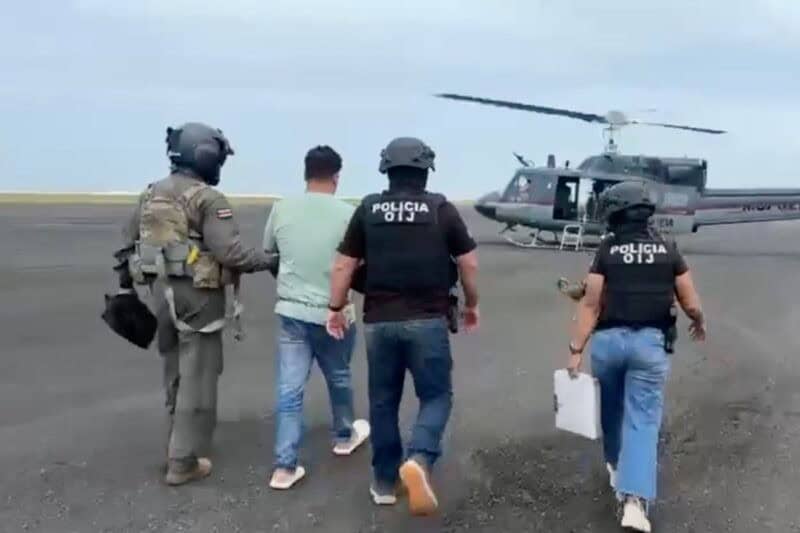
Costa Rican authorities arrested a 40-year-old Costa Rican man Monday morning in Puerto Viejo de Limón after U.S. authorities requested his extradition on drug trafficking charges.
The suspect, identified by the surnames Rojas Porras and known by the aliases “Pirulo” and “Cabro,” is wanted by the U.S. District Court for the Eastern District of Texas. U.S. authorities accuse him of taking part in a cocaine trafficking conspiracy tied to an international criminal organization.
The arrest was carried out by the Public Ministry and the Judicial Investigation Agency, with coordination from the U.S. Drug Enforcement Administration. Authorities said the suspect was located in Limón after Costa Rica received the extradition request and confirmed an outstanding U.S. arrest warrant issued in November 2025.
The case centers on an alleged trafficking network that moved cocaine from Colombia and Ecuador northward through Central America and Mexico before shipments reached the United States.
Investigators say the organization used maritime, land and air routes. The alleged methods included speedboats, semi-submersible vessels, fishing boats, cargo ships, aircraft, tractor-trailers and other vehicles used to move drug shipments across several countries. The route described by authorities passed through Panama, Costa Rica, Honduras, Nicaragua, Guatemala and Mexico before reaching U.S. territory.
Authorities described Rojas Porras as a high-priority target for Costa Rica and the United States. The arrest adds to a growing list of Costa Rican nationals sought by foreign courts in drug trafficking cases, a category that has taken on new importance since Costa Rica changed its extradition rules.
Costa Rica historically barred the extradition of its own citizens. That changed in 2025, when the country approved a constitutional reform allowing Costa Rican nationals to be extradited in cases involving international drug trafficking and terrorism.
The reform has reshaped cooperation between Costa Rican authorities and foreign prosecutors, especially in cases tied to alleged cocaine routes through Central America. Earlier this year, Costa Rica completed its first extraditions of nationals to the United States under the new framework.
Rojas Porras is expected to face the first stage of the process in Costa Rican courts, where prosecutors will seek provisional detention while U.S. authorities complete the formal extradition request. The eventual handover is not automatic. Costa Rican judges must review the request, confirm that legal requirements are met and determine if the case qualifies under the country’s extradition rules.
The arrest also places renewed attention on Limón’s role in international drug investigations. The Caribbean province has long been viewed by law enforcement as a strategic zone because of its port activity, coastal access and location along routes used by criminal groups moving cocaine north.
In the end, Rojas Porras remains a suspect and the charges against him have not been proven in court, and the extradition process will determine only whether he can be sent to the United States to face the case there.





