Over the years of offering wildlife monitoring services using camera traps, I’ve had many projects come and go. Some last a few months, others last several years. No matter the length of the project, each one comes in two distinct phases, the first phase, the beginning, and the second phase, the rest. The beginning of a project involves more adventure and discomfort, but once I power through that, the rest of the project becomes more comfortable and routine.
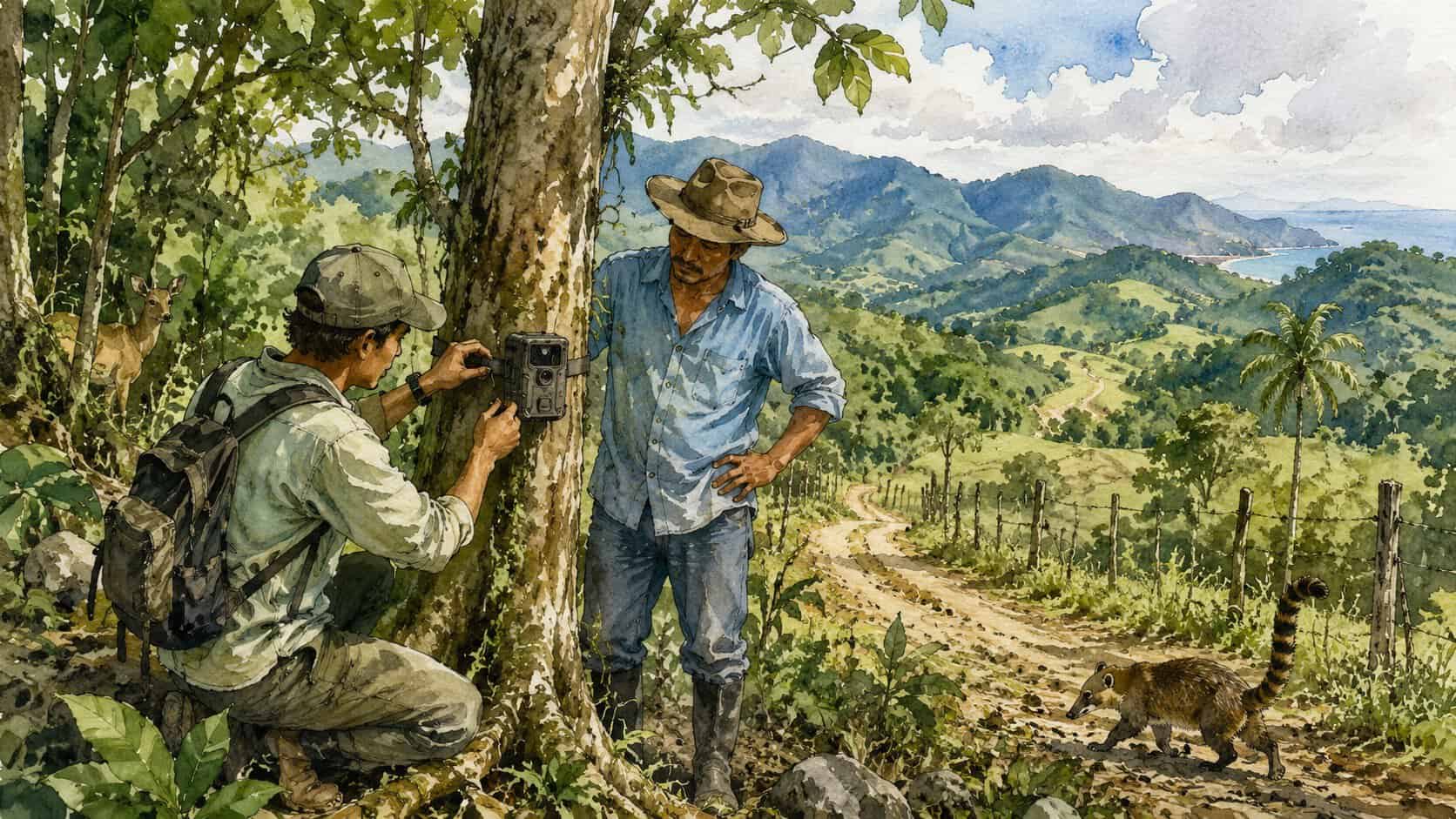
Over the span of the last two weeks, I started a project that involves placing fifteen camera traps on five privately owned farms in the Nicoya peninsula of Guanacaste. Each of these farms are connected, figuratively speaking, via a program that pays them a stipend for conserving the forested areas of their properties. In reality, each farm is geographically scattered across the wild mountains of this part of the country. Which means that within a few days’ time, I completed the more arduous phase one of a new project, five times in a row.
As I mentioned before, phase one is distinct because of the combo of adventure and discomfort. It involves driving to and locating the property, meeting a strange man or strange men, and then aggressively hanging out with them while hiking/riding a horse/splashing through a river while speaking a second language that I’m kind-of good at speaking.
You may take for granted the ease at which you find locations in the area where you live. If you had a new place to visit, I’d guess you’d enter an address into your phone and you’d drive on some perfectly maintained roads until you reach your destination. That’s not what I’m doing when I’m finding a farm I’ve never been to before.
First, there are no addresses. I’m using a satellite map. I try to place a pin on Google Maps where the farm is and then my phone gives me several options on how to arrive. The trick is, it doesn’t say anything to me about the quality of the roads. How many rivers do I have to cross? Which route involves so much mud that I may become a random Gringo whose truck is trapped in the middle of nowhere?
Mostly due to the time of year, I was able to reach farm without much issue. It’s only just begun to rain, so most of the dirt roads are in decent shape. I quick list of commuting highlights includes, roads that go so steeply up a mountain that I need four wheel drive to avoid just spinning my wheels in place, roads where at least one shoulder is a cliff that goes straight down to my instant death if I slid off, at least ten stream/river crossings, one downed tree that I was able to just barely get by, and my phone telling me to drive over what turned out to be a three foot wide walking bridge, resulting in me smooshing my truck into a position that I nearly couldn’t reverse out of.
All said and done, the driving adventure portion of the project went pretty smoothly, though I do have some concerns about the possibility of using these same roads/crossing some of these rivers once the rain really starts to get going.
Getting to the location is only half the battle. Once I’m there, I need to immediately make a second-language, usually old guy, friend. That was the case on two of the farms in this new project. The first guy met me way up high on a mountain in the road and hopped into the truck. He was perfectly friendly and helpful.
He led me to prime locations to place the camera traps to record wildlife. The second older gentleman was also very cool. He mounted his horse and led me around his farm with his happy little dog in tow. He took me to a part of his farm where he said he hasn’t been in forty years and told me stories about people getting stung by a large number of dangerous wasps and the application of different types of citrus fruits that kept them alive. I think we’ll get some awesome results from the cameras there.
The other three farms were a little different, rather than meeting the landowner themselves, I met a group of three environmental consultant dudes who knew each of the three farms quite well. These guys were great. They used their knowledge of the farms to guide me to some nice camera locations and while we hiked, they taught me all kinds of interesting things about the forest.
I now know that you can eat part of an Espavel tree seed (it tastes like candy), a common spikey plant I’ve been walking by for years actually hides a delicious heart of palm at its center, but only for a brief period of the year, and that you can put the bark of the Lagartillo tree on your rotten tooth and it’ll fall out of your head.
With phase one now complete, I can ease into phase two. I know how to get to each location and what roadblocks I may meet on the way and rather than meeting a stranger at each location, I’ll have a buddy waiting for me. I tell myself I like phase two better because both sketchy driving and meeting new people are both things that make me feel uncomfortable, but looking back on past projects, sometimes the beautiful/adventurous commute and the friends I made were the best parts.
About the Author
Vincent Losasso, founder of Guanacaste Wildlife Monitoring, is a biologist who works with camera traps throughout Costa Rica.