

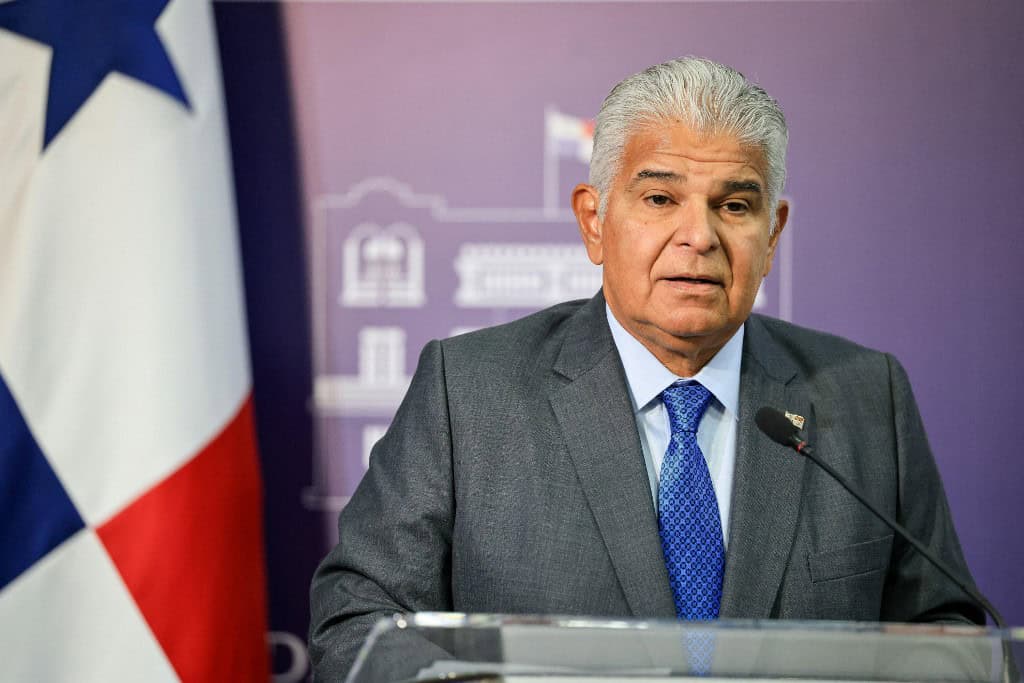
Panamanian President José Raúl Mulino said Thursday his government will not negotiate with gang leaders and will keep a reinforced police presence on the streets in response to a recent wave of public shootings.
He made the remarks after inaugurating the completed Panama North Hydraulic Ring water project in Caimitillo and Guarumal in Panamá Norte. The infrastructure project, which includes expanded storage, pumping stations and distribution networks, is designed to provide reliable water service to more than 200,000 residents who have long relied on tanker trucks.
Mulino tied the violence directly to internal disputes among criminal groups fighting for control of drug territory and markets. He said an entire criminal structure operates from inside Panamanian prisons and called on the courts to impose stricter pretrial detention on captured gang members and drug traffickers.
“No vamos a negociar con pandillas,” Mulino said. “Yo no me voy a sentar, ni el ministro de Seguridad se va a sentar con el jefe de la pandilla equis a negociar. Eso no es posible.” The president defended recent judicial decisions to order pretrial detention for those arrested in anti-crime operations. “No son ángeles, no son personas que por casualidad están en una organización criminal. Son criminales,” he said.
Panama recorded roughly 180 active gangs as of 2024, according to police and government figures. Many of these groups have grown more violent in recent years, fueled by rising cocaine production in South America and the country’s position as a key transit corridor for shipments heading to North America and Europe.
Mulino noted that daily seizures of cocaine and other drugs at ports and in containers underscore the scale of the problem. He pointed to ongoing cooperation with the Netherlands to strengthen intelligence, customs and port surveillance aimed at blocking transshipments bound for European ports such as Rotterdam, Antwerp and Marseille.
The surge in violence has included shootings and “ajustes de cuentas” — targeted killings — that have sometimes caught innocent bystanders in the crossfire. Mulino said these conflicts put ordinary citizens at risk while they walk down streets, eat in restaurants or attend school.
He announced that security forces will maintain and expand their deployment nationwide. The government plans to equip police and other agencies with additional technology, intelligence tools and specialized gear to disrupt criminal networks. Officials are also working with the penitentiary system to break up operations run from behind bars. Mulino said the focus remains on operations, intelligence gathering and sustained pressure rather than any form of dialogue with gang leadership.
The statements come as Panama continues to confront organized crime that has evolved from low-profile activity into open territorial battles. Police operations have produced frequent drug seizures, but Mulino acknowledged that gang-on-gang violence remains difficult to prevent even with increased patrols.
Regional experts link the rise in such conflicts across Central America to record cocaine output in Colombia, Peru and Bolivia combined with shifting trafficking routes through the isthmus. Panama’s ports and coastal waters have become prime targets for these networks, which use local gangs for protection, storage and local distribution.
Mulino said the government’s approach will continue to prioritize citizen protection over any accommodation with criminal elements. “Nos toca apoyar a la ciudadanía en materia de seguridad, dotar a los estamentos y, de esta manera, se podrán prevenir muchos de estos ataques,” he added.
Security officials have been ordered to deliver a detailed report on the current situation so that additional measures can be implemented if needed. The president stressed that the strategy relies on sustained enforcement rather than short-term fixes.
For now, the reinforced police presence will remain visible in high-risk areas while authorities press for stronger judicial tools to keep dangerous suspects behind bars pending trial. Mulino made clear that the fight against organized crime will not involve negotiations with those responsible for the violence.





