

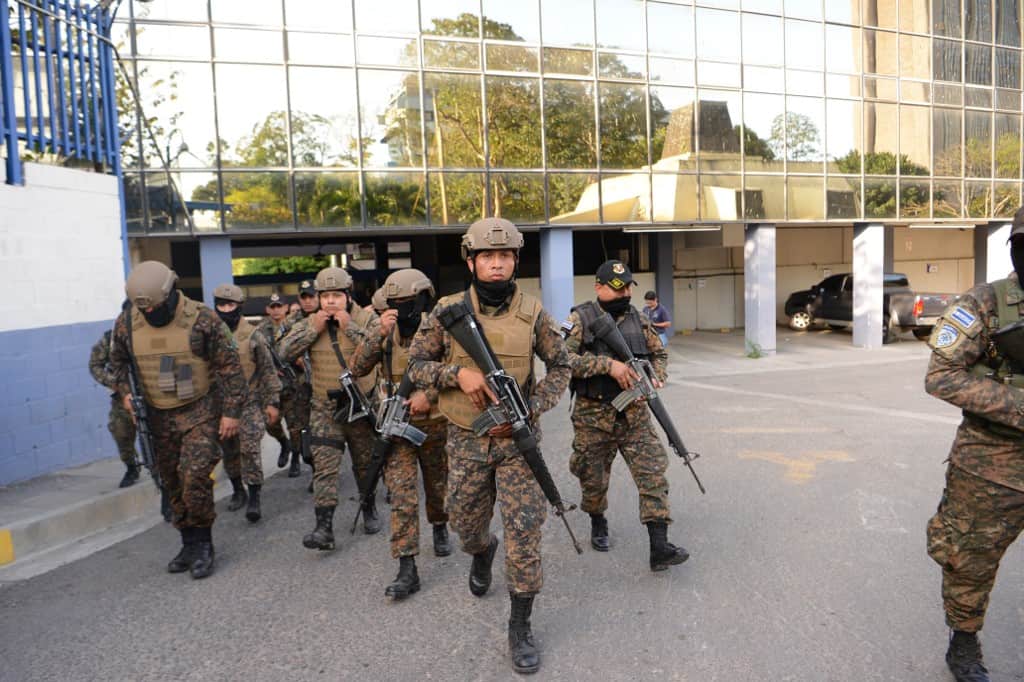
A group of international jurists yesterday, accused the government of Salvadoran President Nayib Bukele of committing crimes against humanity, including torture and disappearances, in its war against gangs. The offensive has unfolded under a state of emergency that allows arrests without a judicial warrant and that, in nearly four years, has sent about 90,000 people to prison, of whom some 8,000 were later released for lack of evidence.
There are reasonable grounds to believe that, within the framework of the state of emergency, crimes against humanity have been committed, said Ignacio Jovtis, Latin America director for the NGO InterJust, when presenting the report by five experts. The GIPES report was presented during a hearing in the session period of the Inter-American Commission on Human Rights in Guatemala City.
GIPES stands for the International Group of Women and Men Experts for the Investigation of Human Rights Violations in the context of the State of Emergency in El Salvador, a body made up of international jurists. The crimes include imprisonments that violate international law, including the detention of children, as well as torture, killings, forced disappearances, sexual violence, persecution, and other inhumane acts, the group added in a statement.
At the hearing, Salvadoran Vice Foreign Minister Adriana Mira rejected the accusations and said that in her country there are no forced disappearances nor anything resembling them. The report adds to a recent complaint by the well-known Salvadoran NGO Cristosal, which moved its operations to Guatemala citing government persecution, that Bukele has 86 political prisoners.
The government has promoted campaigns of stigmatization and criminalization against civil society and the press, GIPES said, backed by the International Federation for Human Rights and the International Commission of Jurists. Data drawn from official and independent reports, as well as from victims, point to 403 deaths in state custody, including four children, and 540 cases of forced disappearance under the state of emergency, the group said.
These are not isolated cases, but rather a policy in which crimes are committed on a large scale and in a systematic way, José Guevara, a humanitarian law specialist and part of the group that prepared the report, added in a statement. Bukele’s war on gangs has reduced violence to historic lows in El Salvador and turned the right-wing leader into one of the most popular presidents in his country and in Latin America.
But his strategy, symbolized by a mega-prison for gang members, has also been criticized because it led to the concentration of all branches of state power, which in 2025 allowed him to establish indefinite reelection.





