

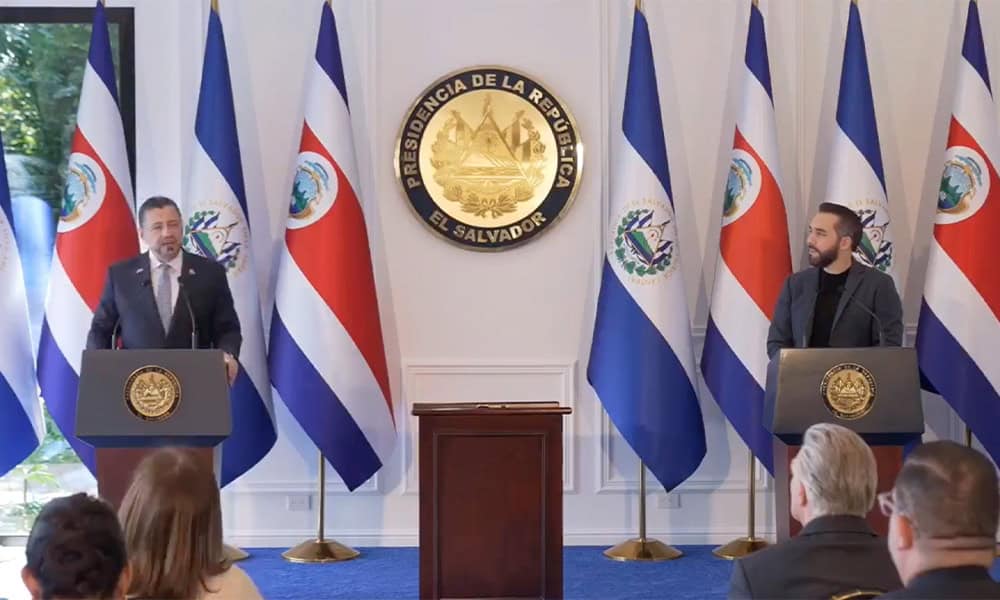
Presidents Nayib Bukele of El Salvador and Rodrigo Chaves of Costa Rica signed the Coatepeque Declaration security pact, forming the Escudo de las Américas alliance to tackle organized crime and foster regional growth. The pact, inked at the presidential residence on Lake Coatepeque in El Salvador, sets up a framework for the two countries to pool resources in security, economic progress, and coordination.
Officials from both sides stated that the alliance will allow them to exchange intelligence, run joint operations against criminal groups, and expand trade, investment, and innovation. They also opened the door for other Central American nations to participate. Bukele highlighted El Salvador’s gains in curbing gang violence as a model Costa Rica could adapt. “We can lend you all our experience, our knowledge, and what we have achieved here, so you can apply it in whatever way you consider appropriate,” he said after the signing.
He pointed to his country’s approaches in breaking down criminal organizations, overseeing prisons, and updating laws to root out crime. Bukele noted that El Salvador had addressed its security challenges effectively, adding, “In terms of security, we have nothing, or very little, left to do.”
Chaves, who faces rising crime rates in Costa Rica, welcomed the partnership. He thanked Bukele for aid during Hurricane Rafael in November 2024, when Salvadoran teams assisted in recovery efforts. “Costa Rica continues to express, and will continue to express for years to come, its deep gratitude to the Salvadoran people and to you personally for the support you gave us with your brigades,” Chaves said.
He commended El Salvador’s strategies that shifted the nation from decades of violence to a benchmark in safety. “El Salvador’s lessons on the fundamental role of the state, which is to protect the lives of its citizens, are truly instructive,” Chaves told reporters.
As part of his two-day official visit, Chaves planned to tour the Terrorism Confinement Center, or CECOT, El Salvador’s maximum-security prison holding around 15,000 alleged gang members from groups like Mara Salvatrucha and Barrio 18. The facility, with space for 40,000 inmates, stands as a key element of Bukele’s anti-gang measures, though rights groups have raised concerns about conditions there.
Chaves has expressed interest in similar tough policies amid Costa Rica’s own struggles with crime. He mentioned facing criticism at home for pushing reforms, saying opponents label him a “fledgling dictator” for wanting to overhaul the judiciary and laws. “What I do want, and I confess it, is for my country to change the judiciary, to change our laws so that citizens can leave the prisons of their homes and criminals stay in prison,” he stated.
The alliance stems from talks that began last year when Bukele visited Costa Rica. “We discussed many issues, and I said that we have a lot to learn from Costa Rica, but that we can support them on the issue of security, which is the problem they are currently facing,” Bukele recalled.
Foreign ministers Alexandra Hill Tinoco of El Salvador and Arnoldo André Tinoco of Costa Rica attended the ceremony, underscoring the diplomatic weight of the agreement. Both leaders urged neighboring countries to join the Escudo de las Américas to counter transnational threats more effectively. The move comes as Central America grapples with drug trafficking, gangs, and migration pressures.
In El Salvador, Bukele’s state of emergency since March 2022 has led to over 90,000 arrests of suspected gang members, with about 8,000 later released due to insufficient evidence. The approach has boosted his popularity but drawn scrutiny from human rights advocates.
For Costa Rica, the pact offers tools to address a surge in homicides and drug-related violence that has strained its traditionally peaceful society. Chaves, amid domestic political challenges including a potential impeachment process, sees the collaboration as a step toward safer streets.
The leaders wrapped up the signing with calls for unity, positioning the alliance as a potential turning point for regional stability.





