
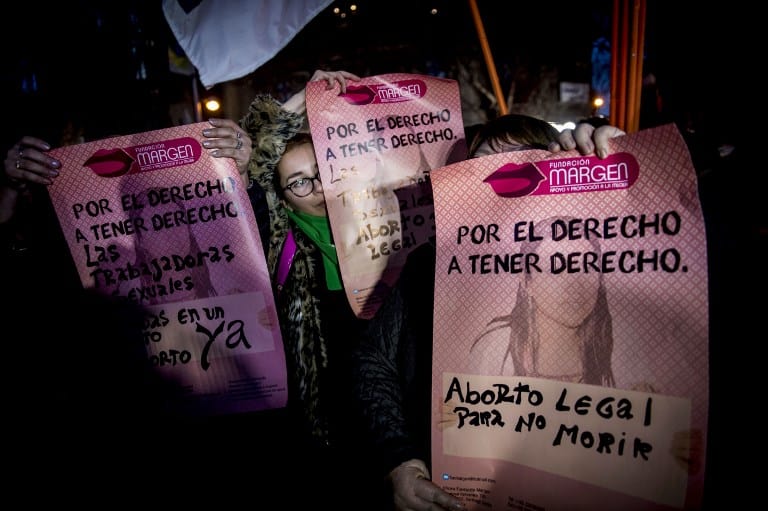
Thousands of women took to the streets across Latin America on Tuesday to demand abortion rights, a practice largely prohibited in the region where hundreds of women are serving prison time under draconian laws.
With banners that read “Legal Abortion Now” and “Right to Decide,” and wearing green scarves that are characteristic of the global movement for decriminalizing abortion, protesters rallied in El Salvador, Chile, Peru, Mexico and Colombia.
In El Salvador, where abortion is banned in all cases, women seeking the procedure can face up to eight years in prison for “aggravated homicide.” Seventeen women currently remain in detention after having experienced obstetric emergencies, women’s rights advocates say.
On Tuesday — International Safe Abortion Day — hundreds of Salvadoran women demonstrated outside the national legislature, carrying a large banner that read: “To decide is my right, legal abortion now.”
A committee of the protesters presented a proposal to Congress for legalizing abortion in certain cases, such as when the pregnancy puts the woman’s life at risk, if the fetus is unlikely to survive after birth, or if the pregnancy “is the result of sexual violence.”
The proposal comes after El Salvador’s President Nayib Bukele withdrew a constitutional reform in mid-September, drafted by his own government, that would have opened the door to legalize therapeutic — or medically necessary — abortions.
Besides El Salvador, abortion is banned in Honduras, Nicaragua, the Dominican Republic and Haiti, and most other countries allow it only for medical reasons or in case of rape.
‘Down with the patriarchy’
In Chile, the lower house of Congress on Tuesday approved a bill to decriminalize abortion within 14 weeks of pregnancy, a major step in a country where the Catholic Church has fiercely opposed the practice.
Lawmakers gave the green light with 75 votes in favor, 68 against, and two abstentions, according to the congressional Twitter account.
The proposal has yet to be approved by Chile’s ultra-conservative senate.
The bill, submitted in 2018 by opposition lawmakers, seeks to change the existing law, which allows elective abortion only in three scenarios: when there is a threat to the life of the pregnant woman, if the fetus is unviable, or if the pregnancy was the result of rape.
These legal abortions represent only about three percent of the thousands of clandestine terminations taking place in the country, according to activists.
Until 2017, Chile maintained an outright ban on the procedure still denied most women in Latin America.
“This is for all the women… who have been persecuted and criminalized,” tweeted Communist lawmaker Camila Vallejo, one of the authors of the bill.
“Down with the patriarchy which will fall, will fall!” she added. “Up with feminism, which will win, will win!”
‘Let the sexists tremble’
In Latin America, abortion is currently legal only in Uruguay, Cuba, Argentina and Guyana, as well as in Mexico City and four of Mexico’s 32 states.
In Mexico City on Tuesday, dozens of women marched downtown calling for the procedure to be decriminalized across the country.
One of the banners carried by the protesters read “Abortion is not legal, rape is.”
Some activists shouted: “Let the sexists tremble, Latin America will be feminist!”
Hundreds of police were deployed at the protest and there were altercations between them and the women.
The demonstration took place after a landmark ruling by Mexico’s Supreme Court earlier this month, which declared that abortion cannot be considered a crime.
The decision opened the door for all Mexican women to access this procedure without fear of being prosecuted and potentially imprisoned, but legal hurdles still remain.
Another pro-choice protest was held in Lima. Dozens marched to demand that the Peruvian government legalize abortion, which is currently allowed only when the woman’s life is in danger.
But the protesters face an uphill battle with the recently elected leftist leader Pedro Castillo, a social conservative who rejecting the idea during the presidential campaign.
In Peru, around 370,000 clandestine abortions are performed each year, according to estimates by civil society groups.
The featured photo shows a pro-abortion march in Chile in 2018.