

WASHINGTON, D.C. – Hondurans don’t have it easy lately. For years, their Tennessee-sized country of eight million has suffered the world’s highest homicide rate: 90.4 killings per 100,000 inhabitants in 2012, according to the United Nations, and a frightening 169 per 100,000 in San Pedro Sula, its second-largest city.
As if that’s not enough, Honduras also ranks as the second-poorest country in the Americas (after Haiti), its economy is stagnating – and now it may be one of the most corrupt as well.
Last week, the U.S. government threw the book at one of the most powerful families in Honduras, frightening political and economic elites across Central America who have long thought themselves untouchable.
Earlier this month, the Justice Department unsealed an indictment against 79-year-old Jaime Rosenthal, his son Yani Benjamin Rosenthal and his nephew Yankel Rosenthal for allegedly laundering cash through U.S. bank accounts from 2004 to 2015 on behalf of drug traffickers.
Until recently, Yankel Rosenthal was an adviser to Honduran President Juan Orlando Hernández. Jaime Rosenthal, one of the country’s richest men, was himself a perennial candidate for president and leader of the Honduran Liberal Party who once met Ronald Reagan in the White House.
On Oct. 10, three days after the feds listed his Tegucigalpa-based Banco Continental under the Foreign Narcotics Kingpin Designation Act, the Honduran government closed the bank and announced the forced liquidation of its assets, estimated at $500 million.
“The question everybody in Honduras is asking, is where were our national institutions? The supervisory body for banks didn’t detect this,” complained Honduran economist Hugo Noé Pino, a scholar with the Instituto Centroamericano de Estudios Fiscales, a Guatemala-based think tank.
See also: He’s a Honduran banker, crocodile farmer and wanted in the US
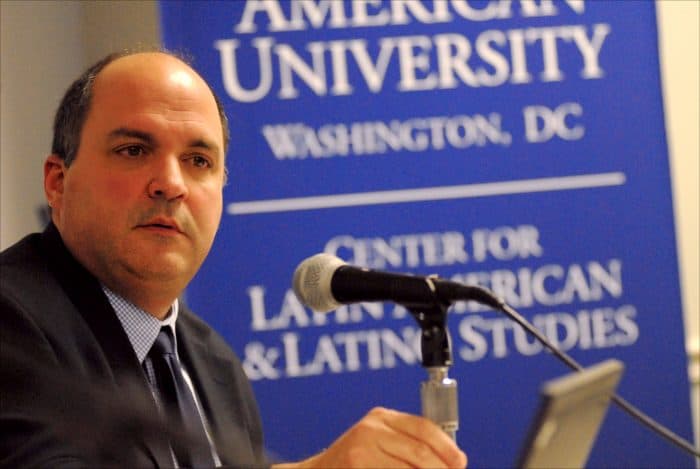
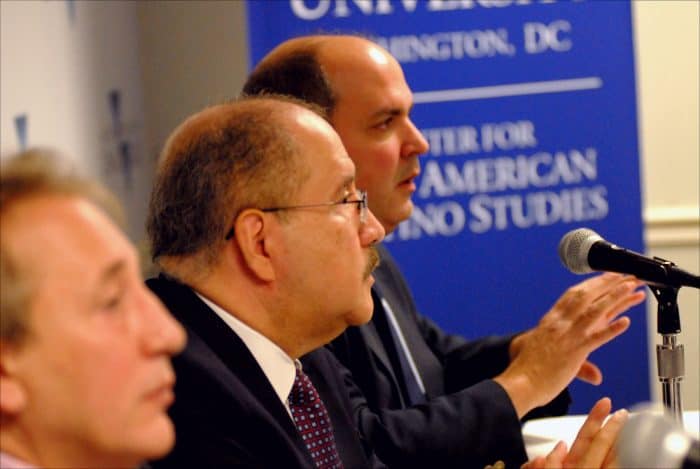
Pino spoke Oct. 13 at a Washington panel co-sponsored by Inter-American Dialogue and the American University’s Center for Latin American and Latino Studies (CLALS). The event, titled “Corruption, Violence and Reform: Honduras’ Struggle for Democratic Governance,” also featured Carlos Ponce of Freedom House, Eric Hershberg of CLALS and Michael Shifter, president of Inter-American Dialogue.
Pino said that despite the country’s expected 3-3.5 percent GDP growth over the next two years, its annual population growth of 2 percent means that “in per-capita terms we are growing only 1 to 1.5 percent, which is not enough to reduce unemployment or poverty – and the situation is getting worse.”
Today, 62 percent of Hondurans live in poverty and 42 percent live in “extreme poverty,” he said. To make matters worse, violence and organized crime is fueling emigration, while the country’s weakened institutions are encouraging a process of remilitarization.
“Police functions are being carried out by the Honduran Army. What we are seeing is a concentration of power in the executive who handles decisions in Congress, the Supreme Court, the Electoral Tribunal and the Controller’s Office,” Pino warned. “The group in power in Honduras is trying to get the president re-elected for another term. That’s going to be very confrontational.”
The Rosenthal case is hardly the first scandal to rock Honduras in recent years. In late 2014, investigators uncovered a massive fraud within the country’s health care system – the Instituto Hondureño de Seguridad Social (IHSS) – in which white-collar thieves siphoned off the equivalent of at least $200 million, leading to the needless deaths of thousands of Hondurans for lack of medicine and hospital equipment.
At least some of that money ended up in the coffers of Hernández’s election campaign; the president has acknowledged as much but insists he was not personally involved.
Faced with increasing public pressure to clean up its act, the government has asked the Organization of American States to intervene, though the new OAS “Support Mission Against Corruption and Impunity in Honduras” has elicited strong skepticism here.
“The solution is not making more reports, but bringing change to Honduras,” said Ponce, who spent six months working there last year. “We’re not talking about India or Brazil but a small country with lots of potential – but a lack of will to change. The families in power are in bed with factions in the government that also control the media. Corruption is linked directly to political parties, so you have to change the power structure.”
Ponce added: “Even a commission tied to the OAS won’t change anything, unless you bring people to justice to face due process. Without that, Honduras will not change.”
Pino said what Honduras really needs is “an international commission against impunity with enough leverage to make investigations.” He called for an entity similar to Guatemala’s CICIG, which helped uncover a widespread corruption network in the country’s tax and customs agency that led last month to the resignation and subsequent arrest of ex-President Otto Pérez Molina.
“I think CICIG with an ‘H’ instead of a ‘G’ at the end would be good for Honduras. I have seen CICIG work in Guatemala,” said Pino. “Honduras needs an international commission like CICIG in order to restore general confidence.”
But that’s unlikely to happen, said Ponce, because the leaders of Honduras will do whatever is necessary to prevent the formation of just such a commission.
“They know that the corruption scandals can touch them. That’s why they tried to find another alternative,” he said. “More than ever, it’s necessary. But this has to be asked by the government itself, and the government doesn’t have the political will to do it.”
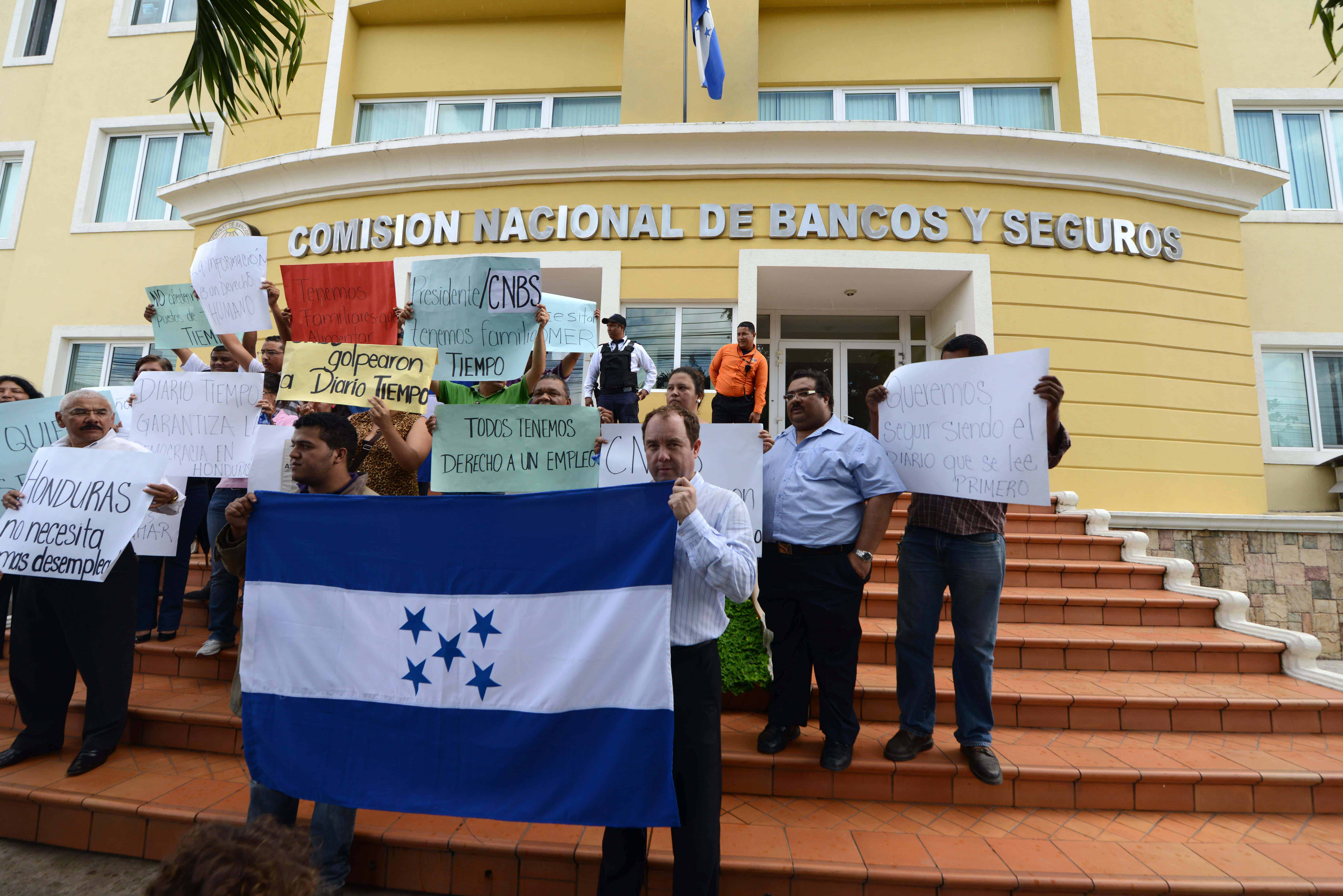
Meanwhile, the closing of Rosenthal’s Banco Continental means the loss of 11,000 direct jobs and possibly other consequences for an already struggling economy. Pino noted that in a recent poll, 63 percent of Hondurans said they’d live elsewhere if they could.
“If I’m a foreign investor, why would I invest in a country like Honduras? Right now, the general sense is that it’s not just the Rosenthals who are involved,” Pino said. “For the first time in my life, I see middle-class and upper-class people protesting in the streets. This is a new phenomenon and I don’t think it’s going to disappear anytime soon.”





