

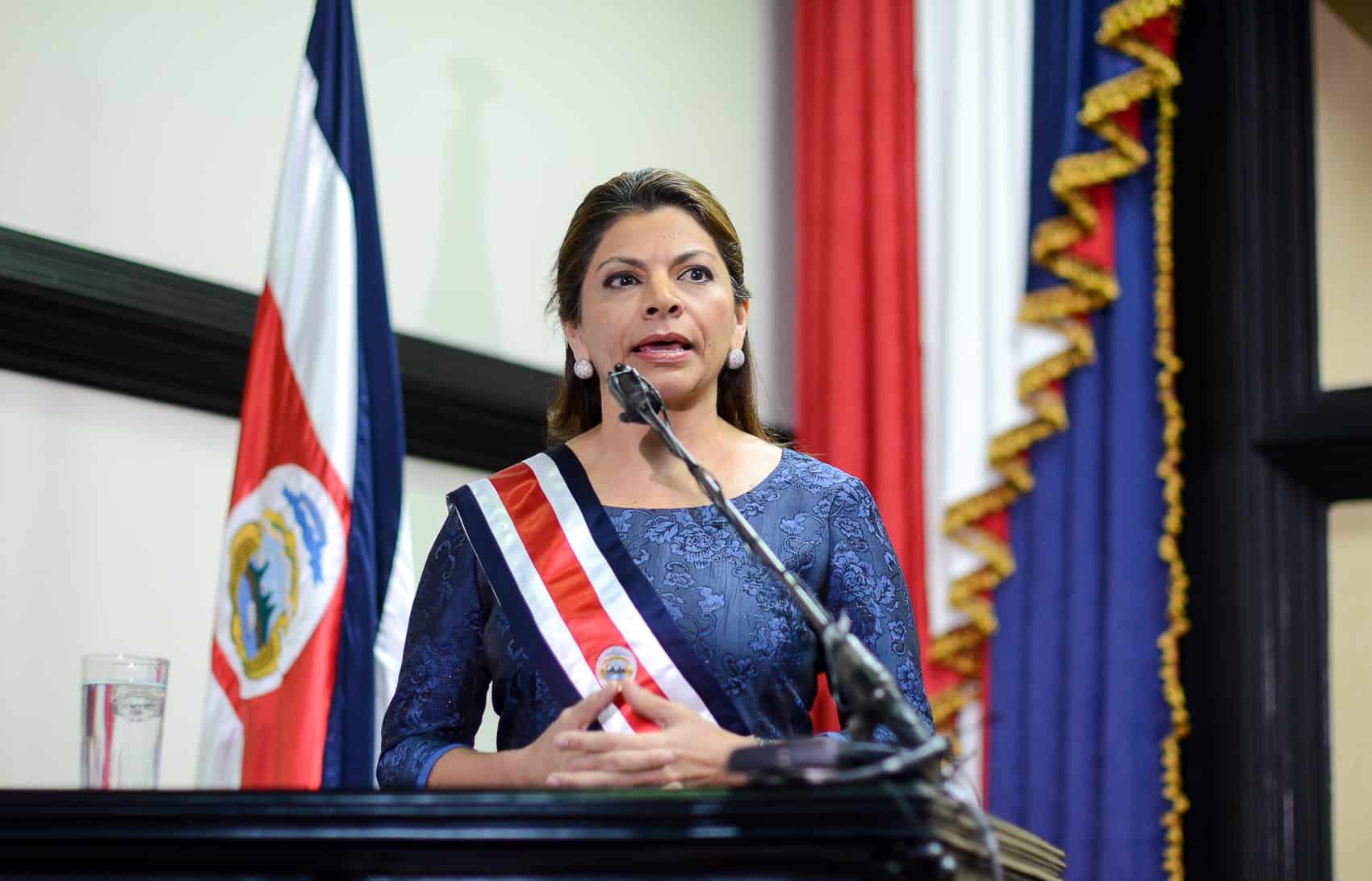
When Laura Chinchilla stepped down as vice president of Costa Rica in the fall of 2008 to launch her campaign, there was no clear pathway to the presidency. Although she enjoyed the blessing of widely popular and internationally recognized President Oscar Arias, she faced a divided party, a credible primary contender and a country that was stumbling through a severe economic recession.
Despite the challenges, Chinchilla pulled off a landslide victory in the Feb. 7, 2010, election. She won 46.9 percent of the vote, becoming Costa Rica’s first female president-elect. Three weeks later, a handful of the country’s top political analysts met at the Mexican Cultural Institute to pinpoint the basis of her success.
“The election is recent, but there has been sufficient time to do a rigorous analysis,” said Jorge Mora Alfaro, director of FLASCO, a Latin American research institute, and moderator of the discussion on February 24. “We can now ask what were the reasons for the vote and what led voters to make certain decisions.”
For Victor Borge, analyst with Borge and Associates, Arias’ veiled endorsement made all the difference. “Arias had high popularity, which allowed him to select his candidate (for the primary election),” said Borge, adding that the president had “significant control of the National Liberation Party (PLN) to ensure that Laura would most likely be the candidate.”
San José Mayor Johnny Araya ran a vigorous primary campaign, but it wasn’t enough to push Chinchilla out of first place. Araya took 42 percent of the primary election vote to Chinchilla’s 55 percent. Turning to the presidential election early last month, Chinchilla’s strategists knew they had the lead and the momentum.
“The idea at that point was to run a campaign that would maintain the difference,” Borge said. To do this, strategists focused on making the campaign more about image than about ideology. There was less concentration on the issues and more on the message. Also interesting, Borge said, was the fact that the campaign did not include many images of the candidate herself. “They were presenting a woman for president, but she wasn’t being presented as a woman,” he continued. “There was no emphasis on women’s issues.”
The main opposition to the Chinchilla/ PLN powerhouse came from those who disagree with the neoliberal model, believing it to be responsible for poverty and inequality, said Constantino Urcuyo, academic director for CIAPA, a public policy think tank based in Costa Rica. Another faction of the opposition consisted of those critical of the Arias regime.
Yet, neither Libertarian Movement Party (ML) candidate Otto Guevara nor left-leaning academic and Citizen Action Party (PAC) candidate Ottón Solís could reach this population.
For Guevara, the third-place finisher in the polls, the problem was a perceived lack of transparency regarding his campaign funds. The analysts said many people questioned how he was financing bus advertisements, large billboards and full-page spreads in magazines. They also said Guevara was perceived as being too authoritarian.
Guevara started his campaign with vague proposals, but he was omnipresent in the streets and media. He climbed from commanding the support of a mere 2 percent of voters to claiming more than 20 percent of the vote in the election, mostly on the back of the security issue.
“At one point, the PLN realized he was a real adversary, and they may have felt threatened by him,” Borge said. “It was a successful campaign but, in the end, it wasn’t enough to make a difference.” Urcuyo called it a “good start, but poor finish.”
For Solís, the runnerup who earned 25 percent of the vote, the story line was a little different. He seemed to take a backseat in the campaign from the outset. “It was like he didn’t believe in the polls,” Borge said, “but polls can be useful.” Even if the studies were wrong in the past, there was no promise of a repeat, he added. The other problem was that Solís was going after the wrong market, the analysts said.
With his poverty relief programs and an emphasis on the disadvantaged, Solís was targeting a sector of the population that didn’t vote for him in the end, according to Borge. He added that his greatest support came from academics and intellectuals, people with money and a high level of education.
Arias had already cultivated the vote of the poor for Chinchilla, Borge said, with his Avancemos program of scholarships and grants to help poor children stay in school. Had either Solís or Guevara amassed enough votes to throw the election into a second round, either of them may have had a better chance to defeat Chinchilla.
But their collective efforts weren’t quite enough, and Chinchilla came away with enough votes to secure her place as the next president of Costa Rica.





