

A burgeoning new cultural center near Arenal Volcano is providing an incentive for cultural preservation for an indigenous group facing high unemployment and the rapid decline of its ancestral language and culture. About a kilometer south of La Fortuna in north-central Costa Rica, the Maleku restaurant and cultural center is a multifaceted project organized by the Maleku indigenous group and cultural organization Kaoranh Ú Tocuf, which means “our big house” in the Maleku language.
Founded in January, the center features Maleku dance, drum and cultural presentations and a restaurant serving traditional indigenous, Costa Rican and international fare. Visitors can tour the butterfly garden, frog exhibit, tombs, botanical garden of medicinal plants and an organic vegetable garden.
The restaurant’s interior and exterior teem with colorful painted traditional art, including masks, drums, rain sticks, bow and arrow sets and woven bags. Painted rain sticks depict tropical fauna with their names in Maleku.
According to Maleku artisan Kanherreu, each of the carved masks has a meaning: The jaguar represents “the man who loves nature”; the blue morpho butterfly represents love; and the toucan represents woman’s inner and outer beauty.
Sales of these pieces, hand-carved from bamboo, balsa and jícara (the hardened shell of the fruit of the same name), provide the main source of income for several families on the Maleku reservation.
“We survive on our artisanal production,” says performer and artisan Turriminh.
The restaurant offers a wide-ranging menu, including Pollo Maleku (¢2,500/$4.50) and Mafuriceka (¢3,000/$5.50), whole fried fish seasoned with an herb known as kuinonh.
Also available are the traditional alcoholic drinks (¢800/$1.50) of machaka, made from fermented ripe plantain, corn, peach palm or manioc, and chicha, made from fermented pineapple, ginger and tapa dulce, or brown sugar. The light, sparkly drink is served in a pupa, a small, carved wooden cup. A delicious casado with grilled chicken, fresh vegetables from the on-site organic garden and a fabulous papaya picadillo with ground beef and pork costs ¢2,500 ($4.50).
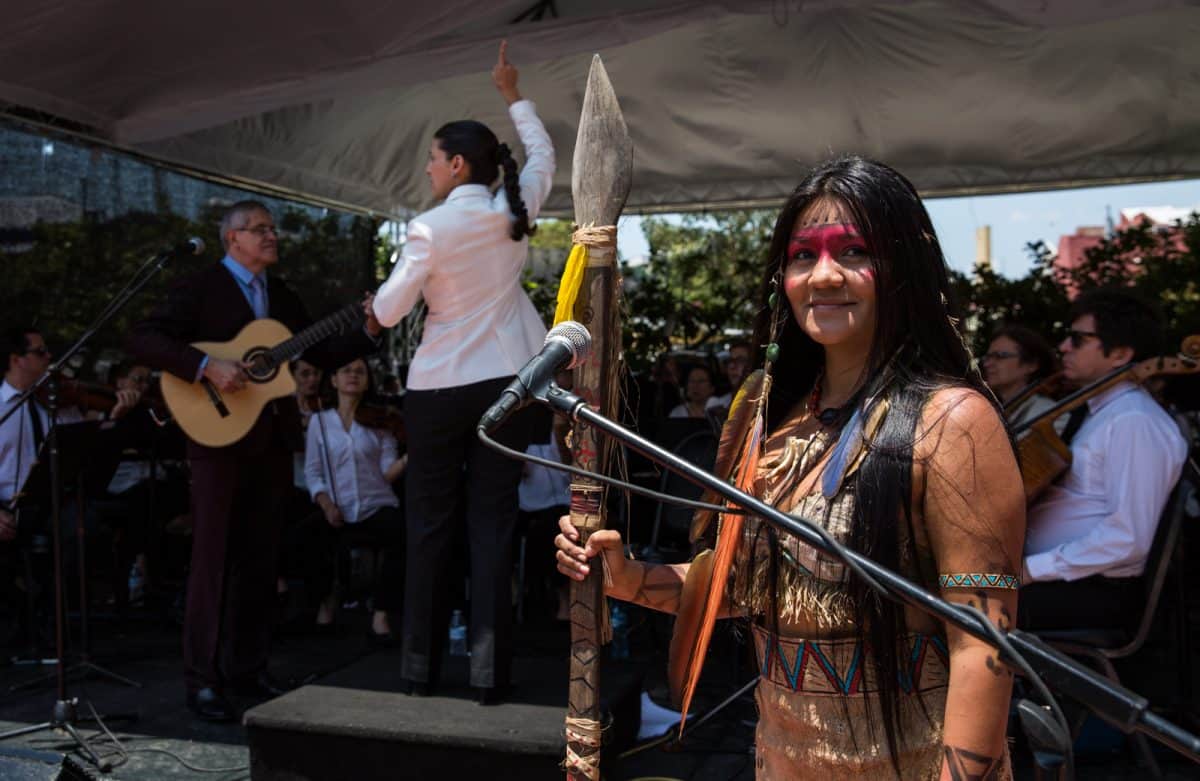
After dinner, drumbeats from outside turn visitors’ attention to the doorway, through which the performers enter and begin to circle the room. The songs, interpretation and performance are in Maleku, translated to English or Spanish by Koren Vela-Vela, manager of the restaurant and cultural center. The performance has a strong environmental message: to protect the Earth and its creatures from destruction at the hands of humans and to be grateful for the gifts of nature.
“The performance is from times past, passed from generation to generation, that we always maintain. It is something real,” says performer Tonji.
The center also offers tours from La Fortuna to Palenque Margarita on the Maleku reservation, about 40 kilometers north of La Fortuna. Visitors can spend two to four days at a ranch and lodge called Kaoranh Upala, which means “big house.” The group also organizes a four-day guided Maleku Survival Tour, a canoe tour on the nearby Río Frío that incorporates physical and spiritual challenges in the wild. Participants sleep on the riverbank, watch for birds, crocodiles and lizards, and catch their own food, “Survivor” style.
The cultural show is presented every two hours from 8 a.m. to 8 p.m., for a minimum of five people. The price is $20 per person for the show only, $30 including lunch or dinner and $40 including a tour of the archaeological site, frog garden, butterfly garden and botanical garden. A visit to the Maleku village in the reservation costs $65 per person.
The four-day Maleku Survival Tour is $500. For information, call 2479-9786, 2479-7675 or 8361-8242, or e-mail malekutribeofcr@hotmail.com.
For Maleku, By Maleku
The Maleku are made up of three subgroups: Palenque Margarita, El Sol and Tonjibe. The roughly 1,200-hectare Maleku territory, home to about 700 Maleku, is located in the Guatuso canton, about 45 kilometers north of La Fortuna.
Maleku artisan Kanherreu says that today most Maleku are marginalized on a fragment of the land to which they are entitled, and attributes this to dubious land transactions a generation ago.
“Ten percent (of the reservation) is in indigenous hands and the rest is in non-indigenous hands,” Kanherreu says. “A hundred years ago, our grandfathers were exploited by non-indigenous people who offered them a little money (for their land). They didn’t know the exchange; they were basically tricked.”
Even today, according to Maleku oral historian Quepoqueposuirra, Costa Rican companies take advantage of indigenous people, paying them unfairly for their work. Combating a legacy of exploitative outsiders and chronic unemployment, the Maleku restaurant and cultural center provides opportunities for advancement through Costa Rica’s swelling tourism industry.
“This is for us and by us – we are managed only by Maleku,” Quepoqueposuirra says. “We are trying to include more Maleku to come work with us so they won’t be exploited by companies from outside.”
Despite a 45-kilometer commute, about 20 members of the Maleku group now work at the center on a rotating basis, alternating between the reservation and La Fortuna.
“We want to rescue the Maleku language, culture, customs and food,” says Koren Vela-Vela, manager of the restaurant and cultural center. Born to a Maleku mother and Costa Rican father, Vela-Vela speaks fluent Maleku, English, Spanish and Greek. With his language skills and business savvy, he hires and manages members of the Maleku group with no outside funding for the developing project.
“We need to teach our children our beliefs, our cultures and language,” says Turriminh, a performer in the center’s cultural show, who stresses that today the Maleku language is at stake.
The reservation’s schools are required to have teachers who can teach the Maleku language and culture, but for Turriminh, this is not enough. She believes the government should make studying Maleku part of the standard curriculum, not an elective as it is now. She says many children decide not to study the Maleku language, leaving a part of their heritage in the past.
The performers at the Maleku center hope their work will inspire Maleku youth to take pride in their roots.
“Tourism has actually helped us to conserve our culture because we try to include the children,” says performer Kepokeposuiva. “They will see that people appreciate our culture.”
–Janiva Cifuentes-Hiss





