

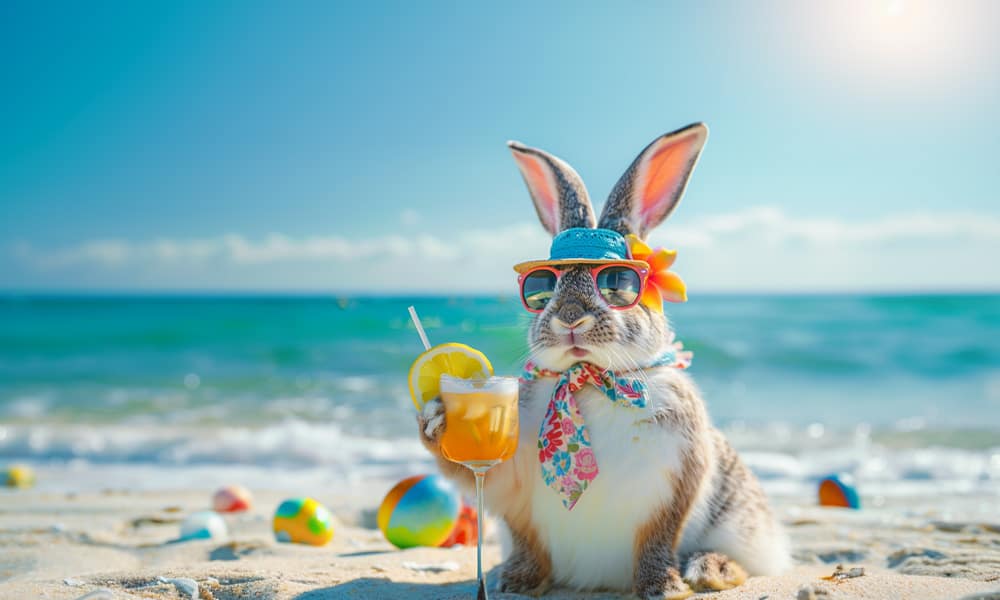
MANY Costa Ricans flock to the country’s shores during Semana Santa (Holy Week), while others solemnly gather and worship the religious holiday through processions. Some foreigners living in Costa Rica celebrate the Easter season with lighthearted traditions, but doing so in a different country comes with its fair share of special challenges.
THROUGHOUT the United States, Canada and Europe, millions of children excitedly wake up Easter morning to discover that the Easter Bunny left baskets full of chocolate rabbits, jellybeans and brightly dyed eggs.
But the eggs for children here may have a brown hue to them and baskets may have a few substitutions. Calls to numerous Costa Rican stores indicated many shelves are not stocked with pastel-colored plastic grass for filling baskets or neoncolored sugar-coated marshmallow Peeps.
EVEN dying eggs are tough. A few Más x Menos stores stock white eggs, which tend to take color better, but supplies are not specially increased for the season. Finding the special dye to color eggs may be close to impossible, as a general phone survey discovered, but food coloring is an acceptable substitute and can be found in almost every grocery store.
Traditional events such as Easter egg hunts do take place – if you know where to look. For more than 20 years, the Dutch Club has held an Easter egg hunt where attendees decorate eggs, hunt for eggs, eat chocolate and enjoy other treats.
In the past, participants brought dyed eggs to the event, but for the past two years children brought hard-boiled eggs to decorate as a group. Eggs are then hidden in the garden and children are sent out to search for them.
“It’s about being together,” said the club’s president Cor Teunissen. “Also, while we have a lot of other events during the year, this one is especially dedicated to the kids.”
THE Dutch Club Easter egg hunt is April 11 in San José and is open to members of the Dutch Club and friends of members who have approval of the board.
The traditional egg hunt came a little early for about 15 children who searched for Easter chocolates as part of the Association of Residents of Costa Rica’s annual charity picnic held in San Rafael, Heredia last Saturday. In the Central Valley, the Escazú Christian Fellowship is considering an egg hunt following its Easter service.
WHILE many North Americans and Europeans celebrate Easter as a joyous springtime holiday with the primary focus on Easter Sunday, celebrations in Costa Rica run the entire week. The first five days are observed solemnly, with parishioners attending Mass, confession and processions.
Processions (re-enactments of Jesus’ Crucifixion) are deep-rooted traditions among Catholics during Semana Santa. Generally held on the morning of Good Friday, locals gather to remember Christ’s walk to the cross.
In most cases, community members alternate carrying an artistic icon of Jesus bearing the cross. However, the procession in San Joaquín de Flores in Heredia has distinguished itself from other processions with live performers re-enacting Jesus’ last hours through the Viacrusis, or Stations of the Cross.
From its solemn drum choir of men dressed as Roman soldiers in rooster-like helmets and silk dresses to the young girl chosen for the sought-after role of Mary Magdalene to the actor depicting Christ to the hundreds of spectators that line the streets, processions in Costa Rica incorporate the entire community in recalling the Stations of the Cross.
CAROLINA Quesada, who is in charge of the biblical characters, said about 80 people are performing the various parts, including Jesus, the Virgin Mary, Mary Magdalene, Veronica, Simon, Caifas, Pilate, the apostles, priests, soldiers and more.
“This year we decided to change certain traditions,” Quesada said. “We chose the actors, whereas, before young people used to register at the church.”
By selecting the actors, Quesada said they could choose those who they thought were mature enough to fill such serious roles, which helps “to make the Passion more real.”
Quesada said that understanding the significance of the procession is very important for those involved.
“We motivate the actors trying to make them understand that they are not performing any other play, but they are representing the most sacred act of love for humanity,” she said. “They have to meditate and feel every word they have to say and in this way they can increase faith in the spectators.”





