

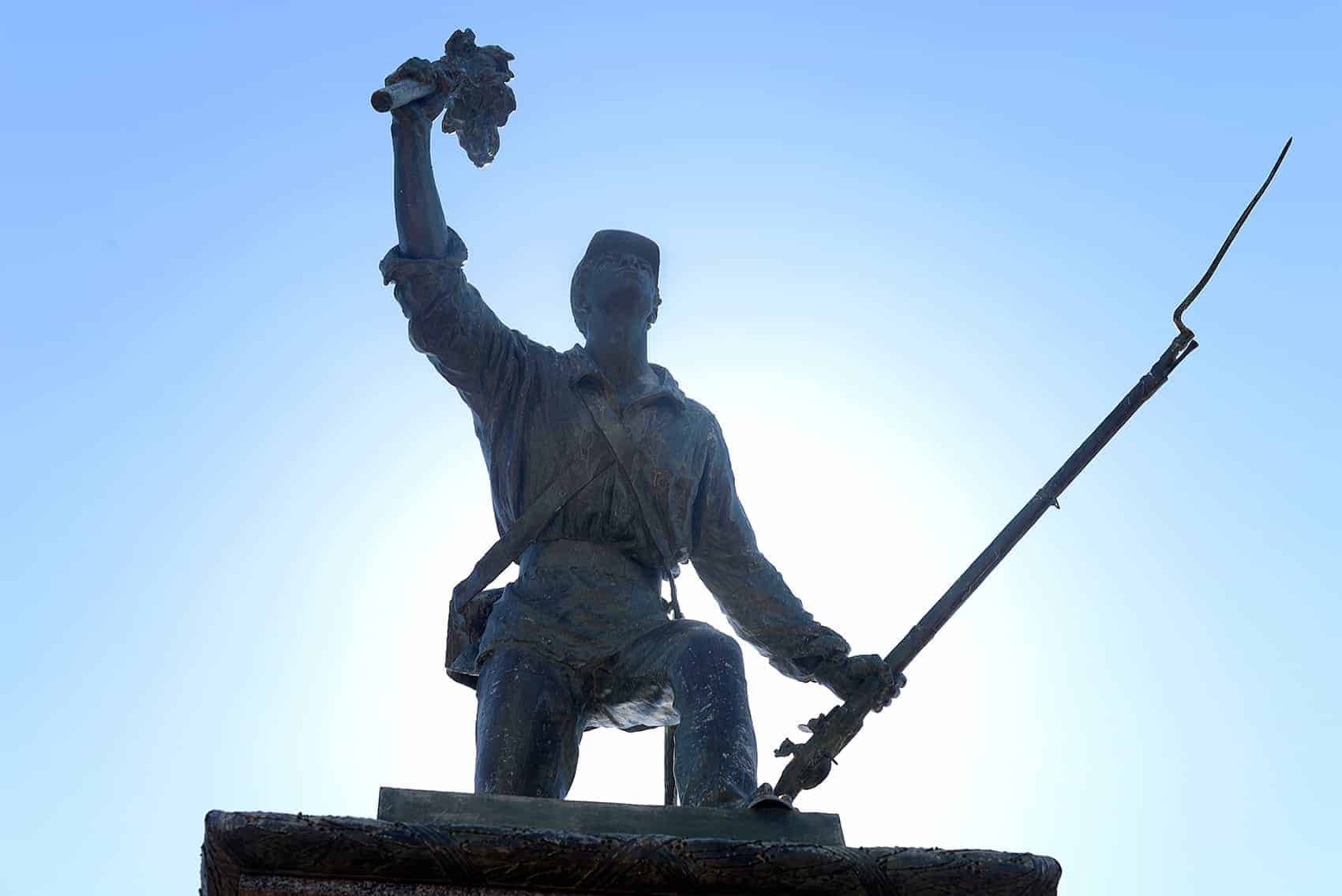
Juan Santamaría Day is a Costa Rican holiday to remember the Battle of Rivas in 1856 and the heroic action of Juan Santamaría, a common soldier from Alajuela who saved the battle and Costa Rica’s right to be a nation.
William Walker, a U.S. southerner, sought to make slave states of the five Central American republics. With his mercenary army, Walker claimed Nicaragua, then turned to Costa Rica. President Juan Rafael Mora Porras called for recruits to chase out the filibusteros, as the invaders were known, and defend the borders. Four thousand Ticos answered the call and set out for the northern zone, routing the North Americans and chasing them north to Rivas, Nicaragua.
It was in Rivas that the decisive battle took place on April 11, 1856. As every Costa Rican student learn in school, Santamaría, carrying a torch, set fire to the Mesón de Guerra, Walker’s headquarters.
Although the war continued for another year along the river route on the northern border, Walker never regained the upper hand.
What was life like in Costa Rica in 1856?
How did the soldiers endure the long marches and fierce firefights? By the standards of the day, Costa Rica was a rich country. Coffee production had had a broad impact on society: even the humblest members of the population had a chance to work with the huge crops. Demand for coffee from Europe and North America created jobs and brought in foreign exchange, and that drew merchants from France, Germany and other countries to set up emporiums with imported products.
Costa Ricans could now buy porcelain dishes, elegant fabrics for clothes, lamps, furniture and even pianos, from Europe. They also imported hats, gloves and crinolines for the ladies and girls, and ropa blanca or white clothes, the euphemism for underwear. Culture flourished: books, music, theater and carriages were part of the social scene. Even in the rural areas, there was a sense of identity within the young nation.
The army benefited as well, with rifles from England and military trainers from Germany (Saxony and Prussia). Wearing loose white pants and tunics, broad-brimmed hats, and leather sandals called caites, 4,000 men set out from San José on March 4 for the 300 kilometer route to Puntarenas and north to Santa Rosa. This meant 20 days in the March heat, over rocky roads, high mountains and steep valleys.
They passed through La Uruca, Lagunilla, San Antonio de Belén and around Alajuela, through La Garita and El Coyol, Altos de Monte and onward, on roads used to carry the coffee-laden oxcarts to the port. They stopped and rested in flat areas near streams and grass for the oxen and horses.
They ate rice and beans and meat with plátanos. And they were not alone. Women – wives, sisters and others interested in helping the men and the country – came along. They cooked the huge pots of food, washed and mended clothes, and even helped the fighters, carrying supplies and loading rifles. National heroine Pancha Carrasco helped save a cannon with her sharp shooting.
Although the war in Santa Rosa and Rivas, known as the “first campaign,” were important victories for Costa Rica, an epidemic of cholera hit the army and forced it to retreat. In December, 1856, the “second campaign” to clear the San Juan river of Walker’s troops was also successful, and Costa Rica proved itself as a sovereign nation.
See also: Who was Juan Santamaría? Five (debated) things you should know
The Juan Santamaría Historic and Cultural Museum in the center of Alajuela, on the northwest corner across from the central park, is open Tuesdays to Sundays from 10 a.m. to 4:30 p.m. with information and displays on the Campaign of 1856.
This article first appeared in 2016





