

It is, for our home planet, an extremely warm year.
Indeed, last week we learned from the National Oceanic and Atmospheric Administration that the first eight months of 2015 were the hottest such stretch yet recorded for the globe’s surface land and oceans, based on temperature records going to 1880. It’s just the latest evidence that we are, indeed, on course for a record-breaking warm year in 2015.
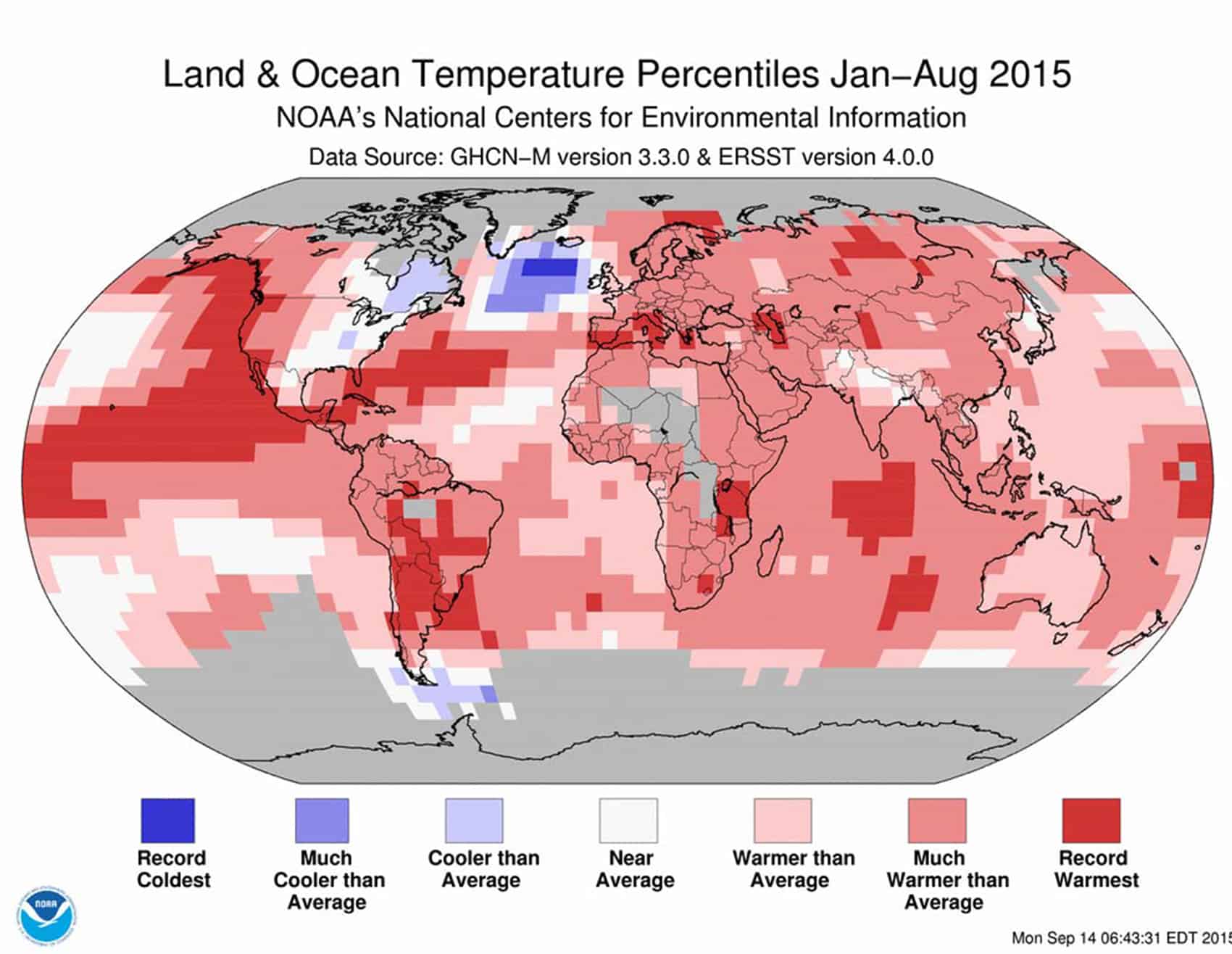
Yet, if you look closely, there’s one part of the planet that is bucking the trend. In the North Atlantic Ocean south of Greenland and Iceland, the ocean surface has seen very cold temperatures for the past eight months. What’s up with that?
First of all, it’s no error. Deke Arndt, chief of the climate monitoring branch at NOAA’s National Centers for Environmental Information, confirmed what the map above suggests – some parts of the North Atlantic Ocean saw record cold in the past eight months. As Arndt put it by email:
For the grid boxes in darkest blue, they had their coldest Jan-Aug on record, and in order for a grid box to be “eligible” for that map, it needs at least 80 years of Jan-Aug values on the record.
Those grid boxes encompass the region from “20W to 40W and from 55N to 60N,” Arndt explained.
And there’s not much reason to doubt the measurements – the region is very well sampled. “It’s pretty densely populated by buoys, and at least parts of that region are really active shipping lanes, so there’s quite a lot of observations in the area,” Arndt said. “So I think it’s pretty robust analysis.”
Thus, the record seems to be a meaningful one – and there is a much larger surrounding area that, although not absolutely the coldest it has been on record, is also unusually cold.
At this point, it’s time to ask what the heck is going on here. And while there may not yet be any scientific consensus on the matter, at least some scientists suspect that the cooling seen in these maps is no fluke but, rather, part of a process that has been long feared by climate researchers – the slowing of Atlantic Ocean circulation.
In March, several top climate scientists, including Stefan Rahmstorf of the Potsdam Institute for Climate Impact Research and Michael Mann of Penn State, published a paper in Nature Climate Change suggesting that the gigantic ocean current known as the Atlantic Meridional Overturning Circulation, or AMOC, is weakening. It’s sometimes confused with the “Gulf Stream,” but, in fact, that’s just a southern branch of it.
The current is driven by differences in the temperature and salinity of ocean water (for a more thorough explanation, see here). In essence, cold salty water in the North Atlantic sinks because it is more dense, and warmer water from farther south moves northward to take its place, carrying tremendous heat energy along the way. But a large injection of cold, fresh water can, theoretically, mess it all up – preventing the sinking that would otherwise occur and, thus, weakening the circulation.
In the Nature Climate Change paper, the researchers suggested that this source of freshwater is the melting of Greenland, which is now losing more than a hundred billion tons of ice each year.
“I was formerly somewhat skeptical about the notion that the ocean “conveyor belt” circulation pattern could weaken abruptly in response to global warming. Yet this now appears to be underway, as we showed in a recent article, and as we now appear to be witnessing before our very eyes in the form of an anomalous blob of cold water in the sup-polar North Atlantic,” Mann said via email.
Rahmstorf also commented via email:
“The fact that a record-hot planet Earth coincides with a record-cold northern Atlantic is quite stunning. There is strong evidence – not just from our study – that this is a consequence of the long-term decline of the Gulf Stream System, i.e., the Atlantic ocean’s overturning circulation AMOC, in response to global warming.”
Rahmstorf was asked whether, if his thinking is right, we should expect this cold patch to become a permanent feature of temperature maps, even as the world continues to warm. His answer was complex, but not anything that gives you much reassurance:
“The short term variations will at some point also go the other way again, so I don’t expect the subpolar Atlantic to remain at record cold permanently. But I do expect the AMOC to decline further in the coming decades. The accelerated melting of the Greenland ice sheet will continue to contribute to this decline by diluting the ocean waters.”
Granted, it’s not clear that all climate scientists agree with this interpretation of what’s happening in the North Atlantic – but clearly some important ones do, and they have published their conclusions in an influential journal.
The longer the situation continues, the more it is likely to attract attention. But it has already been around for a while. “It’s been really persistent over the last year and a half or so,” NOAA’s Arndt says.
Indeed, Rahmstorf previously discussed about the cold patch in the North Atlantic in March, when his study came out – and when a NOAA temperature chart for December 2014 through February 2015 also showed record cold in this area. As Rahmstorf wrote back then, “The North Atlantic between Newfoundland and Ireland is practically the only region of the world that has defied global warming and even cooled.” Since then, the trend appears to have only continued.
So in sum, if Mann and Rahmstorf are right, a slowing of Atlantic Ocean circulation could be beginning, and even leaving a temperature signature for all to see.
This won’t lead to anything remotely like The Day After Tomorrow (which was indeed based – quite loosely – on precisely this climate scenario). But if the trend continues, there could be many consequences, including rising seas for the U.S. East Coast and, possibly, a difference in temperature overall in the North Atlantic and Europe.
So on future climate maps, even as we rack up more hot months and years, we’d better watch the North Atlantic closely.
© 2015, The Washington Post





