

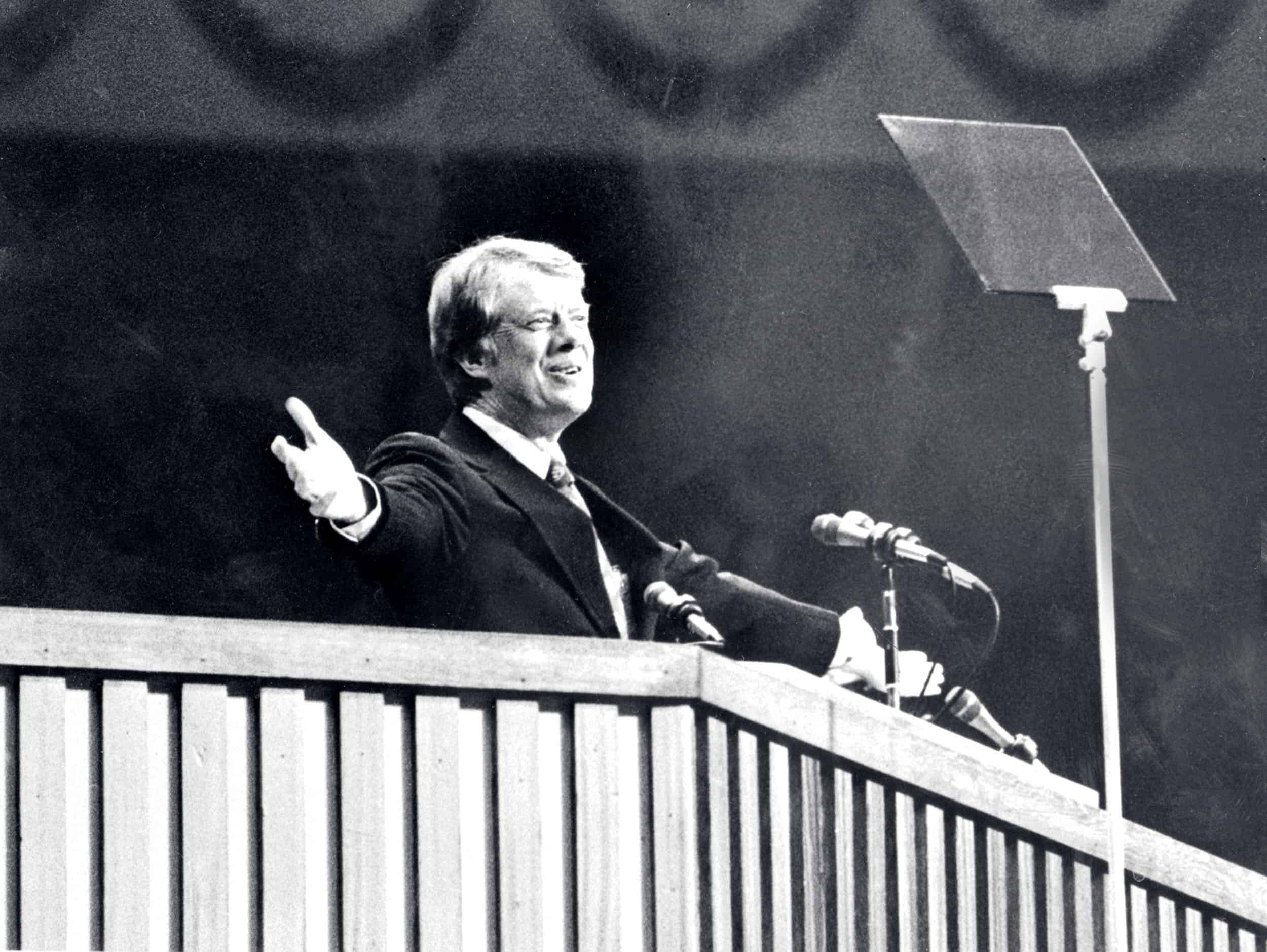
Forty-one years ago, Jimmy Carter, then governor of Georgia, delivered an extemporaneous address that established his credentials as a politician who was willing to tell the truth, even to powerful and moneyed interests – a speech that, in the wake of the Supreme Court’s Citizens United decision, might never again be heard in U.S. politics.
In light of Carter’s recent announcement that he has cancer, it’s worth reflecting on what made him a politician utterly different from both the presidents who succeeded him, and many who preceded him.
One of the venerable traditions at the University of Georgia Law School is Law Day, an occasion to honor student achievements as well as to invite distinguished guests, ranging from Supreme Court justices and attorneys general to cabinet members and politicians of national stature. On this Saturday in May 1974, the featured speaker was Edward M. Kennedy, the senior senator from Massachusetts.
Two hours after Kennedy delivered his keynote speech, Carter, one of the undercard speakers, unleashed a blistering extemporaneous critique about the legal and legislative process. Carter’s own sense of justice, he said, derived from two sources. The first was Reinhold Niebuhr and his mandate to establish justice in a sinful world, and the second was the venerable theologian Bob Dylan. It wasn’t until he heard Dylan’s “I Ain’t Gonna Work on Maggie’s Farm No More,” Carter said, that he began to appreciate the plight of the poor, especially tenant farmers.
Carter, building on his understanding of the Christian faith, expressed his solidarity with those on the margins, took on corporate interests and upstaged Kennedy, who was then considered the front-runner for the 1976 Democratic presidential nomination.
Carter lamented that “the powerful and the influential in our society shape the laws and have a great influence on the legislature or the Congress.” The status quo serves their interest. Carter lit into lobbyists and decried the incestuous relationship between corporations and the agencies regulating them.
Carter noted that the prison population consisted overwhelmingly of poor people, the only ones who serve time. Part of the problem, he suggested, is that “we assign punishment to fit the criminal and not the crime.” He concluded his remarks by sounding the populist theme that he was already honing for his presidential bid. Any hope for the future, Carter said, lay in “the combined wisdom and courage and commitment and discernment of the common ordinary people.”

Carter’s address captured the attention of Hunter Thompson of Rolling Stone magazine. During the course of his speech, Carter noticed that Thompson had briefly left the room; he surmised that the self-proclaimed “gonzo journalist” had simply exited to refresh whatever adult beverage he was drinking that day. Thompson, however, scurried to the parking lot to retrieve a tape recorder so he could record what he believed was an extraordinary moment: a politician who dared to speak the truth.
“I have heard hundreds of speeches by all sorts of candidates and politicians,” Thompson wrote later, “but I have never heard a sustained piece of political oratory that impressed me any more than the speech Jimmy Carter made at Law Day at the University of Georgia on that Saturday afternoon in May 1974.”
Could a presidential candidate make a similar speech today, one that repudiated “the powerful and the influential,” challenged corporate interests and questioned the justice of a criminal system that overwhelmingly punished the poor while ignoring the plutocrats? I suspect not.
Sen. Bernie Sanders, the self-described democratic socialist from Vermont, is sounding some of the same themes on the campaign trail, but pundits generally minimize his prospects; Carter, on the other hand, made it to the White House. Furthermore, the attention — and the crowds — that Sanders is attracting suggest how exceptional it has become in American political rhetoric to hear a presidential aspirant take on powerful interests.
For most politicians, the message is clear. The Supreme Court’s calamitous equation of money with speech in the Citizens United decision opened corporate spigots that have flooded the political arena. No politician harboring national ambitions can afford to alienate those interests.
As president, Carter sought, with mixed success, to act on the principles of fairness and equality he articulated. Since leaving the White House, however, and freed from political constraints (including raising campaign money), Jimmy Carter has been remarkably effective in his pursuit of peace, justice and care for those on the margins, those who lack the resources to command the attention of politicians.
Balmer is chair of the Religion Department at Dartmouth College. His most recent book is ” Redeemer: The Life of Jimmy Carter.”
© 2015, The Washington Post





