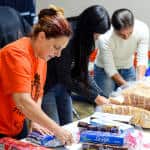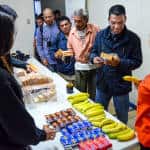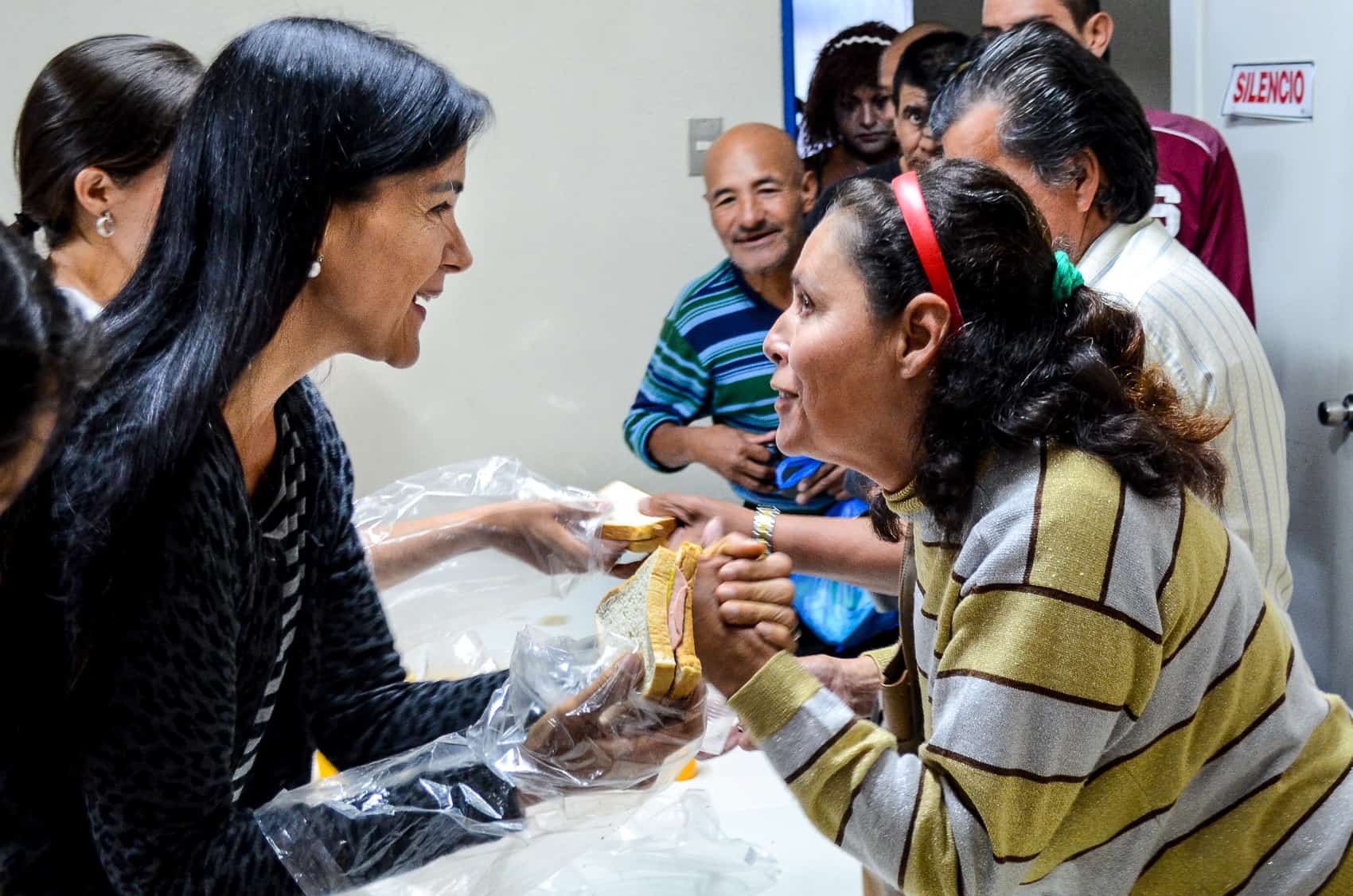
Breakfast is served. There are sleeves of ham sandwiches, packets of sweet wafers, a crateful of bananas and two Rubbermaid coolers of coffee and orange juice. Seven volunteers from Asociación Naranja pour black java in ceramic mugs and arrange the food on foldout tables. They move quickly, a flurry of activity in this colorless backroom. It’s 6:25 a.m., breakfast only lasts about a half-hour and everyone has to be gone by 7. No time to waste.
Moments before they open the door, the volunteers form a circle and join hands. The group is non-denominational – they forbid proselytizing – but they do say a quick prayer.
“Don’t worry,” one says. “We always start with a prayer, but we’re not a cult.”
Everybody laughs.
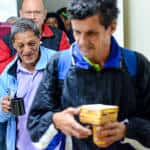
At last, a queue of men and women files into the room. There are exactly 100 of them, because that’s how many people are permitted to stay overnight at this San José homeless shelter. They wear all kinds of clothes, including sports jerseys, jackets and jeans, and most of them are decently groomed. Some are transvestites; some are fairly fashionable. Most of these people could pass for bus drivers or store managers or attorneys. No one shoves or curses. Nearly everyone smiles brightly as they enter the room, and the volunteers smile back.
“This is the only shelter in San José that’s really working,” says Adelia Acosta Hernández, co-founder of Asociación Naranja, a volunteer organization dedicated to feeding and helping the city’s homeless population. “A lot of people criticize us, because they think we are just supporting lazy people. But we all come from different circumstances. We have to share. I tell people, ‘Work with us for just a couple of days.’ After that, their [attitude] is totally different.”
Naranja is about as grassroots as an organization can get: They have no budget, offices, meetings, website or hotline. Acosta started the effort seven years ago with her husband, José Oller, an industrial engineer, when they visited La Merced Park and handed out food to people squatting there. But they ran into problems with local law enforcement.
“The police started chasing us, because it was ‘not legal,’” Acosta says, using dramatic air-quotes. As it turned out, the most illegal part of almsgiving was that Acosta and Oller needed to be certified in food handling by the Health Ministry. Soon after, they received proper training and started the endeavor again, this time in an actual shelter.
Five years later, Naranja incorporates 220 regular volunteers, and they distribute breakfast every single morning, including holidays. All their food and beverages are donated by local businesses. On weekdays, they serve food only within the confines of the shelter, but during the weekends they also distribute food in the adjacent street. (Local storeowners dislike public breadlines on business days, and Naranja’s relationship with the National Police remains frosty).
Like most sizable cities, homelessness is a challenge in San José, where people can be found at all hours on sidewalks and in city parks. The municipality estimates that more than 1,800 people in San José are “indigentes,” the common Spanish term. San José’s homeless population can survive here because of its mild weather, its abundant public spaces in La Merced Park and La Sabana Park, and navigable terrain. The Municipality budgets ₡100 million (about $200,000) annually to providing food, shelter, and health care for desperate persons, used by such organizations as the Mixed Institute for Social Aid (IMAS) and the Alcohol and Drug Abuse Institute (IAFA), as well as this homeless shelter. But life is still hard, especially given a major cause of homelessness in Costa Rica: substance abuse.
“They kill each other for drugs,” Acosta says. “Crack is everywhere, because it is very cheap. You can buy a [crack rock] for ₡500 [$1]. A lot of girls have their babies in the street, and they feed crack to their babies, because it’s cheaper than milk.”
To combat these addictions, Naranja does not give services to people who are obviously under the influence, and guests must be sober to stay at the shelter. As a reward for abstaining from substances, the first 100 people to arrive at the shelter are allowed to stay in its dormitories, where they can remain until 7 a.m. But there is a cutoff point: the 101st visitor must find somewhere else to sleep, no exceptions.
Part of Acosta’s charm is that she makes helping people look effortless. She smiles constantly and looks completely serene, as if she couldn’t imagine being anywhere else. This serenity extends into her personal life: When Oller spotted Acosta on a bus 30 years ago, he followed her home and brazenly knocked on her door. All these years later, they have two adult children and live comfortably in Zapote. Oller continues to help move and hand out food. “We are best friends,” says Acosta with a chuckle.
When asked how much time she dedicates to Naranja, Acosta just grins and answers, “Very little. It just flows.” She doesn’t permit “church people” to preach directly to shelter guests, but she herself is proudly spiritual. “We thought there was too much religion happening inside the church. We wanted to bring religion outside.” To whit, she speaks glowingly of Pope Francis, who has gained widespread attention for his interest in poverty.
“The best part is that you can give,” Acosta says, “and you know they cannot give back.”