

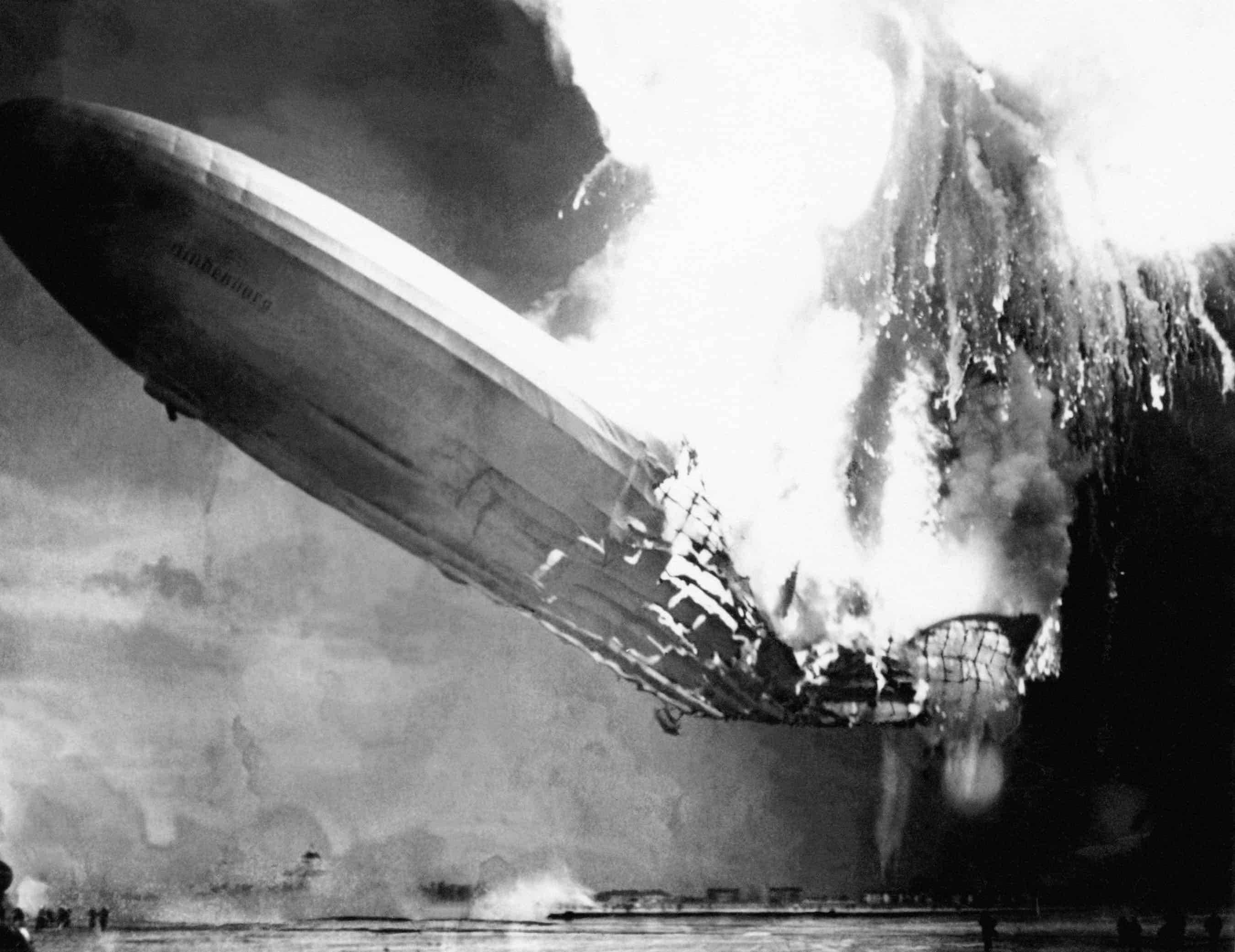
In 1936 and 1937, young Werner Franz worked as a cabin boy on the Hindenburg, the largest, fastest and sleekest mode of transportation the world had seen up to that time.
The German-built airship, which was 804 feet long and kept aloft by hydrogen gas, was an engineering marvel, capable of making the journey from Frankfurt to the United States in a mere three days. It was also a powerful propaganda tool of the Nazi regime.
Franz, who was 14 at the time, washed dishes and delivered coffee to the crew, but in 2004 he described his seven months with the Hindenburg as “the best time of my life.”
The airship, built by the Zeppelin company, made 34 successful Atlantic crossings in 1936 and was considered the height of luxury and speed in commercial aviation. But the era of the airship came to a ghastly end on May 6, 1937, when the Hindenburg burst into flames as it was attempting to land at a naval station in Lakehurst, New Jersey.
Within seconds, the mighty aircraft was reduced to a smoldering metal skeleton, killing 35 of the 97 people on board, plus another person on the ground. It was the first major air disaster on American soil, made more vivid by the newsreel cameras, press photographers and radio reporters who were present to record the Hindenburg’s arrival.
Franz managed to escape, leaping to the ground from an opening in the bottom of the airship. He was last surviving crew member of the Hindenburg when he died Aug. 13 at his home near Frankfurt. He was 92.
The cause was a heart attack, John Provan, a U.S. historian in Germany, said Saturday in an interview.
Franz, who was born May 22, 1922, in Frankfurt, needed to find a job to help out his family after his father became ill and had to quit his job as a hotel switchboard operator. Through his older brother, he learned of an opening on the Hindenburg. He made his first flight, a transatlantic voyage to Rio de Janeiro, in October 1936.
Two months earlier, the Hindenburg had impressed spectators at the Olympic Games in Berlin as it flew over the stadium, a polished silver ship in the sky. Nazi swastikas were emblazoned on the tail of the Hindenburg in red, black and white.
The Hindenburg was longer than the U.S. Capitol, end to end, and 250 feet longer than the height of the Washington Monument. It was 135 feet high. Except for a sister Zeppelin that never saw commercial service, there has never been a larger passenger aircraft of any kind. In August 1936, it made its fastest crossing, going from Lakehurst to Frankfurt in 43 hours, 2 minutes.
“It was twice as fast as the fastest transatlantic ship,” said Dan Grossman, an Atlanta-based airship historian. “It was definitely the Concorde of its time.”
In June 1936, German boxer Max Schmeling flew on the Hindenburg from the United States to Frankfurt after he defeated U.S. heavyweight Joe Louis. Schmeling was originally scheduled to fly to the United States in May 1937 but canceled his plans and came by ocean liner instead.
There were 36 passengers and 61 crew members aboard when the Hindenburg reached the United States on May 6. It circled Manhattan and flew over parts of New Jersey at its usual cruising altitude of about 650 feet before it coming in to land at Lakehurst.
At 7:25 p.m., with the tail of the craft unusually low, flames broke out in the rear of the airship. Leaking hydrogen was ignited by an electromagnetic spark, and within seconds the linen membrane of the airship was engulfed in flames.
Franz was clearing tables in the officers’ mess. With the nose of the aircraft pointing up, dishes and silverware began to clatter to the floor, and he was drenched by a ruptured ballast tank filled with water.
As the Hindenburg began to sink closer to the ground, Franz kicked open a hatch used to load provisions onto the craft. He jumped out, a few feet above the ground, and ran. He can be seen in newsreel footage of the disaster.
A radio broadcaster, Herbert Morrison, memorably described the scene: “It’s a terrific crash, ladies and gentlemen. It’s smoke, and it’s in flames now; and the frame is crashing to the ground, not quite to the mooring mast. Oh, the humanity!”
Franz ran in the direction of the wind, keeping the fire behind him. He escaped with no injuries or burns and was “one of the few survivors who were in the belly of the ship,” Grossman said.
The next day, Franz returned to the site of the crash and walked through wreckage to the spot where his bunk had been. There, he found a pocket watch that had been given to him by his grandfather.
During World War II, Franz was a radio operator for the German Luftwaffe and later repaired precision machines for the German post office. He also worked as a figure-skating and roller-skating coach. One of his ice skaters, Marika Kilius, won two Olympic silver medals in the pairs competition.
Survivors include his wife of 52 years, Annerose Franz; and several children and grandchildren.
A week after the crash, Franz testified before a U.S. board of inquiry about the Hindenburg. When he saw an officer with the German air ministry, he asked, “When the next Zeppelin is ready, may I fly again with her?”
© 2014, The Washington Post





