

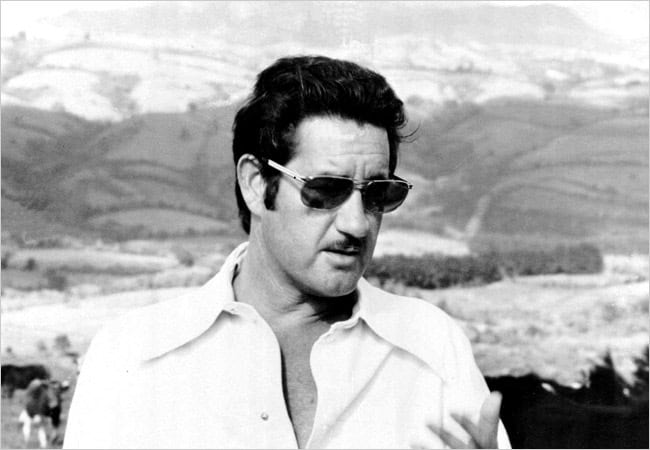
From the day Robert Vesco arrived in Costa Rica in 1972 until his departure five years later, hardly a week went by that his name wasn’t in the headlines. The fugitive U.S. financier, accused in the U.S. of looting Investors Overseas Services (IOS) of $224 million, and his six associates moved his troubled financial empire here from his earlier haven in the Bahamas on invitation of then- President José (Pepe) Figueres, hoping to set up a “financial district” with its own set of laws – a “country within a country” to serve as a refuge for international funds of dubious origin.
Don Pepe’s determination to champion Vesco disillusioned many admirers of the visionary leader who led Costa Rica’s 1948 revolution, instituted the country’s modern democracy and abolished its army. But the feisty three-time President defiantly shrugged off all criticism, saying Costa Rica needed investments and shouldn’t question their source.
Vesco wasted no time repaying his hosts. Shortly after arriving with his yacht and lavishly- appointed Boeing 707, he moved his wife Pat and children Danny, Tony, Dawn and Bobby (son Patrick was born here) into a luxurious, heavily guarded walled home office compound in the eastern suburb of Curridabat and invested in numerous Figueres family operations. He bought bars, restaurants and casinos, invested in radio and TV stations through bearer-share corporations, acquired a large spread, complete with airport, in the northern province of Guanacaste, and even bought Country Day School from its founders, Robert and Marian Baker, to set up a center for children with learning disabilities so Bobby would receive specialized instruction.
He also financed Excelsior, a daily newspaper created as a voice for Figueres’ National Liberation Party to compete with the leading daily La Nación. In one of the decade’s biggest scandals, the controversial paper folded after racking up mountainous debts; its owners were never identified and government funds earmarked for poverty programs were used to pay off its employees.
Legendary Largesse
The financier’s largesse quickly became legendary – his name was linked (accurately or not) to almost every new venture, and communities throughout the country proclaimed themselves pro-Vesco because he had bankrolled local projects. At one point his investments here were believed to total between $25 million and $60 million.
In 1974 The Tico Times published an exclusive interview with “The Man Behind the Myth,” which revealed him as articulate, wily, cocky and wryly humorous. Already he was making a career of battling what he termed “political persecution” here and in the U.S., and would grow increasingly bitter as pressure against him mounted.
The U.S. had requested his extradition based on an allegedly illegal $200,000 contribution to the campaign of U.S. President Richard Nixon, but at the end of Figueres’ term, the so-called “Vesco Law” was hastily pushed through Costa Rica’s Congress, giving the presidency final say over extradition matters.New President Daniel Oduber, from Figueres’ Liberation Party, informed Vesco publicly that he could stay in Costa Rica as long as he respected local laws.
Costa Vesco
But Ticos were not happy about what the famous fugitive was doing to their country’s international image. One U.S. cartoon, widely reprinted here, showed a tourist arriving in “Costa Vesco”. Calling him “a whale in a puddle,” veteran local journalist Julio Suñol detailed the Vesco “takeover” in his book, “Robert Vesco Compra Una República” (“Robert Vesco Buys a Republic”.)
Both Guido Fernández, director of La Nación, and Rodrigo Madrigal, director of the daily La República, issued repeated calls for his ouster, alleging that he had tried to intervene in local politics and had ties to the Mafia. In the U.S, he was accused of negotiations to import 2000 submachine guns to Costa Rica and finance an arms factor with Figueres’ son, José Martí.
In 1976, The Tico Times published an exclusive interview with Vesco’s former pilot, Al (“Ike”) Eisenhauer, who had “hijacked” the financier’s Boeing in Panama and flown it to the U.S. at the request of U.S. officials, then wrote a book about his adventures with Vesco titled “The Flying Carpetbagger.” In the interview, Eisenhauer recounted many of Vesco’s shenanigans with the Figueres family, and described his former boss as “just a Detroit row-house kid.”
“I love that guy,” he said. “He’s the perfect bullshit artist – a genius.”
Meanwhile, elderly local architect Carlos Rechnitzer, who claimed he lost $250,000 in IOS, sued Vesco in local court, in a “Mouse that Roared” drama that dogged Vesco throughout his stay. In separate manifestos, 216 respected leaders and 5,000 citizens urged President Oduber to expel the financier as “harmful to the country,” and Congress began debating his ouster as an undesirable alien. Vesco spent his 39th birthday defending himself on national radio and TV.
From Bad to Tragicomic
A careless remark by Don Pepe during an interview with The New Republic magazine finally brought the curtain down on the Vesco Era, when he said Vesco had financed a “major part” of Oduber’s 1974 campaign. President and financier were summoned to testify before a legislative commission. La Nación and La República reported that companies connected to Vesco had received the lion’s share of profits from the 1975 nationalization of local gas distributors, and the clamor for his expulsion grew.
The situation went from bad to tragicomic when perennial maverick presidential candidate G.W. Villalobos wrapped himself in the Costa Rican flag and fired 60 shots into the wall of Vesco’s compound before being arrested.
In a futile effort to keep Vesco from becoming a campaign issue, Oduber went on national radio and TV to say he’d asked him to leave as soon as the lawsuit against him here was resolved.Vesco, however, applied for Costa Rican citizenship and said he hoped to stay. President-elect Rodrigo Carazo vowed to keep his campaign promise and expel him.
The local court hearing the Rechnitzer case made it easy one everybody (except Rechnitzer) by throwing out the lawsuit, freeing Vesco to leave, which he did three days before Carazo took office. The new President ordered Costa Rica’s borders closed to him, and his citizenship bid was rejected.
The “whale” eventually headed for a new haven in Cuba, but for years afterwards, “Vesco sightings” here were as common as Elvis sightings in the U.S. as the financier made several attempts to return to Costa Rica.





