

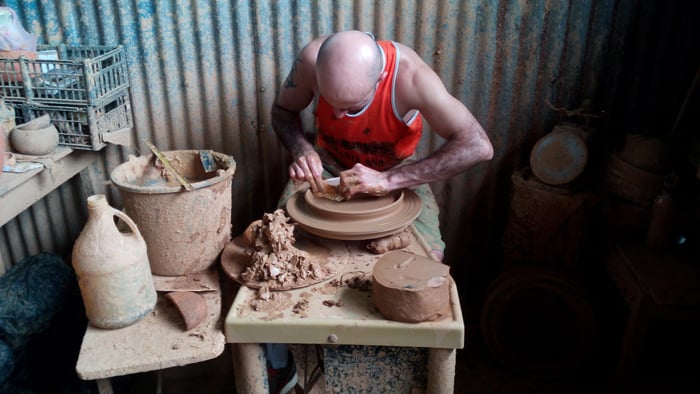
You’ve heard the question posed in the famous riddle: What’s black and white and red all over? Now, The Tico Times should answer, “A newspaper” – think “re(a)d” – but we’ll toss out another possibility, too: the indigenous Chorotega pottery from Guaitil.
Guaitil ceramics, one of Costa Rica’s signature artisan souvenirs, come from the town of the same name (pronounced gwye- TEEL) in the center of the NicoyaPeninsula. Made from powder extracted from nearby land, the natural dyes used mix and match three basic colors – black, white and red – to form an earth-tone rainbow of beige, pink, gray, orange and ocher.
“Little has changed from the way my ancestors made these things,” Guaitil native Arbin Espinosa told The Tico Times, and, indeed, the town’s dozens of households that make a living throwing vases, plates, pots, jars and pitchers, use techniques handed down from generation to generation.
Several artisans have begun to use a pottery wheel over the past decade, said Espinosa, who has set up his Guaitil Pottery Studio in the nearby beach community of Tamarindo. The wheel represents a more efficient change from the entirely hand-thrown process once used exclusively.
The other huge change? The pottery was once entirely utilitarian, used for cooking in area kitchens. These days, it’s more likely to be snatched up by tourists looking for that perfect souvenir from their trip to Costa Rica.
The story of the region’s ceramics might be called “A Tale of Two Cities … or TwoTowns.” Though Guaitil is most associated with the works, residents of other communities, most notably nearby San Vicente, craft similar pottery. In fact, much of the clay used by Guaitil’s artisans these days comes from the land around San Vicente. And no visit up here is complete without a stop at the newish San Vicente Eco-Museum with exhibits dedicated to the region’s culture, pottery-making included.
The process itself? The clay is extracted from about one meter below the topsoil, sifted to remove stones, dried and then pulverized with a wooden mortar and pestle. The resulting powder is mixed with water and very fine freshwater sand. “The tourist industry calls it ‘iguana sand,’” Espinosa said, explaining that it comes from favored places for iguanas to lay eggs. “We just call it ‘sand.’”
A lot of kneading, stretching and shaping later (frequently with peeled corncobs), the works are fired in igloo-shaped, woodburning ovens – they’re a distinctive feature of yards in the town – and then dried in the sun.
Hand-painting is accomplished with natural dyes. Animal designs – bats, toads, turtles, iguanas, serpents – are favorites, just as they have been since pre-Columbian times, although a few avant-garde artisans, Espinosa among them, are experimenting with modern designs, too. Polishing with a graphite stone puts the finishing touch on the work.
More complex pieces can take up to a week to complete during the dry season, possibly double that time during the wettest of the rainy season.
Getting There
Guaitil lies 13 kilometers east of Santa Cruz, on the old road to Nicoya. A couple of daily buses connect Santa Cruz and Guaitil, with travel time about 20 minutes. The town has no lodging options. Many regional tour operators offer half-day Guaitil shopping tours, some of which stop for a típico lunch in Santa Cruz. Operators tend to stop at the same shops – commissions are probably in play here – but feel free to wander around to other vendors during your time in town. Shops are open mainly Monday to Saturday.





