

Like all cultures, Costa Rica’s has its share of legends. These tales are meant to be scary to keep people in line. Who’s going to venture out for a little mischief knowing that the headless man, the beauty who turns into a beast, the devil dog, witches or creatures who steal children are out there? Many legends cross borders. The Zegua and the Lorelei both lure unsuspecting fools to their deaths.
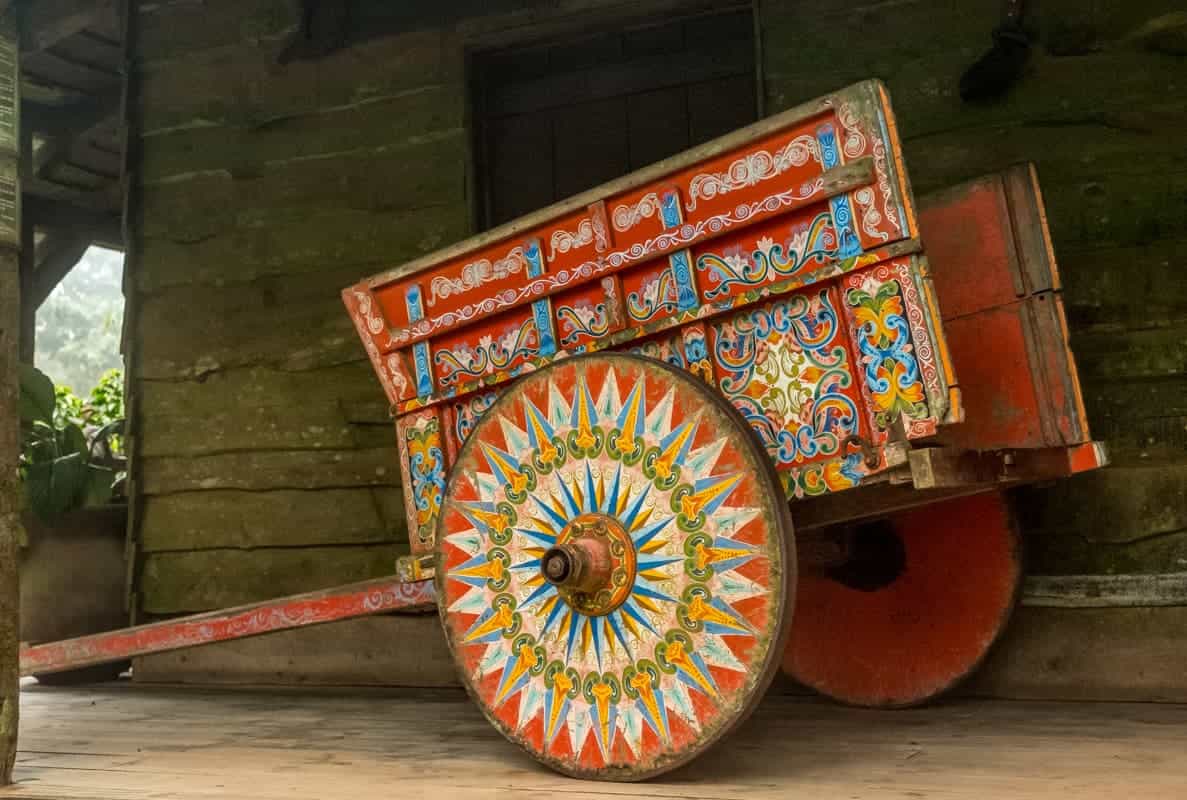
The headless priest and the headless horseman share the same problem. Cadejos, the devil dog, resembles the werewolf and all the other nasty wolves that populate folk tales. But there is one story that is uniquely Costa Rican because it is about an ox cart, the national symbol. This particular ox cart propels itself along rural roads only in the darkest part of the night. It has been reported around Atenas, northwest of San José, and Escazú, on the southwest side of the city, and myriad lesser towns.
None have ever seen it, but many people swear they heard it pass, going traca, taca, tarata . . . traca, taca, tarata. The repetitive sound is exactly like that of wooden oxcarts, the way they used to rumble along in the old days with the chunky wooden wheels rubbing on their axles. But who could it be? It’s not one of the area farmers hauling sugar cane to the mill or a load of pineapples to the market while they are still dew fresh because all the farmers now have pickup trucks and don’t get up until 6 a.m. And why don’t we hear the sound of hooves?
Eight huge oxen feet would make a lot of noise pounding the asphalt. Nor do we hear the beasts snorting as they pull their load. And where is the boyero or teamster? We don’t hear him calling commands or coughing or snoring or whatever. Just the traca, taca,tarata as it approaches, passes the house(phew) and goes on its way, the sound now cushioned by the distance. The cart without oxen began its strange, lonely journey in the early 1700s when San José was just a small village and new.
The people wanted to build a church, the most important building for any community in that era because it was prayer and the saints that helped them survive in what was a primitive wilderness. For that reason, too, all towns had patron saints to watch over and protect them and San José, or St. Joseph, was wisely chosen for this one.
At that time the Cuesta de Moras, where the National Museum now stands, was a wooded area, almost a forest and that’s where the men from the village went to cut down trees for the church, the altar, the statues and pews. They cut the wood in the menguante, or waning moon, naturally, because they knew that’s when the sap isn’t flowing.
The fallen logs lay on the ground overnight waiting for the mento return in the morning to claim them. But an unscrupulous, neer-do-well wastrel from Escazú seized the opportunity to steal the lumber when no one was watching and with the spoils built himself a house, a stable, a mill, a bench and a fancy, new cart.
He hadn’t counted on St. Joseph, watchman on high and retired carpenter, who also enjoyed close connections in the heavenly hierarchy. As a result, the scoundrel sickened and died and was condemned to ride the roads forever, snug in his casket, in his fancy new cart – albeit now faded and creaky after 300 years.
The oxen, innocent of all misdeeds, were freed from punishment and the cart, with its gruesome passenger, rumbles along on its own. Urban dwellers are exempt from hearing the phantom phaeton, it being strictly a campesino conveyance. But out in the country, where houses are scattered and nights are dark and silent, it is still possible to hear traca, taca, tarata as the old wooden wheels rotate and the cart, operating on celestial remote control, continues its endless wandering.
And we, trembling under the covers in the pre-dawn chill, with twitchy nerves and galloping hearts, know that the cart without oxen has just gone by.





