

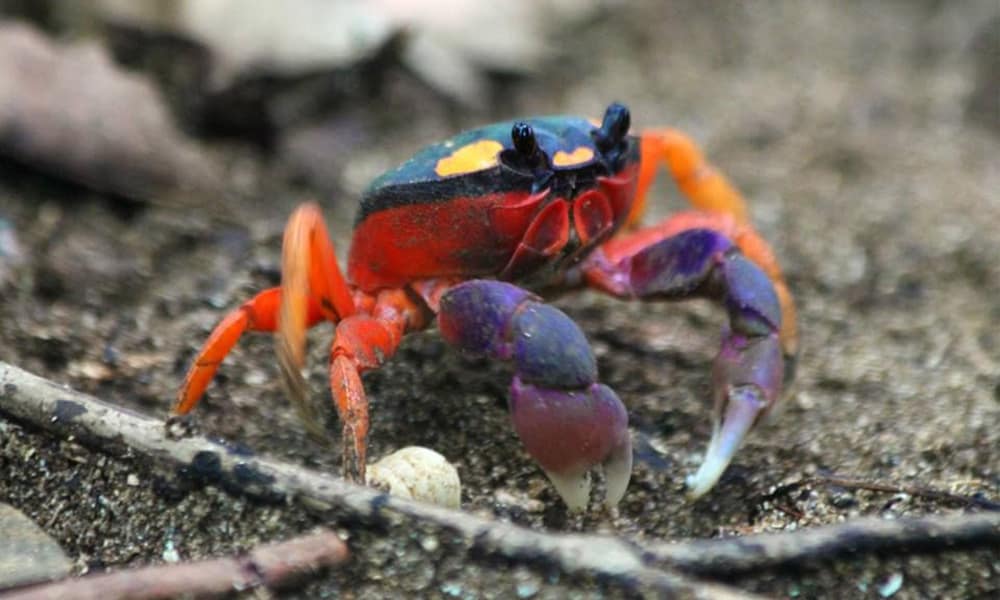
A few years ago, I had an unexpected guest from Costa Rica that ended up staying at my home in Redondo Beach, California, for a year. The stowaway made it through three airports undocumented, undetected and passport less. When it revealed its presence in my home, my response was astonishment –and a yelp of pain.
The guest manifested itself in my suitcase in the form of a crab. It had stowed away inside my swim fin for my return flight from Costa Rica to the United States.
It was one of those orange-and-purple crabs that are quite abundant on the Pacific coast – you know, the ones that scuttle under the door into your cabina in the early hours of the morning and, sadly, can be seen flattened by cars on highways near the coast. The suitcase the crab stowed away in was not opened for seven days. When finally decided to unpack it, the swim fins were the first items I took out.
While my fingers probed inside the fin for excess sand, I felt a painful pinch on my index finger. The reflexive jerk of withdrawing my hand from inside the fin caused the crab to release its arm along with its claw – still attached to my finger! My immediate thought was to flush the junk-species crustacean down the toilet.
But then I realized I should wait until my wife got home, so I could show her the parasite that had come back with us. My wife, a kindergarten teacher and the patron saint of all living creatures, called the California Science Center, and was told the center had many different kinds of crabs and would be happy to take our stowaway off our hands. She turned the offer down.
“I can’t imagine that poor little creature being put in some tank. Besides,” she said, putting the one-clawed crab to her ear, “this little guy is trying to communicate something to us. “She was right. That pinching prober made clicking and bubbling sounds when you brought it to your ear. We could only interpret these noises as:
“Take me back to Costa Rica! “We would have to wait a whole year to return our clawed, clicking guest to its beach. In the meantime, we gave it a name: Pícoco. We bought it a tank and created a beach-sand terrarium, with an electric heater to simulate tropical temperatures and a little dish of water for it to dip into when it wanted. Pícoco was easy to please.
Cheese, bits of apple, tuna chunks – this animal did not fuss about its nutrition. One day we noticed bits of crab shell in the terrarium. Soon after, we were surprised to find that our guest’s claw had grown back. We learned later that Pícoco’s kind molt and shed their carapacesas part of their growing process.
The land crab, scientifically known as Gecarcinus quadratus, gets a bum rap. At times it gets treated no better than a cockroach because it is so abundant. These coastal scavengers aerate the soil with their tunneling, in addition to aiding the decomposition process and adding humus to nutrient-deficient sandy soils – truly, an important component of the natural world.
At last, the time arrived for our annual trip to the land of perpetual mucho gusto –with crab in tow! I wondered if we might be arrested for taking the animal out of the country and then trying to bring it back. What kind of jail time, fines, persecution and public humiliation would we suffer for being crab smugglers?
Before departure, I contacted my attorney in Costa Rica and told her everything, including my intentions and fears. Her reply was: “Don’t worry! You are bringing back a natural resource to the country. “Departure and arrival went smoothly –even at Customs, when it came time to open the suitcase containing Pícoco.
The crab did its job and stayed put inside the fin for the whole 11-hour flight and inspection, and the agent waved us through with a smile. In our airport hotel room, Pícoco was put in the bathtub with a piece of cheese. Tomorrow the journey would continue with a three-hour drive to the ferry terminal in the Pacific port town of Puntarenas, and then on to the Nicoya Peninsula.
Finally, we reached Pícoco’s home territory. About 200 meters from the high-tideline, we released Pícoco into the coastal brush at Playa Guiones, on the country’s northern Pacific coast. That the little creature survived through all those airport transits – not to mention a yearlong uprooting – is a tribute to its constitutional makeup and tenacity. Pícoco left a mark on us forever.





