

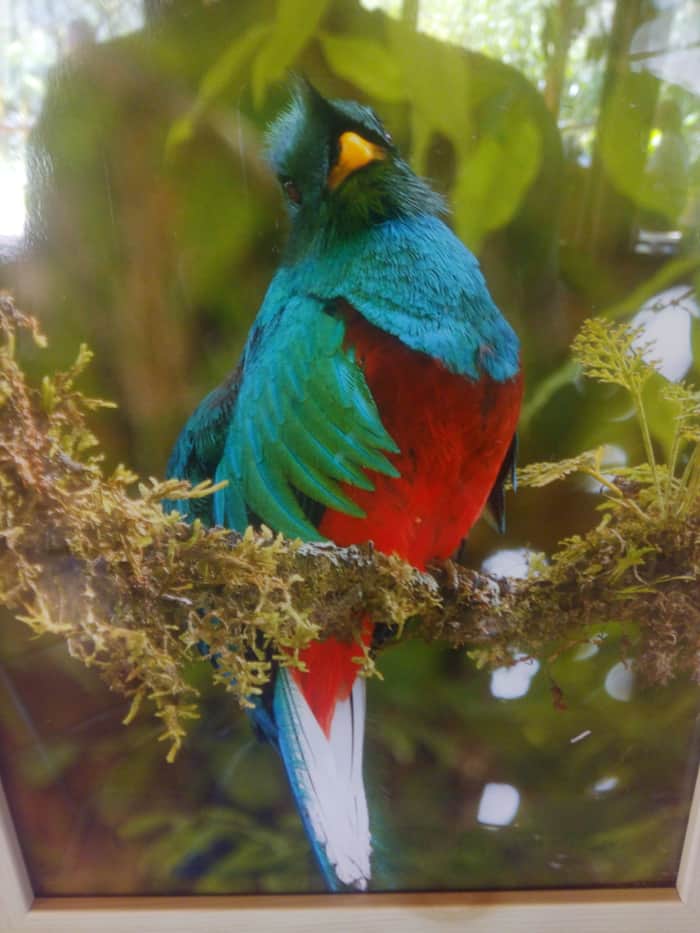
Costa Rica is home to nearly six of every ten resplendent quetzals left on Earth, according to a new study that puts the species’ total population at about 334,000 birds, less than half of the most recent published figure. The research, published in the peer-reviewed journal Bird Conservation International, estimates that about 193,900 quetzals live in Costa Rica’s highland forests and another 83,700 across the border in Panama. Together the two countries hold roughly 83% of the global population.
The remaining birds, about 56,500, are spread across southern Mexico, Guatemala, Honduras, El Salvador and Nicaragua, where the study found that the bird’s breeding forests have been cut roughly in half in three decades.
Lead author Edward H. Backus, an independent scholar based in Oregon, worked with four co-authors, among them Sofia Solórzano of the National Autonomous University of Mexico and Knut Eisermann of Bird Studies Guatemala. The team combined satellite forest records for 1990, 2011 and 2021 with elevation data to map cloud forest between 1,500 and 3,000 meters (4,900 and 9,800 feet), the band where quetzals nest.
They found about 864,000 hectares (2.1 million acres) of core breeding habitat still standing across Mesoamerica in 2021. Some 361,000 hectares (892,000 acres), close to 30% of the forest that existed in 1990, had disappeared. The losses were far from even. El Salvador lost 73% of its quetzal breeding habitat over the period, Mexico 65%, Guatemala 53%, Nicaragua 52% and Honduras 37%. Costa Rica lost 8%, or about 32,800 hectares (81,100 acres), and Panama 5%.
The difference comes down largely to one mountain range. The Cordillera de Talamanca, which runs from Costa Rica into Panama and includes La Amistad International Park, holds a single block of breeding forest of about 442,000 hectares (1.09 million acres). The next largest, in Guatemala’s Sierra de las Minas, covers about 50,700 hectares (125,000 acres), less than one-eighth the size.
Protection also sets the south apart. Of the roughly 388,000 hectares (958,000 acres) of core habitat the study mapped in Costa Rica, about 371,000 hectares (917,000 acres) of quetzal habitat lay inside protected areas in 2021. The bird continues to turn up in new corners of that network, including a first record at a Cartago refuge last month.
The quetzal is divided into two subspecies, and the study shows them on very different paths. The northern form, found from Mexico to Nicaragua, lost 51% of its breeding habitat between 1990 and 2021. The southern form, found only in Costa Rica and Panama, lost 7%.
On that basis the authors recommend that the International Union for Conservation of Nature move the species from Near Threatened to Vulnerable on its Red List, and they argue the northern subspecies warrants a higher category still. Habitat for the species as a whole shrank 26% between 2000 and 2021, just under the 30% threshold for a threatened listing but within the study’s margin of error.
The authors identify the conversion of forest to farmland and pasture as the main threat. They also point to climate pressures on cloud forest, including drought, fire and the loss of cloud cover, a concern already documented in the drying of Monteverde.
The population figure carries real uncertainty, the authors caution. It rests on assumptions about how many birds a given area of forest supports, and field counts are sparse and were made with different methods at different times. For Costa Rica and Panama the team assumed 50 birds per 100 hectares (247 acres) after halving the upper field estimates to avoid overcounting.
Even so, the new total is a sharp downward revision. A rough estimate published in 2023 by Alan F. Poole, a co-author of the new paper, had put the population at about 770,000.
The authors single out the Talamanca highlands as a priority for long-term monitoring. The quetzal is also among the main draws of a birdwatching sector that has become a growth area for Costa Rican tourism, which leaves the country holding both the largest share of the species and the largest stake in what happens to it.





