
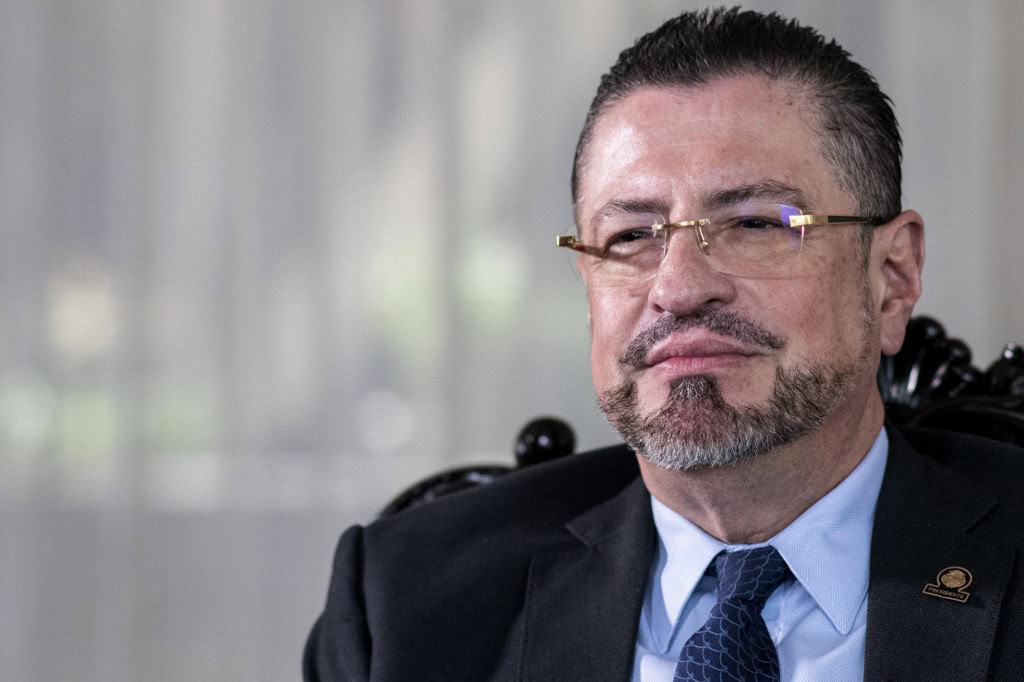
Costa Rica’s Attorney General’s Office has opened a criminal investigation into former president Rodrigo Chaves, now minister of the Presidency and of Finance, for alleged influence peddling linked to public works he offered an Alajuela community if local officials dropped their legal fight against a proposed landfill.
The Fiscalía General said it opened the case in response to published reports and a complaint it received. The office confirmed the investigation on Monday, Nov. 16. Prosecutors declined to provide further details, citing the confidentiality of the preparatory stage under Article 295 of the Code of Criminal Procedure. The opening of a case does not mean that criminal responsibility has been established.
The investigation centers on a public meeting Chaves led on Nov. 4 at the high school in Turrúcares, a district of Alajuela. Several ministers, government officials, members of the Alajuela Municipal Council and community representatives attended.
At the meeting, Chaves presented a package of projects for the district, including a technical high school, a CEN-CINAI childcare center, care centers for older adults, sports facilities, and repairs to national routes 721 and 136 and their bridges. He made the investments conditional on the Municipal Council withdrawing lawsuits that seek to annul the land-use permits for a landfill planned at the Bajo Pita property in San Miguel de Turrúcares.
When Education Minister Leonardo Sánchez said staff would assess land for the technical school, Chaves instructed that the work not begin while the municipality’s lawsuits remained in place. The value of the package has been reported differently. Chaves announced works valued at about 6 billion colones (about $13.4 million). The Presidency has since cited a figure of about 100 million colones (about $223,000) in infrastructure projects.
The landfill would be built by Empresas Berthier EBI de Costa Rica, which the government has promoted as an environmental technology park. The Municipality of Alajuela granted the project’s land-use permits more than a decade ago but later moved to annul them through lesividad proceedings, arguing the project conflicts with the canton’s zoning plan.
Investors linked to the Canadian company Berthier EBI and to Bajo Pita S.A. then filed an arbitration claim against Costa Rica at the International Centre for Settlement of Investment Disputes (ICSID). Chaves told residents the state faces potential exposure of up to $150 million and that the municipality’s lawsuits weaken Costa Rica’s defense.
He also attached a deadline. Chaves said the offer would be withdrawn once the government had to pay for the country’s legal defense in the arbitration, a cost he estimated at 2 billion colones (about $4.5 million), with the process starting Dec. 2.
No signed agreement guaranteeing that the investors would withdraw the arbitration was presented at the meeting. Legal specialists Álvaro Sagot and Nicolás Boeglin have questioned Chaves’s reading of the case, arguing that the state has legal defenses available and that the claim may be time-barred.
Chaves has rejected accusations of extortion, saying his intervention was intended to warn of the economic consequences the country would face if it lost the international case. No response from Chaves to the opening of the criminal case had been published as of Wednesday morning.
Lawmakers from the National Liberation Party, the Social Christian Unity Party and the Broad Front accused Chaves of blackmail the day after the meeting. An opposition motion condemning his statements, filed Nov. 9, was rejected 31 to 24, with the ruling Pueblo Soberano party voting against it.
In Alajuela, the decision rests with the council. Council president Jorge Arturo Campos described the offer as a trade-off and said residents should take part in the decision, while Chaves rejected a popular consultation and said the council’s 11 members should decide. Two weeks after the meeting, Campos said the council had received no formal request to vote on the landfill and had nothing on its agenda. Turrúcares residents have protested at council sessions and want the court challenges kept in place.
Influence peddling carries a penalty of two to five years in prison under the Law Against Corruption and Illicit Enrichment in Public Service. Any prosecution would face an additional hurdle. As a minister, Chaves holds immunity from prosecution, meaning the Supreme Court’s full bench would first have to approve a request to lift it before the Legislative Assembly votes, where 38 votes, a two-thirds majority, are required.
A separate request by prosecutors to lift his immunity, in a case over alleged parallel financing of his 2022 presidential campaign, has been stalled for months by vacancies among substitute justices on the Constitutional Chamber. The dispute unfolds as the waste disposal capacity tightens. Olivier Álvarez, president of the Association of Chemical Engineers and Allied Professionals (CIQPA), said in remarks published Wednesday that three or four of Costa Rica’s seven active landfills are months, not years, from the end of their useful life, and that the Greater Metropolitan Area needs a new disposal site.
Álvarez said 55% to 60% of household waste is organic and roughly 20% could be recycled if kept clean, and he called for a model that recovers more material rather than one that depends on finding new places to bury garbage. Prosecutors have not said when the preliminary investigation might conclude.