

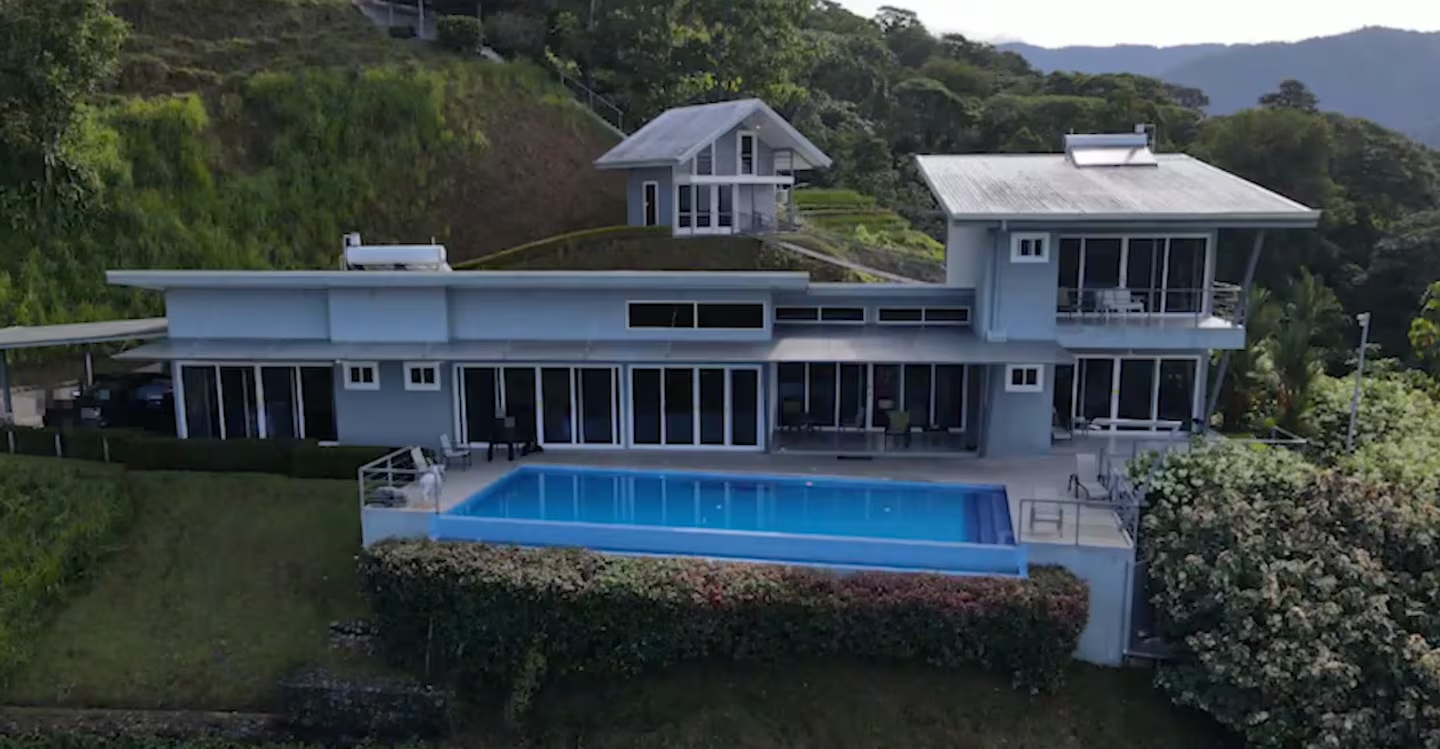
Costa Rican police seized 357 packages of cocaine and four firearms made with 3D printers from a luxury house in Uvita, a beach town on the South Pacific coast, the Ministry of Public Security reported yesterday. The ministry described it as the first seizure of 3D-printed weapons by its police forces.
Officers from the Drug Control Police (PCD) and the National Intelligence and Security Directorate (DIS) had been watching the property, a house with an infinity pool and extensive grounds in the canton of Osa. According to the PCD, a drug trafficking organization was using the home as a storage site.
The operation on Tuesday led to an exchange of gunfire between officers and suspected members of the trafficking group. Authorities reported no injuries. Police arrested two Costa Rican men, surnamed Quesada, 26, and Aguilar, 41, who allegedly guarded the property. Aguilar has prior judicial records, including entries for illegally carrying a firearm, assault and drug possession, while Quesada has none. Prior judicial records in Costa Rica do not by themselves indicate convictions.
Both men were referred to the Public Ministry and will remain in custody until a hearing on precautionary measures. Neither has been charged, and the Specialized Prosecutor’s Office for Organized Crime is directing the investigation.
Alongside the cocaine, officers found four 3D-printed assault rifles marked with the Spanish phrase “devorador de almas,” or “soul eater.” They also seized two pistols, a drum magazine, 249 rounds of 5.56 mm and 7.62 mm ammunition, satellite phones, GPS devices and 162,000 colones (about $354) in cash.
According to the Ministry of Public Security, the plastic parts of these weapons are printed from digital designs and then assembled with metal components from conventional firearms, allowing them to fire like factory-made guns. Vice Minister of Security Nelson Barquero said criminal groups are modernizing and may increasingly carry weapons made this way, and that the police will keep working to stop them.
Investigators say the main concern is tracing. Farlem Portuguez, an investigator with the Judicial Investigation Agency (OIJ), said 3D-printed guns have turned up in Costa Rica before and that they typically lack serial numbers, brand or manufacturer markings. That makes them nearly impossible to track through the country’s firearm registry, which is why investigators call them ghost guns.
The Uvita raid came a day after the Coast Guard, with support from the US Drug Enforcement Administration, recovered roughly 1,400 packages of cocaine dumped from a boat off the Osa coast, a case aided by a US surveillance plane. The ministry said the two operations together yielded 1,757 packages in less than 24 hours.
The seizures add to a sharp rise in drug interdictions this year, with cocaine seizures up nearly 50% in 2026. Authorities have not said where the Uvita shipment was headed or whether more arrests are expected.





