

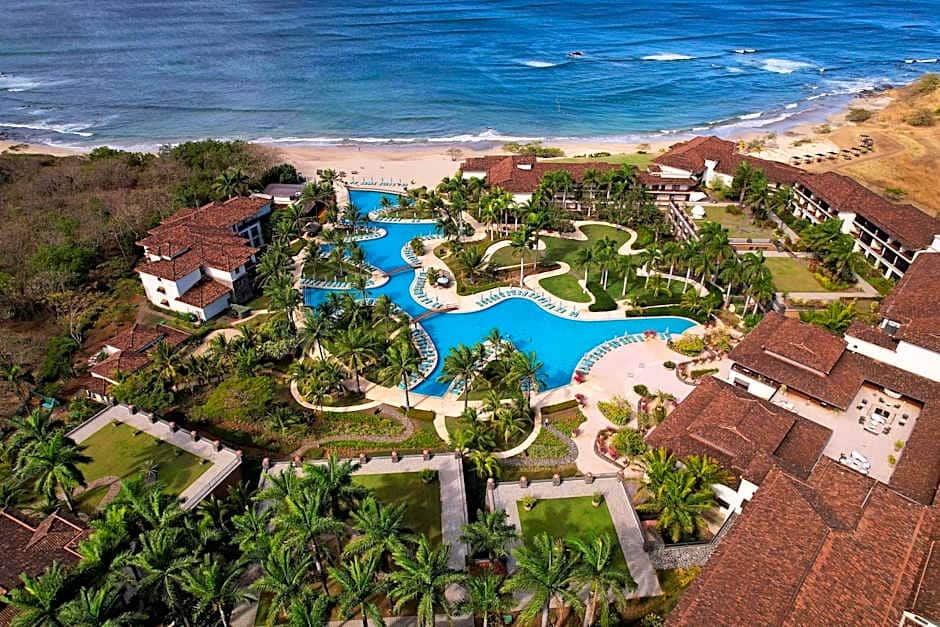
Costa Rica is now home to the world’s first all-inclusive JW Marriott. The JW Marriott Costa Elena Resort & Spa has opened at Playa El Jobo in La Cruz, Guanacaste, Marriott International announced on October 6. The opening marks the luxury brand’s entry into the all-inclusive market, and the company chose Costa Rica’s northern Pacific coast for its global debut. Advertised rates start at about $900 per person per night, based on double occupancy.
The beachfront itself is not new to resort guests. The property occupies the site of the former Dreams Las Mareas, an all-inclusive that changed hands in 2025 and was converted to the JW Marriott brand. Mullen Hospitality Management, the resort’s franchise operator, has described the project as a $60 million transformation.
The resort sits within Costa Elena, a resort-residential community that Marriott says covers about 1,200 hectares (3,000 acres) of tropical dry forest near the Nicaraguan border. The resort has 415 rooms and suites with villa-inspired designs, private terraces, and spacious interiors. Some ground-floor rooms open directly onto semi-private swim-out pools, and Presidential Suites include separate living areas.
The opening comes as Costa Rica draws growing attention from luxury travelers. Marriott recently ranked the country among the five most popular destinations for Latin American travelers looking ahead to 2027. Guanacaste’s luxury market has also expanded with properties such as Nekajui, a Ritz-Carlton Reserve, which opened on the Papagayo Peninsula in 2025.
Dining plays a central role at the property. It has 15 restaurants and bars serving Costa Rican and international cuisine, according to Marriott. Leal draws on Guanacaste’s culinary traditions and offers coffee-roasting experiences and a seven-course tasting menu inspired by Costa Rica’s seven provinces. Casado is a wood-fired coastal grill and Puerto Limón focuses on the Afro-Caribbean culinary heritage.
Other concepts include Italian, Mexican, and Japanese restaurants. There is also LaGloria, a root beer stand that honors the nine-seat Washington, D.C., business J. Willard Marriott opened in 1927, the company’s starting point. The property has its own JW Garden, which grows herbs, edible flowers, fruits, and vegetables for the kitchens and bars.
Wellness is another major focus. A wellness area of nearly 1,500 square meters (16,000 square feet) houses Spa by JW, a fitness center, and the brand’s first Mindfulness House. Treatments include hydrotherapy, sound healing, Reiki, and cacao ceremonies. Some therapies use local ingredients such as volcanic clay and native cacao.
The resort has 17 pools, including an oceanfront infinity pool. Marriott describes the complex, which covers roughly 4,090 square meters (44,000 square feet), as the largest resort pool area in Costa Rica. The resort also introduces Griffin Club, a 45-room private section for guests who want more privacy and personalized service. Members have a separate lounge, a dedicated pool, a private beach area, personal assistance, and priority reservations for restaurants and pool cabanas.
Families can use the Family by JW Club, which offers nature walks, children’s yoga, creative activities, storytelling, and movie nights. The resort’s design references Sibú, a central figure in the traditions of Costa Rica’s Bribri and Cabécar Indigenous peoples. Building materials such as wood, stone, and palm reflect traditional Costa Rican construction.
Weekly night markets bring local artisans, food, music and dance to the property. Excursions include kayaking, fishing, scuba diving, sunset hikes, and private yacht charters. The project may not be Marriott’s last on the site. When the deal was first announced in 2025, the company said JW Marriott-branded residences could follow on adjacent land. That is another sign of the large-scale luxury investment still flowing to Guanacaste’s coast.





