

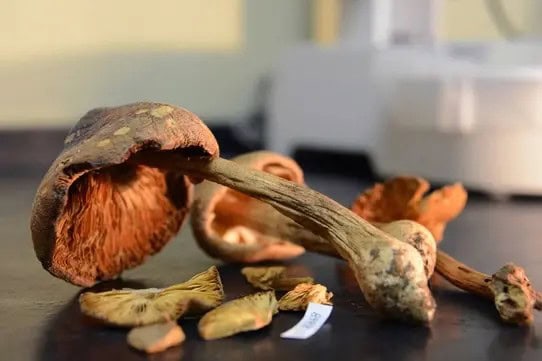
Costa Rica is known around the world for monkeys, sloths, toucans, sea turtles and an enormous variety of plants, but one of the richest forms of biodiversity we have here is much easier to overlook, growing in the soil, on fallen trees, among wet leaves and sometimes almost completely out of sight.
A major study led by researchers at the University of Costa Rica suggests the country could be home to more than 40,000 species of fungi, even though scientists have formally documented fewer than 7,000 so far, highlighting just how much remains to be discovered in a country already considered one of the world’s biodiversity hotspots.
Researchers Melissa Mardones, Julieta Carranza-Velázquez and Carlos Rojas examined 78,333 records of fungi collected in Costa Rica over roughly 170 years, using specimens stored at the University of Costa Rica, the National Herbarium and collections in other countries. Their study, published earlier this year in the scientific journal Plants, People, Planet, pulled together one of the most complete pictures yet of the country’s fungal life.
By combining those collection records with species already reported in scientific publications, the researchers raised the number of fungal species known from Costa Rica from 5,676 to 6,789, an increase of nearly 20%. The bigger finding, however, is how much may still be missing.
Scientists used several methods to estimate how many fungal species could actually exist in Costa Rica, including comparisons with the number of plants and arthropods already known and information from modern DNA-based studies. Those calculations produced estimates ranging from about 6,900 species to as many as 40,373.
That upper figure should not be confused with 40,000 species that scientists have already found and are waiting to name. Instead, it is an estimate of how large Costa Rica’s fungal population could eventually prove to be if scientists were able to search the country much more thoroughly, particularly in places where little collecting has taken place.
The existing collections make clear how incomplete that work remains. Nearly 80% of the 78,333 records had been identified only as far as their genus, meaning researchers knew the broader group the fungus belonged to but had not determined its exact species. Among the specimens identified to species level, the database contained 2,862 different species, and almost 90% of those appeared in the collections five times or fewer.
In practical terms, many Costa Rican fungi are known from only a handful of specimens collected over more than a century, making it difficult to determine whether they are genuinely rare or whether scientists simply have not spent enough time looking for them.
Where researchers have looked also makes a major difference. The southern Talamanca mountain range, the Osa Peninsula and parts of central Guanacaste are among the better-studied areas, while the Nicoya Peninsula, the Central Pacific and several forest zones along the Pacific side of the Guanacaste mountains remain poorly represented in the collections.
Those gaps mean that areas already popular with residents and tourists could contain large numbers of fungal species that have never been formally recorded, while less accessible forests may hold an even greater amount of unexplored diversity.
Costa Rica’s rainy season also appears to play an important role in when fungi become visible. Researchers found a median of 98 specimens collected per calendar day during the dry season, compared with 181 during the rainy season, when moisture creates better conditions for many fungi to produce mushrooms and other visible reproductive structures.
The researchers caution that historical collecting habits can influence those numbers, since scientists may simply have spent more time looking for fungi during wetter months, but the overall pattern remained strong enough to show a close connection between rainfall and fungal activity.
The project also tells part of the story of biological research in Costa Rica. Collections expanded slowly through much of the early 20th century, then grew dramatically between 1990 and 2015 during the years when the former National Biodiversity Institute, known as INBio, carried out extensive field work around the country. Collecting declined sharply after that period, reinforcing concerns among researchers that completing the country’s fungal inventory will require sustained funding and many more years of work.
That matters for more than simply adding new names to a list. Fungi break down dead vegetation, recycle nutrients, help trees and other plants absorb water and minerals, support healthy soils and form relationships with much of the plant life found in Costa Rica. Some species can also cause diseases in crops, while others have potential uses in medicine, agriculture and biological pest control.
Researchers say Costa Rica’s existing collections provide something else that may become increasingly valuable: a record of where fungi were found and when they appeared. By returning to the same places in future decades, scientists may be able to see whether changing temperatures, rainfall patterns, land use or other environmental pressures are altering fungal populations.
The study recommends more field work in poorly sampled regions, better identification of specimens already sitting in collections, more consistent recording of where fungi are found and the creation of a national fungal culture collection that could preserve living samples for future research.
Fungi also remain largely absent from international conservation efforts compared with mammals, birds and plants, despite their importance to forests and other ecosystems, and researchers noted that tropical fungi are particularly poorly represented in assessments such as the International Union for Conservation of Nature’s Red List.
For a country like ours that has spent decades building its international reputation around biodiversity and conservation, the findings are a reminder that much of Costa Rica’s natural wealth may still be unknown, including thousands of species that could be growing unnoticed just beneath the forest floor.





