

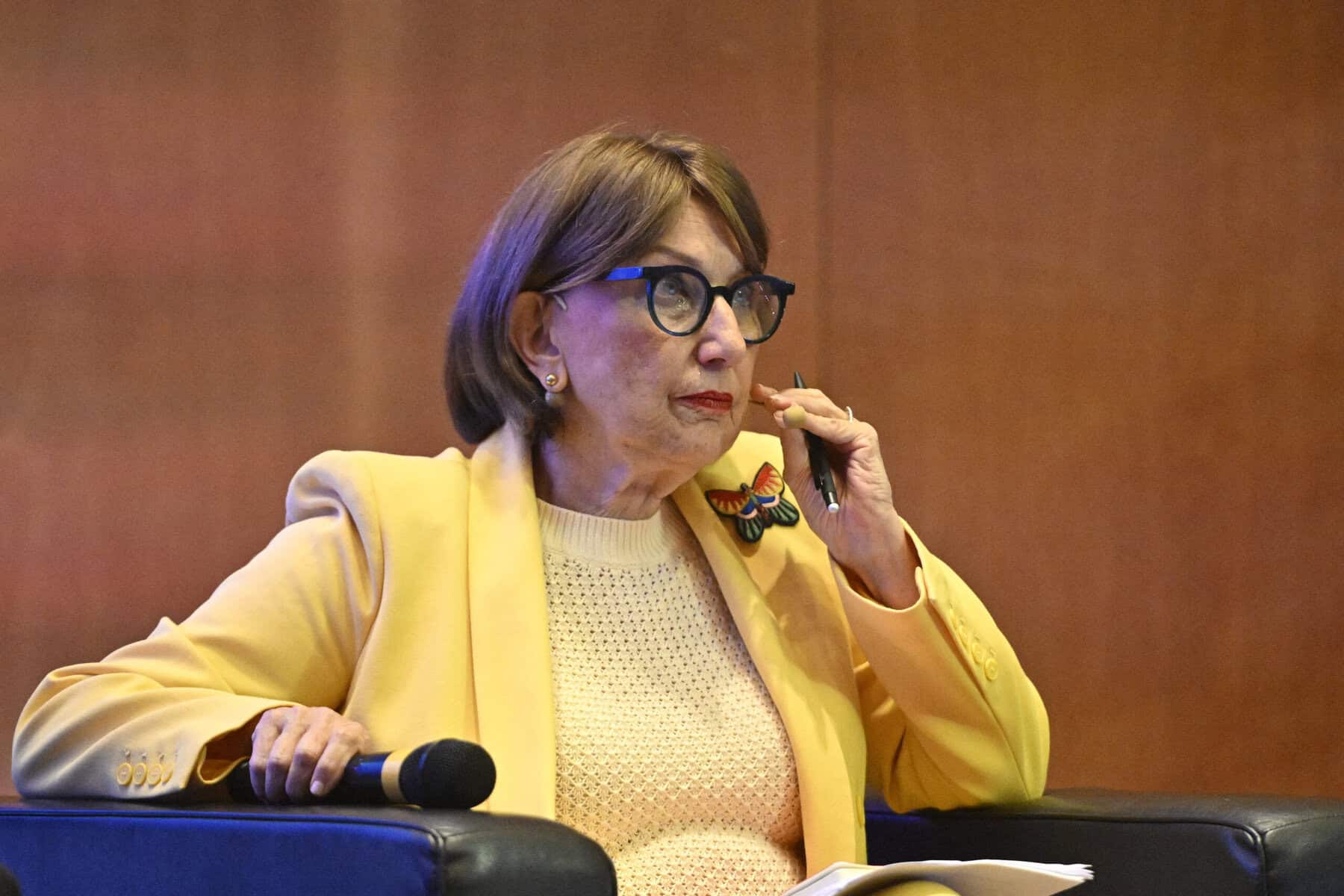
Costa Rican economist Rebeca Grynspan moved back to the front of the race to become the next secretary-general of the United Nations on Friday. She drew the most support in the Security Council’s third informal straw poll. Grynspan, who leads the UN Conference on Trade and Development (UNCTAD), received nine “encourage” votes, five “discourage” votes and one “no opinion” among the Council’s 15 members, according to diplomatic sources. The vote took place behind closed doors in New York.
Guyana’s ambassador to the UN, Carolyn Rodrigues-Birkett, finished a close second with eight encourage votes, six discourage votes and one no opinion. The two women have drawn the strongest backing across all three rounds. Friday’s result reverses the order of the Aug. 21 poll, when Rodrigues-Birkett led the field. Grynspan had topped the first round on July 30 with 10 encourage votes. That means she returns to first place with slightly less support than she started with.
Argentina’s Rafael Grossi, director general of the International Atomic Energy Agency, received five encourage votes and eight discourage votes. Grossi’s candidacy has the backing of the administration of US President Donald Trump. Senegal’s former president Macky Sall and Uganda’s Olara Otunnu also drew five encourage votes each. Sall received nine discourage votes and Otunnu seven.
Eight candidates remain in the race to succeed António Guterres, whose second five-year term ends Dec. 31. Besides the leading contenders, the field includes former Chilean president Michelle Bachelet, former Ecuadorian foreign minister María Fernanda Espinosa and former Ecuadorian minister Ivonne A-Baki.
Straw polls are non-binding. They allow Council members to signal support or resistance before the body sends a formal recommendation to the General Assembly, which makes the appointment. The Assembly has historically ratified the Council’s choice. The hardest test is still ahead. In the next round, the five permanent members, the United States, China, Russia, France and the United Kingdom, vote on differently colored ballots.
That reveals whether any of them would veto a candidate. A single veto is enough to eliminate a contender, no matter how many encourage votes they collect. To be recommended, a candidate needs at least nine votes in favor and no veto from a permanent member.
That makes discourage votes almost as important as encourage votes at this stage. Compared with the August round, Grynspan gained two votes of support but also added one more vote against her, according to diplomatic sources. The contest is also shaped by the lack of agreement between Washington and Beijing, which have not converged on a consensus candidate. No date has been set for the next round.
A decade ago, the Council formally settled on Guterres in mid-October after several rounds of voting. The next secretary-general will take office in January 2027. Costa Rica’s government has supported Grynspan’s candidacy throughout the process. After meeting with Grynspan and President Laura Fernández in August, Foreign Minister Manuel Tovar said the momentum appeared to favor her.
He added that the race was not over and that the Foreign Ministry was determined to carry the bid through its final stage. If selected, Grynspan would be the first woman to lead the United Nations since its founding in 1945, and the first Costa Rican to hold the post.





