

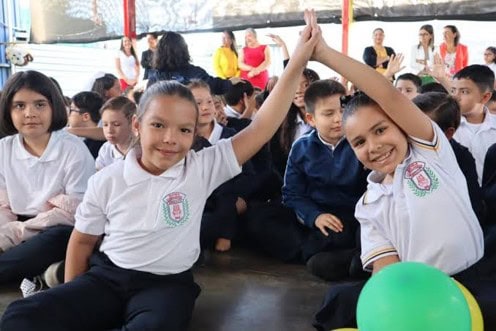
Costa Rica marked Children’s Day on Wednesday with a demographic reality that is already changing the schools and will eventually reshape its workforce: there are 180,220 fewer children ages 0 to 12 than there were a decade ago. The National Institute of Statistics and Censuses (INEC) estimates that Costa Rica has 794,618 children in that age group in 2026, down from 974,838 in 2016.
The decline amounts to about 18.5% in just 10 years. And the trend is expected to continue. By 2036, INEC projects that Costa Rica will have 607,548 children ages 0 to 12. If that estimate holds, Costa Rica would have 187,070 fewer children than today and 367,290 fewer than in 2016, a decline of nearly 38% over two decades.
The change comes as Costa Rica records one of the lowest fertility rates in Latin America. The United Nations Economic Commission for Latin America and the Caribbean estimated the fertility rate at 1.32 children per woman in 2024, only slightly above the level the organization considers “ultra-low” fertility.
The shrinking number of children, however, does not mean the challenges facing them are getting smaller. INEC data show that 21.5% of children are classified as living in poverty, while another 8.7% live in extreme poverty. The highest rates are found outside the Central Valley, particularly in the Huetar Norte, Brunca and Central Pacific regions.
Access to technology also remains uneven. Nearly two-thirds of children, 63.7%, do not have a computer, while 9.5% do not have internet access at home. Education presents another gap. About 39.5% of children between ages 2 and 6 do not attend formal education. Among children ages 7 to 12, the figure falls sharply to 0.2%.
Other indicators are more encouraging. About 96.6% of children have health insurance, while 91% live in homes with basic services. The demographic decline is already being felt in Costa Rica’s public schools. Education Minister Leonardo Sánchez said enrollment fell by roughly 35,000 students between 2025 and 2026. The drop is part of a longer decline that has pushed total enrollment from levels that once exceeded one million students to close to 900,000.
Sánchez said approximately 14 or 15 schools have closed this year and expects the trend to continue. Many of the affected schools are small, one-teacher schools in communities with very few children. Dozens of schools currently have only one student, meaning more closures could follow as those students leave the system.
Fewer students could also create an opportunity if education funding does not fall at the same pace. “If we maintain the budget, that means investment per student increases, not only overall but also in social programs and other forms of assistance we provide,” Sánchez said.
The Ministry of Public Education is also looking at how classrooms may change as technology becomes more important and student numbers decline. For Costa Rica, the consequences extend well beyond schools. Today’s smaller generation will eventually enter a labor market with fewer young workers replacing those who retire.
That will put greater importance on education, training, technology and productivity if Costa Rica wants to maintain economic growth with a workforce that expands more slowly. An aging population could also place additional pressure on Costa Rica’s pension system as the balance between workers making contributions and retirees receiving benefits changes. At the same time, demand for people who care for older adults is expected to increase.
Children’s Day, celebrated each September 9 in Costa Rica, therefore arrived this year against a very different demographic backdrop than it did a generation ago. Costa Rica is not simply facing the prospect of having fewer children. It is facing the challenge of making sure a smaller generation receives the education, technology and opportunities it will need to support an older Costa Rica in the decades ahead.





