

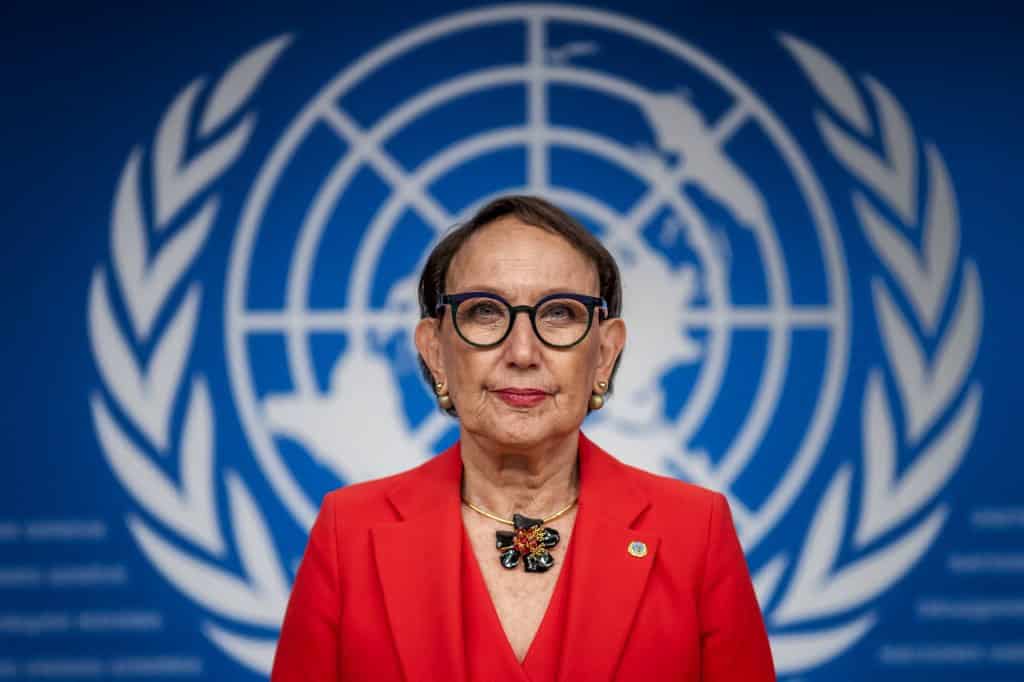
Costa Rican diplomat Rebeca Grynspan emerged as the early frontrunner to become the next leader of the United Nations after receiving the strongest support in the first informal vote by the U.N. Security Council today. Grynspan received 10 “encourage” votes, one “discourage” vote and four votes expressing no opinion from the council’s 15 members.
The secret, nonbinding vote was the opening round in what is expected to be a months-long process to choose a successor to Secretary-General António Guterres. Former Guyanese Foreign Minister Carolyn Rodrigues-Birkett finished second with nine encouraging votes, while Rafael Grossi of Argentina, who heads the International Atomic Energy Agency, received seven.
The result places Grynspan in a strong early position, but it does not guarantee that she will advance to the final stage. The first rounds do not reveal whether opposition comes from China, France, Russia, the United Kingdom or the United States, the five permanent Security Council members with veto power.
A single veto from one of those countries could eventually block her candidacy. Later votes will use different-colored ballots to show whether discouraging votes come from permanent or elected members of the Security Council. Several rounds are expected before the council reaches an agreement, possibly in September or October.
The Security Council must ultimately recommend one candidate with at least nine votes in favor and no veto from a permanent member. The recommendation then goes to the 193-member U.N. General Assembly, which traditionally confirms the council’s choice. Other candidates include former Chilean President Michelle Bachelet, former Ecuadorian Foreign Minister María Fernanda Espinosa, former Senegalese President Macky Sall and Ugandan diplomat Olara Otunnu.
Bachelet and Sall each received six encouraging votes, while Espinosa received five and Otunnu received two. Diplomats familiar with the results said the first round showed no clear consensus despite Grynspan’s lead. The three candidates receiving the most support all come from Latin America and the Caribbean. The United Nations follows an informal system of regional rotation, and many diplomats expect the next secretary-general to come from the region.
There is also growing pressure for the United Nations to appoint a woman for the first time. Every secretary-general since the organization was founded in 1945 has been a man. Grynspan, 70, served as Costa Rica’s vice president from 1994 to 1998 during the administration of José María Figueres Olsen. She has also held senior positions with the United Nations Development Programme and the Ibero-American General Secretariat.
Since 2021, she has served as secretary-general of U.N. Trade and Development, known as UNCTAD. She took temporary unpaid leave from the position to concentrate on her campaign for the U.N.’s top job. Costa Rica officially submitted her candidacy on March 3, presenting her international experience, economic background and support for multilateral cooperation as central qualifications.
During her campaign, Grynspan has argued that the United Nations must become more effective, rebuild international trust and place greater emphasis on diplomacy and conflict mediation. She has also acknowledged that the organization faces severe financial pressure and will need to reduce duplication and set clearer priorities.
The next secretary-general will inherit an institution facing wars in several regions, growing tension among major powers and criticism over its ability to respond effectively to global crises. Funding shortages and unpaid contributions from member countries have also increased pressure for internal reform.
Guterres, a former Portuguese prime minister, will leave office on December 31 after serving two five-year terms. His successor is expected to begin a five-year term on January 1, 2027. Thursday’s result gives Grynspan important momentum and places a Costa Rican at the front of a major international contest. The more difficult test will come in later rounds, when the positions of the five veto-holding countries become clearer.





