
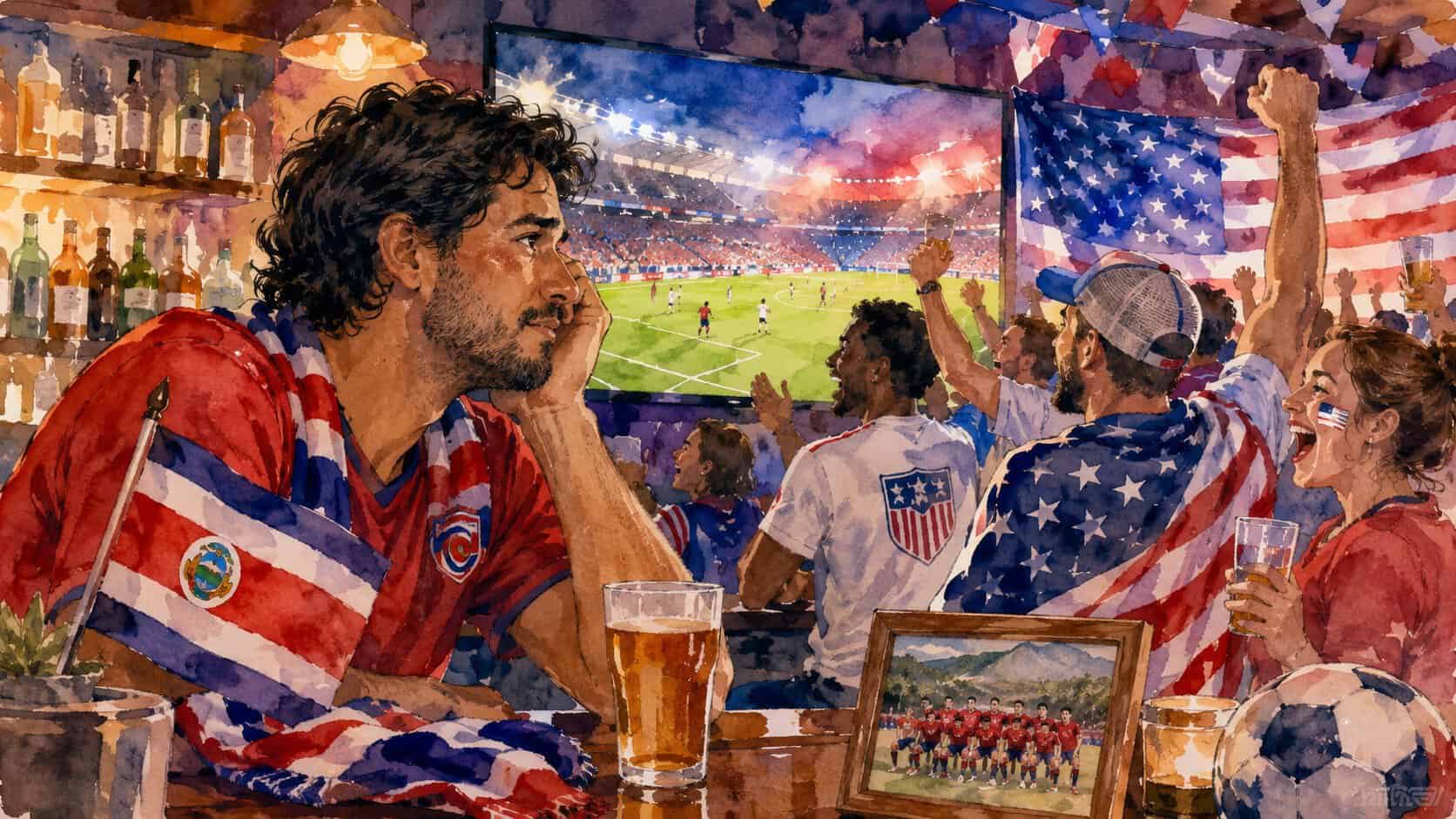
It is still hard to believe that, even with the gift of an expanded 48-team field, I am watching only the second World Cup since 1998 without the presence of La Sele, the Costa Rica national team. In a year when Costa Rica did not have to play Mexico, the U.S. or Canada, they still managed to finish behind a Haiti team that had to play its home games in Aruba because of the anarchic state of its country.
I have watched all of the games so far from here in the U.S., and I am impressed with the passion and enthusiasm from fans everywhere. When the U.S. first hosted the Cup 32 years ago, most of my stateside friends followed it in passing. When Team USA was knocked out in the round of 16 by Brazil, many lost interest.
Fast forward to 2026 and the whole country, it seems, is locked in. Take my younger brother. Never a follower until now, he cheered wildly along with everyone else in the packed North Carolina sports bar where we met to watch the U.S. beat Australia. It is fun to see Tico-style passion for fútbol among Gringos, but I have to admit, I am a bit jealous.
Everything I know about soccer, from strategy to history to simply how to watch a game, I learned in Costa Rica. I root for La Sele, even when they play the U.S. And now here I am in the States, with my brother, reduced to talking about the amazing run Costa Rica made in the 2014 World Cup.
My brother listens with flagging interest as I go on and on about Keylor Navas’ cat-like reflexes, the tight, disciplined defense, Bryan Ruiz’s header to beat Italy, and the penalty shootout against Greece that got La Sele into the final eight. I trash the teams from our region that qualify and then lose out in the first round. I am talking about you, Panama. And you, Haiti.
Costa Rica has seven wins all time in the World Cup, behind only the U.S. and Mexico in the Concacaf region. The rest of Central America has zero. But the year is 2026, and Costa Rica’s past glories do not matter. Team USA is led by an Argentinian coach, has a melting pot of a roster, and its best offensive players have the last names Balogun and Pulisic.
They are an easy team to support and cheer for, and truly a classic American underdog team. The upcoming knockout round game against Bosnia and Herzegovina should draw some of the highest ratings ever for soccer in the U.S. This World Cup will also be remembered as the first with mandatory hydration breaks. These essentially make it a four-quarter game, with a three-minute break about 22 minutes into each half.
You can make an argument for this in games played in the afternoon summer heat, but are they really necessary for a night game in Vancouver? And let’s be honest, FIFA can talk all it wants about player safety, but in reality, three minutes of down time means three minutes advertisers will pay for.
And in the nobody asked me, but I will give my opinion anyway department, soccer should change the dumbest scoring rule in any sport: the own goal, or autogol. No other sport does this. In basketball, if a defensive player accidentally tips the ball into his own basket, either the shooter or the closest offensive player is credited. Same goes with hockey, lacrosse and any other sport where goals are scored.
Only soccer insists on embarrassing the defender who accidentally kicked it into his own goal. He gets an OG by his name and a goal credit for the opposition. Many own goals are the result of a powerfully kicked ball into the goal mouth that none of the defenders can contain. It is ridiculous to discredit the last defender to touch the ball and not credit the player who kicked a solid one-pound ball toward the goal at a speed of 90 mph.
Own goals aside, the first round has been great, with the stars, Messi, Haaland, Mbappé, Vini Jr. and Cristiano Ronaldo, all scoring multiple highlight-reel goals. The usual favorites will be challenged in the knockout rounds. While the betting favorites are as expected, Argentina, France, Brazil, Germany and England, keep an eye on these two sleepers: Morocco and Japan.
When you read this, I will be back in Costa Rica, cheering for the U.S., my second favorite team.
Read more of Don Mateo’s writing from his newly published ebook.