Where do I put my next camera trap? If you see me out somewhere and I have a kind of faraway look in my eye, I’ve likely zoned out of whatever is happening in front of me and I’m thinking about a good place to put a camera trap. I’m sure I’ve covered these before in previous articles, but my tried-and-true locations are sources of water, sources of food, and trails.
By far the most common location I choose for a camera is alongside a human or wildlife trail. The forest is full of brush and tangled vines and just about every other plant is either laden with spikes or teeming with some sort of insect that will sting or bite you if disturbed. For that reason, many creatures will choose to walk on a path if it’s available. It’s just easier.
Recently, I put two cameras in two different locations that are sort of like paths but with a little something extra. The first location was sort of like a path, but it was a tree branch. It was a nice big, horizontal branch with connections to other giant trees, and it looked like a place I’d walk if I was an arboreal animal. Think of it as an above ground path. The second location was a tree that had fallen over a small body of water, making itself into a natural bridge. A path above water.
After a few months of monitoring with these cameras, much of what I recorded was exactly what I thought I was going to record, a bunch of species walking on the path. It just so happened that both locations also offered something I wasn’t expecting, a great place to take a nap.
Ocelot Tree
The big branch where I decided to place my camera was in a tempisque tree, appropriately enough, located along the Tempisque River. For the first four months I had the camera in the tree, it had done an OK job. I recorded a million variegated squirrels and fat little birds, but none of the monkeys or kinkajous that I was really hoping for.
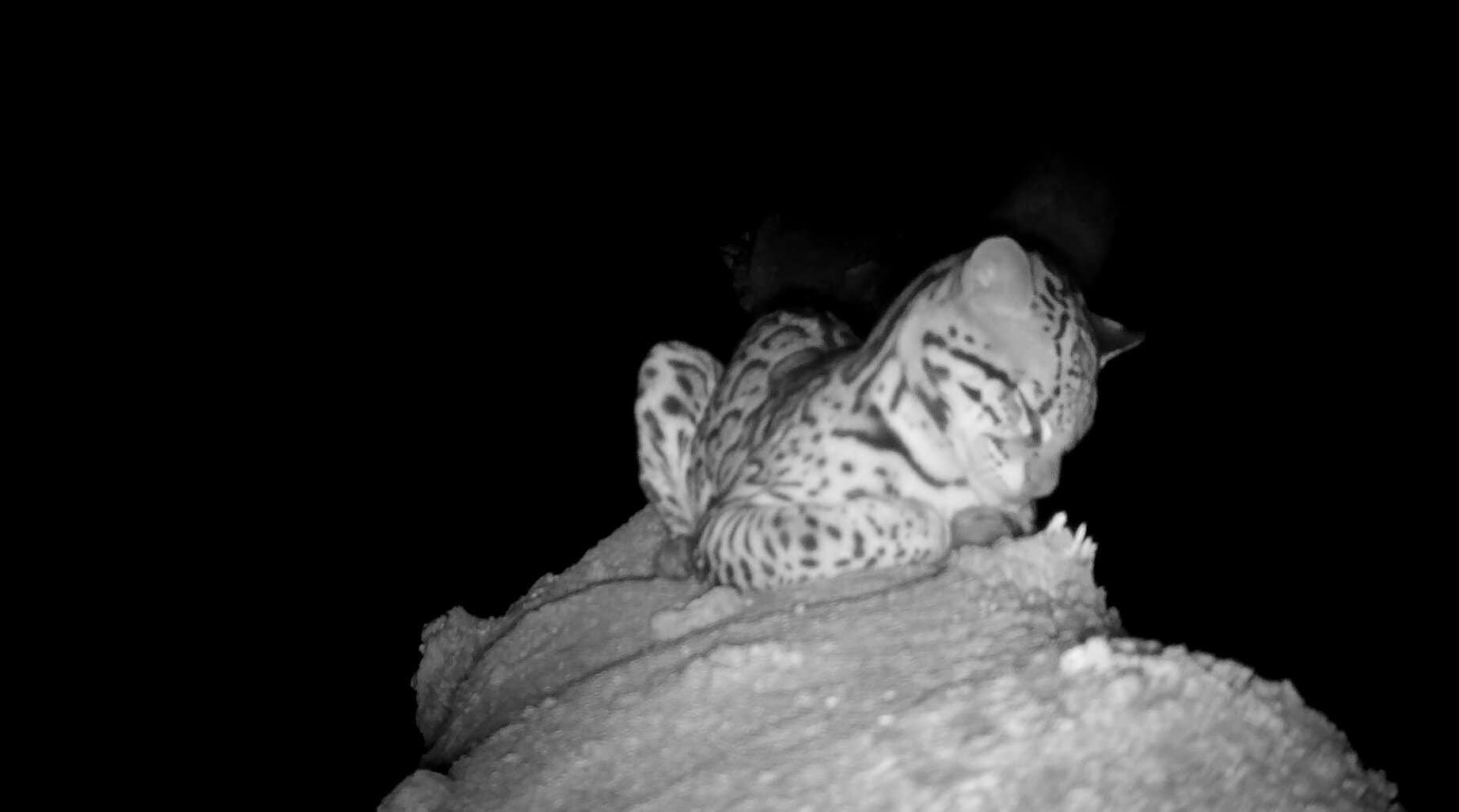
When I climbed the tree in February, I had already decided to take the camera down and find a new location on the property somewhere. As I sat on the big branch with my feet dangling on either side reviewing the previous month’s videos, I came upon a series of videos that told me I wasn’t going to move the camera. A young male ocelot had decided to take a three-hour nap directly in front of the camera. I hadn’t noticed when I placed the camera, but there was an ocelot-sized groove about a foot and half in front of the camera, and he decided it was a great place for a snooze.
Of course, I had to know if this was going to be a repeated behavior, so I left the camera in its place. Ever since then I’ve been treated to way too many adorable ocelot sleeping videos. He comes back for a nap a few times a month. The camera is still there and I’m positive I’ll see him snoozing again the next time I visit. Take a look at a few of the clips in the video below.
Crocodile Log
The story of the camera on the log path was extremely similar. I started out recording many species walking across the log, especially waterbirds, and then around two months in I started recording a big old crocodile napping on the log. As if that wasn’t good enough, with time, I recorded two bonuses. The first was an epic crocodile dismount.
A few of the videos showed the croc lying on the log and then deciding to re-enter the water by diving off with a big splash. The second was that every so often, the big crocodile was joined by a pile of small crocodiles. I’m no crocodile expert, by I’m assuming these tiny crocodiles are related to the giant one or they’d likely be a nice snack. Take a look at some clips of the crocodile log in the video below.
About the Author
Vincent Losasso, founder of Guanacaste Wildlife Monitoring, is a biologist who works with camera traps throughout Costa Rica.