

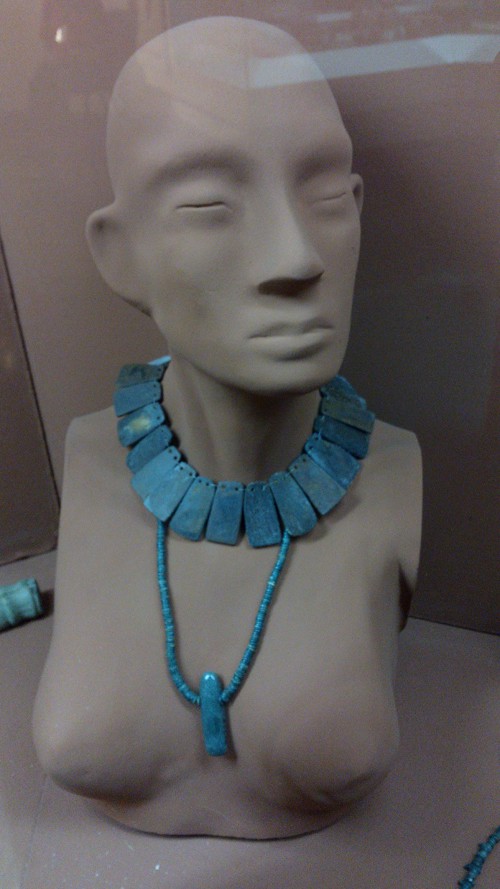
In my last column on Costa Rica’s extraordinary and prolific jade carving tradition, always involving high status and religious symbolism, we saw that significant lapidary work in jade or similar stones began in Mesoamerica to the north at least 500 years before its florescence in Costa Rica, which began approximately 500 B.C. and lasted for some 1,000 years (TT, Sept. 25, 2009).
The first gold pendants seem to have appeared about A.D. 400 to 500, and were imports from Colombia through a Caribbean route. Over two to three centuries, A.D. 400 to 700, jade and gold pendants coexisted, and have been found together in a limited number of tombs by archaeologists.
But what this meant, in cultural evolutionary terms, was profound and far-reaching, resulting not only in changing house and tomb forms, ceramics and stone sculpture – those things we can observe today – but also undoubtedly in population shifts and changes in religious belief systems, things modern archaeologists can only infer.
What Changed?
The inherent physical differences in carved jade – usually more three-dimensional and more stylized, given the difficulty in carving this fibrous, hard stone – and gold pendants, made with a totally different casting technique and always emphasizing the flat, shiny, reflective qualities of the metal, is profound. One of the most extraordinary aspects of Costa Rican archaeology is that the two disparate techniques coexisted over two or three centuries. What makes this remarkable is that the two religious, ritual symbolic contexts of the two very different media were also nothing alike.
It is very likely that the symbolism of jade or similar stone pendants was water (and water-dwelling animals), fertility, seed (the Maya glyph for seed is almost identical to that for jade) and young, green maize plants, as put forth clearly in Mesoamerican indigenous texts and early Spanish chronicles.
There is no reason to believe it was much different in Costa Rica. In other words, from its inception, jade carving was intrinsically linked to agriculture, which in turn allowed the gradual development of complex societies.
The striking difference between jade carving in Mesoamerica and Costa Rica was that the former began as early as 1000 B.C. and persisted in importance until the Spanish arrival in the early 1500s. In Costa Rica, on the other hand, jade working seems to have begun as early as 500 B.C. (inspired by Mesoamerican trade), and jade dominated as the most sacred, valued material for about 1,000 years – until metallurgy, diffusing northward from Colombia, began to become more important to ancient Costa Ricans.
Gold (actually, almost always an alloy of gold and copper) was flashy, reflective and, in the most complex pendants with danglers, tinkling as well. Its basic symbolism was celestial, solar (the hammered gold disks) and very frequently associated with avian motifs.
In fact, the flared tail feathers stylized on so many Costa Rican gold pendants became in themselves a symbol for gold, painted on northwest Costa Rican polychrome pottery and elsewhere in Central America. During these few centuries of overlap between jade and gold, the same motifs were sometimes portrayed in both media, the best example being the so-called curly-tailed animals, probably depicting the coati in most cases, although avian and fantastic mythical combinations of different animal traits are also seen.
Once the metallurgical technology had diffused to Costa Rica from Colombia, the lost wax process was the basic technique utilized. A beeswax model was made, often of very complex pendants, and then coated with soft clay, leaving drainage holes filled by small sticks. Upon firing, the clay turned hard, the wax melted away through the holes, which were then again plugged, and the molten metal was poured into the empty mold.
Luckily for archaeologists, a group of students led by Dr. Frederick Lange discovered one-half of an actual fired clay mold, which even incorporated the splayed feet of a frog effigy, so we know that broad, thin areas of gold pendants were cast as a whole, not hammered separately.
Further, it is not generally known that the melting temperature of a gold-copper alloy is actually lower than that for either metal separately. This meant a facilitation of casting technology and, importantly, a savings in pure gold, which, in Costa Rica, is found as placer deposits, tiny nuggets washed into streambeds.
What Else Happened?
The drastic differences in jade and gold-working technology are fascinating in themselves over the A.D. 400 to 700 centuries in Costa Rica, but the shift was accompanied by other changes that signified a major cultural watershed. Rectangular houses gradually became circular (house forms in ancient cultures worldwide had great symbolic significance). Corridor-shaped tombs became stone box tombs with floors and lids.
Ceramic styles altered in a major way, including resist or negative painting, in which a fatty substance is used to paint designs on an already fired red or brown slip, then burns away in a second smoky firing, leaving negative, darker smoked designs, not unlike the batik technique in cloth.
And village settlement patterns started to nucleate and draw in on themselves, likely for defensive purposes. This was the period in which human sacrifice, shrunken trophy heads and other bellicose imagery came to the fore. Realistic human stone sculpture, and even ceramic portrait heads of real people, appeared for the first time.
Archaeologists still do not know if this meant great population shifts or intrusions, but the style of culture changed markedly in a relatively short time span. Seemingly, a rather long and peaceful period of cultural evolution was truncated and forever changed for the remainder of Costa Rican prehistory.
A graduate of Yale and Columbia universities, Michael Snarskis, Ph.D., has worked in Costa Rica for more than 30 years.





