

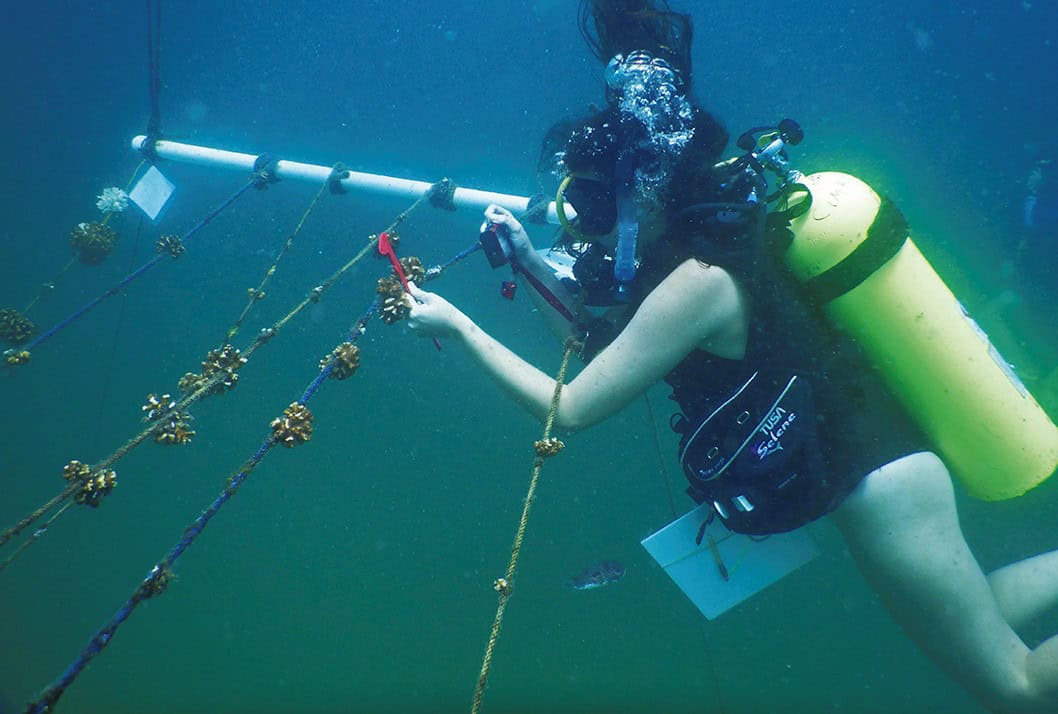
Costa Rica is expanding the use of coral gardening as part of a growing effort to restore damaged marine ecosystems along the country’s coast.The technique works like an underwater nursery. Small coral fragments are collected, placed on submerged structures, allowed to grow in controlled conditions, and later attached to degraded reef areas.
The process gives corals a better chance of survival and allows them to grow much faster than they would on the seafloor.The current wave of coral gardening in Costa Rica began with a pilot project in Golfo Dulce in 2013. Thirteen years later, the method has helped cultivate thousands of corals along the Pacific coast, with one of the clearest examples now underway at Isla Tortuga in the Gulf of Nicoya.
“We place the coral fragments in a nursery, like a hatchery, which is why we collaborate with agronomists. This gives them time to grow in a more controlled environment. If these fragments remain on the seafloor, they die,” marine biologist Carlos Pérez Reyes explained. “They’re like guests at a five-star hotel and grow up to four times faster,” he said.
At Isla Tortuga, the project has become a visible model for coral restoration tied to research, diving, tourism and local environmental work. The goal for this year is to reach 3,000 cultivated corals, a milestone the team hopes to achieve on June 6. The initiative began in 2024 and has already cultivated more than 2,700 corals on 58 underwater structures. Those structures include antenna, spider, clothesline and tunnel designs, each built to hold coral fragments in the water column while they grow.
The project is backed by a partnership between the National Distance Learning University, the National Learning Institute and Bay Island Cruises. For every tourist who takes one of the company’s tours, one dollar is donated to help fund the coral gardening work around Isla Tortuga, which receives up to 100,000 visitors a year.
The process begins with coral fragments that have naturally broken off and would likely be lost on the seafloor. Divers collect those pieces and place them on suspended structures where they receive better light and protection from predators. Once the corals reach the right size, they are permanently attached to damaged reef areas, where they can help rebuild habitat for fish and other marine species.
For Costa Rica, the effort matters well beyond Isla Tortuga. Coral reefs cover only a small part of the ocean, but they support a large share of marine life. They also help protect coastlines and sustain tourism, fishing and coastal livelihoods. Local researchers say the work at Isla Tortuga shows how restoration can connect science with tourism. Visitors are not only helping finance the project through tour contributions but are also seeing how reef restoration is carried out in the water.
The Isla Tortuga project has moved quickly. In July 2024, UNED reported 490 corals planted in the first stage of the effort. By June 2025, the program had passed 2,000 corals, with 43 nursery structures installed and a reported success rate above 90%. Now, the project is approaching 3,000 cultivated corals.
Costa Rica has also taken steps to regulate and guide this type of work. A national protocol for coral reef and coral community restoration was created to help standardize how coral gardening projects are planned, permitted and monitored. The challenge remains large. Coral reefs in Costa Rica face pressure from pollution, sedimentation, warming waters and human activity. Restoration does not solve those problems by itself, but it gives damaged reef systems a chance to recover where conditions still allow coral to grow.
At Isla Tortuga, the work is showing measurable progress. Thousands of corals are now growing in underwater nurseries, with the next major milestone expected this week.





