
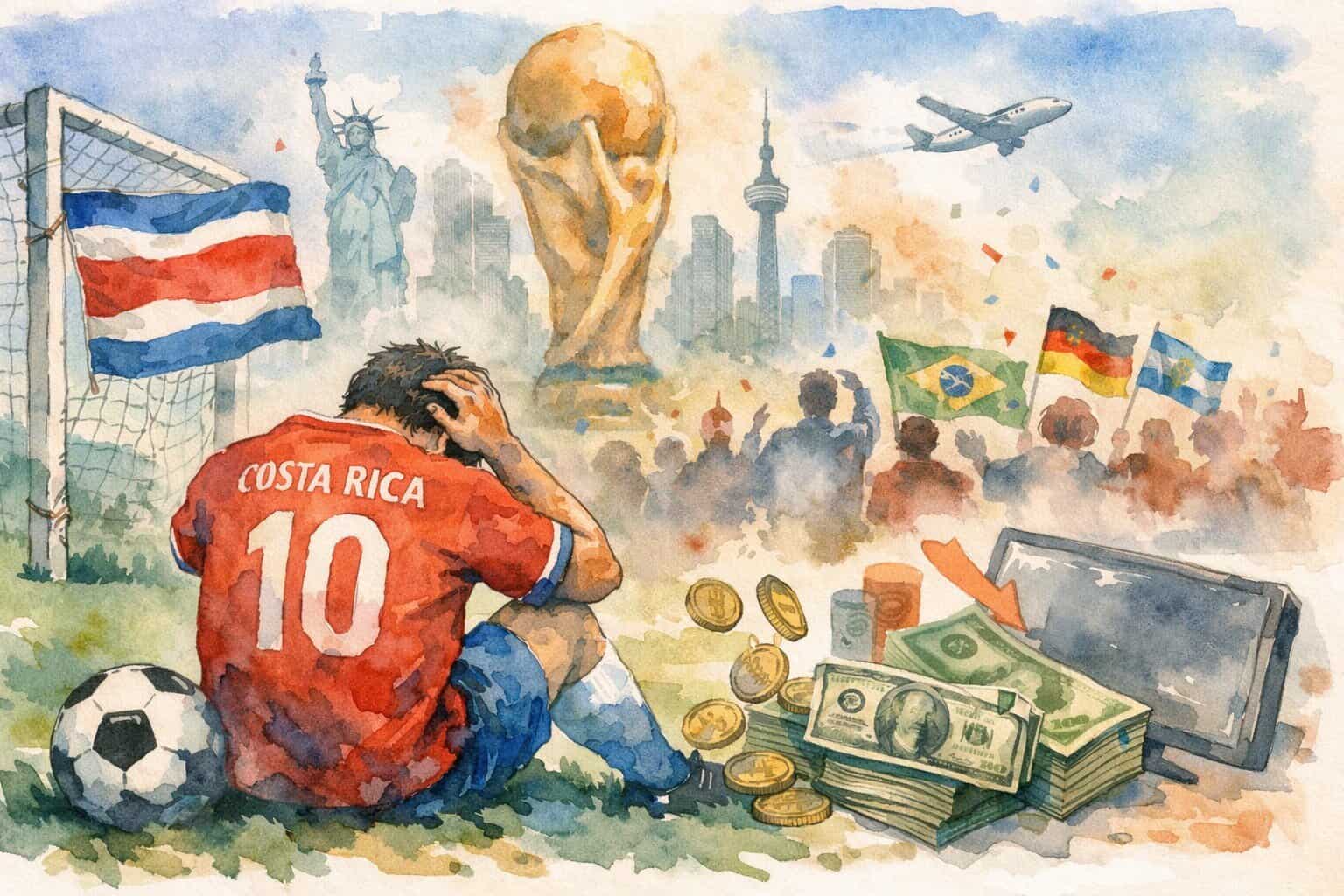
The Men’s Soccer World Cup is coming up in June. For only the second time in the 21st century, Costa Rica will not be represented. For fans of La Sele, it is hard to fathom. Qualification seemed a given. Previous National Teams had gone head-to-head with Mexico, Team USA and Canada and earned their way to the ultimate fiesta de futbol, held every four years.
This year, with the three aforementioned countries serving as tri-hosts, and three more spots available thanks to the cup expanding from 32 to 48 teams, Ticos throughout the region looked forward to the possibility of a quick flight north to catch La Sele in person.
Alas, it was not to be. All Costa Rica had to do was win a mini-league that also consisted of Nicaragua, Honduras and Haiti. Six games, three in San Jose, over opponents that the Ticos had routinely dispatched in the past. Game one should have been an indicator that this group was not going to be the expected cakewalk. Nicaragua, better known for baseball than soccer, managed a 1-1 draw, scoring the tying goal late while a man short due to a red card.
Game two was worse, blowing a two goal lead at home to Haiti in the second half, then needing a goal in extra time to stagger in with a 3-all draw. La Sele dug itself into too big of a hole, and the group was won by Haiti, a country in such a dysfunctional state that it was unable to host any games, instead playing its designated home games at a stadium in Willensted, Curacao. The other two spots were captured by Panama, who in recent years has dominated Costa Rica in head-to-head matches, and Curacao, total population 156,000, and likely the only place to have two different World Cup teams use their stadium as a home venue.
How could this have happened? A decade earlier, Costa Rica stunned the world by making it to the final eight, defeating Uruguay, Italy and Greece, before losing to The Netherlands on penalty kicks. Coached by Jorge Luis Pinto, a Colombian, it was easily the most ordered and disciplined Tico team ever fielded. Allowing only two goals in five regulation games against top 20 teams, it seemed a new chapter of football was being written to the delight of fans.
But hold on– following the World Cup many players decried Pinto’s coaching methods as too harsh and he was soon relieved of duty, despite his amazing success. Since then there has been a revolving door of coaches, and the past two World Cups saw Costa Rica with 3 losses, 2 draws, and a 1-0 upset of Japan. They allowed a dreadful 16 goals in those six games, while netting just five.
The final coach was the Mexican Miguel Herrera, well past his prime, who once sucker punched a Spanish language sports journalist while waiting in line to board a plane at Philadelphia International Airport. The journalist had written something he didn’t like. After his dismal performance this past year, the line of sportswriters he would like to punch for criticizing him would likely stretch from Monterrey to Chiapas.
It is not just the fans who suffer. Failing to qualify for the 2026 World Cup represents a heavy economic blow for Costa Rica. The total loss is estimated at over $100 million. This includes direct FIFA prize money, broadcasting rights, marketing revenue, as well as reduced sales of appliances (televisions), food, beverages, and sporting goods. And though our tourism industry remains strong, the absence of free international exposure for Costa Rica is an intangible added to the red ink in the ledger.
I doubt I am the only fan that would love to see a Pinto-like coach return, players’ sensitive feelings be damned. For now, there will still be thousands of screens streaming the games locally, and teams such as Brazil, Argentina and Germany will be closely followed in lieu of La Sele. As soccer is the closest thing to a sport-religion we have, the party will go on. Like a wallflower at a party, we will watch others dance for a month, lamenting our missed opportunity.
Read more of Don Mateo’s writing at donmateoinparadise.com