
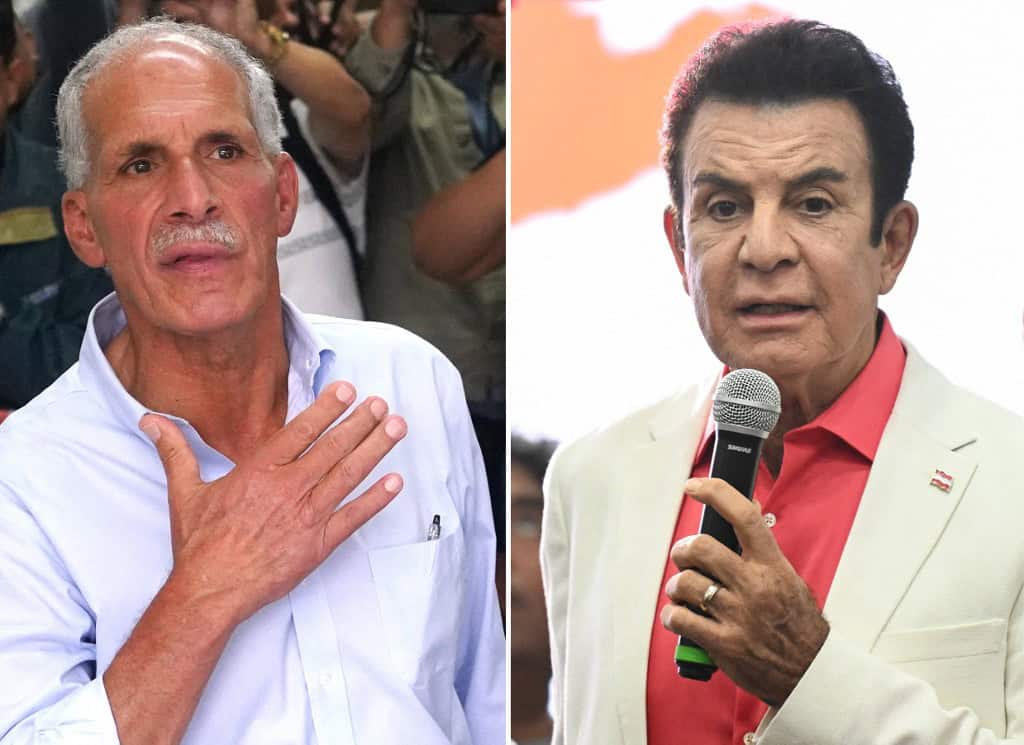
US President Donald Trump warned Monday of “serious consequences” if a supposed attempt to “change” the results of Honduras’s presidential election is confirmed, as a technical tie persists between right-wing candidates Nasry Asfura, whom he backs, and Salvador Nasralla.
Trump has taken an active role in the vote held Sunday, threatening to cut cooperation with the impoverished Central American country if Asfura, a 67-year-old businessman from the National Party (PN), does not win. “It looks like Honduras is trying to change the results of its presidential election. If they do, there will be serious consequences!” he warned on his Truth Social platform.
The president labeled Nasralla, a 72-year-old television host and candidate for the Liberal Party, “almost a communist” for having held a senior position in the government of leftist President Xiomara Castro, with whom he later broke. Nasralla blamed Trump’s remarks on “malicious disinformation” by his rivals. Asfura, for his part, said he was ready to work with the United States, home to two million Hondurans and the country’s main trading partner.
Trump called on the National Electoral Council (CNE) to conclude the vote count, which currently shows Asfura ahead by just 515 votes after the digital tally of 57% of the tally sheets. Earlier, the CNE said it had begun the manual count, without specifying when it would be completed and asking for “patience.”
“The numbers will speak for themselves,” Asfura said Monday, while Nasralla declared that he could only lose if they “cheat” him.
Pardon for a drug kingpin
The election amounted to a punishment for the left led by Castro, who governs one of Latin America’s most violent countries, plagued by drug trafficking and corruption. Her candidate, Rixi Moncada — whom Trump accused of being an ally of Venezuelan President Nicolás Maduro and his “narco-terrorists” — finished more than 20 percentage points behind.
Trump’s support for the former mayor of Tegucigalpa “was understood by the people as a form of coercion,” Moncada said Monday. Castro came to power in 2021, more than a decade after the coup d’état against her husband, Manuel Zelaya, following his rapprochement with Venezuela and Cuba, which triggered an unprecedented left-right polarization.
Asfura and Nasralla built their campaigns on the claim that keeping the left in power would turn Honduras into a new Venezuela, mired in a deep crisis, and they signaled their willingness to move closer to Taiwan at the expense of ties with China.
Trump’s intervention went even further when he announced he would pardon former Honduran president Juan Orlando Hernández, sentenced in the United States to 45 years in prison for shipping hundreds of tons of drugs in alliance with Mexican kingpin Joaquín “El Chapo” Guzmán.
According to US justice, Hernández, who governed from 2014 to 2022 with Asfura’s party, turned Honduras into a “narco-state,” but Trump argues he was the victim of a “set-up” by his predecessor, Joe Biden. The announced pardon runs counter to Trump’s deadly anti-drug offensive in the Caribbean, part of his pressure campaign against Maduro, an ally of Xiomara Castro.
The pardon for this “drug kingpin” was “processed” by local elites, denounced the leftist candidate, a 60-year-old lawyer.
No clear forecast
Asfura, known as “Tito” or “Papi,” has 39.91% of the vote compared to 39.89% for Nasralla, who admires the presidents of Argentina and El Salvador, Javier Milei and Nayib Bukele. “It is impossible to determine the winner with the data we have,” said political analyst Carlos Cálix.
Asfura is seeking the presidency for the second time, after losing in 2021 to Castro, while Nasralla is running for the third time. In a country where 60% of its 11 million inhabitants live in poverty and that has a long history of electoral fraud and unfulfilled social promises, politicians are widely discredited.
“They don’t do anything for the poor, the rich get richer every day and the poor poorer, only thieves govern us,” said Henry Hernández, a 53-year-old car guard, on Monday. Michelle Pineda, a 38-year-old shopkeeper, hopes that whoever wins this close race will see the country as “more than just a bag of money to loot.”
Nearly 6.5 million Hondurans were called to elect Castro’s successor, as well as deputies and mayors for four-year terms. After a campaign marked by early fraud accusations, election day unfolded calmly, according to the OAS observer mission.