
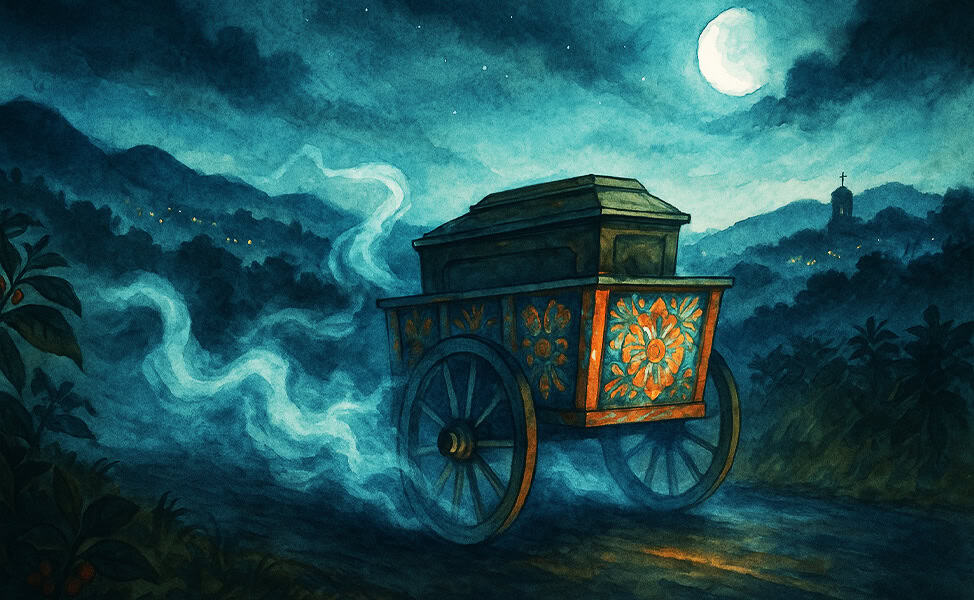
As October draws to a close, Costa Ricans prepare for Halloween with a mix of modern festivities and age-old tales that echo through rural communities. While carved pumpkins and costumes have gained popularity in urban areas, the holiday often revives local folklore, including ghost stories passed down for generations. One such narrative, the legend of La Carreta Sin Bueyes – the Cart Without Oxen – stands out as a distinctly Tico spooky story, tied to the nation’s history and symbols.
This tale centers on a ghostly ox cart that roams country roads in the dead of night, its wooden wheels creaking with a rhythmic traca, taca, tarata. No oxen pull it, no driver guides it, and no hooves pound the ground. Instead, it carries a faded casket holding a condemned soul, a punishment for greed and theft centuries ago.
The story traces back to the early 1700s, when San José was a fledgling village in a rugged wilderness. Residents sought to build a church, the heart of any community at the time, and turned to the wooded hills of Cuesta de Moras – now the site of the National Museum – for timber. They felled trees during the waning moon to avoid sap flow, leaving the logs overnight.
A man from nearby Escazú, known for his laziness and dishonesty, saw his chance. He stole the wood under cover of darkness and used it to construct a house, a stable, a mill, a bench, and a new ox cart. But the theft did not go unnoticed. San José’s patron saint, St. Joseph – a former carpenter with divine oversight – intervened. The thief fell ill, died, and faced eternal judgment: to wander forever in his stolen cart, now self-propelled and silent except for its eerie rumble.
Freed from blame, the oxen vanished from the curse, leaving the cart to travel alone. Sightings, or rather hearings, persist in places like Atenas northwest of San José, Escazú to the southwest, and smaller towns across the countryside. Farmers with pickup trucks no longer haul loads at dawn, yet the sound echoes on asphalt roads, a reminder of past misdeeds.
Costa Ricans share this legend during Halloween gatherings, where it fits alongside other spectral figures like La Llorona, the weeping woman, or La Segua, the seductive beast. Though Halloween arrived via U.S. influence, it blends with traditions rooted in colonial times and indigenous beliefs. In rural areas, where nights fall quiet and dark, families recount these stories to explain unexplained noises or teach moral lessons about honesty and respect for community efforts.
Variations of the tale appear in different regions. In some accounts, the thief promised wood for the church but failed to deliver. Others link it to a witch in old San José who enchanted the cart. Despite differences, the core remains: a symbol of justice from beyond, embodied in the ox cart, Costa Rica’s national emblem representing hard work and rural life.
Today, the legend lives on in festivals, podcasts, and online discussions, especially around October 31. It appears in cultural events reviving folklore, from school parades to community storytelling sessions. As Costa Rica modernizes, these narratives preserve a connection to the past, turning Halloween into more than costumes and candy – a time to honor the spirits that shaped the land.
In our country where faith and folklore intertwine, La Carreta Sin Bueyes serves as a cautionary echo. Next time a strange rumble breaks the night silence, locals know: the phantom cart passes by, its journey unending.