
There are at least 141 different species of snakes in Costa Rica. With that large number of species packed into such a tiny nation, one would think that you’d be tripping on serpents every time you stepped out of your front door. Unfortunately for us snake-lovers, that’s not the case. The preferred habitat of many of these species does not include our porches and most do what they can to avoid contact with humans. That being the case, it took me several years to finally run into one of Costa Rica’s most iconic reptiles, the eyelash palm-pitviper.
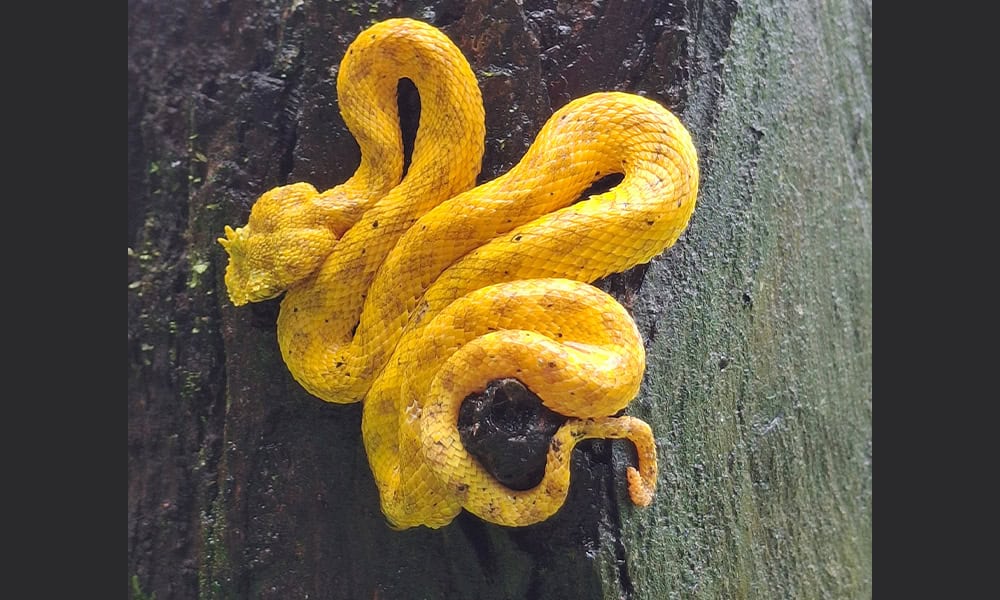
The eyelash palm-pitviper (Bothriechis schlegelii) is a snake of many names. Its English names include eyelash palm-pitviper, eyelash viper, and Schlegel’s pitviper. Among its many Spanish names are bocaracá común, toboba de pestañas, and, in the case of the yellow individual featured in this article, oropel.
The wide variety of names makes sense for this snake because it comes in a huge variety of colors, so much so that you could easily convince someone that each color morph is its own species of snake. Their rainbow of color variations includes base colors of green, brown, orange, pink, white, and yellow all with blotches, spots and crossbands of various colors. Every time I find a color and pattern that seems as though it can’t be beat, I’ll keep scrolling and find an even more beautiful variation.
The most outstanding physical characteristic that is consistent among all colors of eyelash palm-pitvipers are the raised spine-like scales above each eye. These scales, resembling eyelashes, are thought to aid in camouflage, breaking up the snake’s outline. Another hypothesis says that the spiney scales help to protect their eyes from the roots and vines where they often intertwine their elongated bodies.
These snakes are absent from Costa Rica’s highest points and driest places, preferring to inhabit the wet forests of the lowlands and foothills. They can be found coiled among tree roots on the forest floor, along streams, and among the bromeliads and vines up in the branches of trees. Generally, younger individuals are found in lower parts of the forest where they feed on small lizards and frogs and larger, more mature individuals spend more time higher in the trees seeking heftier prey like small mammals and birds. They subdue their prey with potent venom injected through enlarged, hollow fangs.
I’ve had two interactions with eyelash palm-pitvipers in the field. The first was fleeting and came a few years ago. My wife and I were on a nearly impossible to come by weekend away from the kids, and we decided to hike in Tenorio National Park. On the hike we passed by a juvenile on a broad green leaf. Its coloration is known as the “Christmas morph” because it was a base green with a red pattern. We marveled at it momentarily, and I snapped a picture that has since been lost to the great database in the sky that holds the photos from all of our dead cellphones.
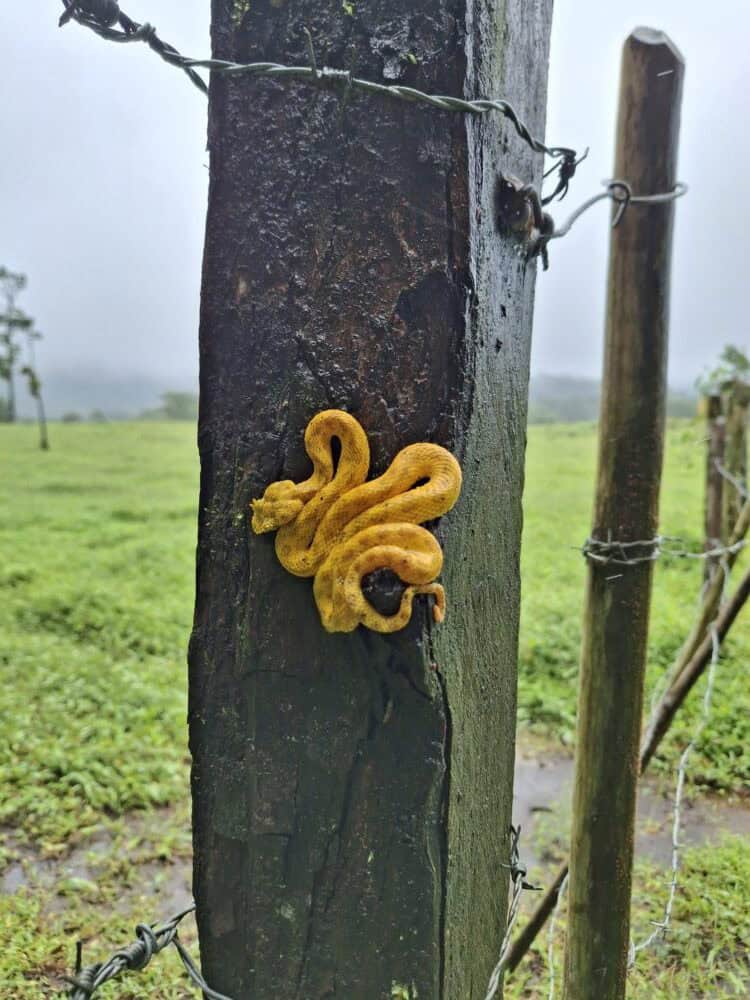
Just last week I had the interaction that inspired this article. I was hiking through the rain with a farm owner and his farmhand, installing a few camera traps in the lush tropical forest. After successfully deploying the cameras, we were walking through cow pastures to return to the homebase. As the farmhand closed a barbed wire gate between two pastures after allowing us to walk through, he let out a little yelp. He called me over and pointed to the post that the gate was attached to and contrasting boldly from the wet, dark brown post was a bright yellow eyelash palm-pitviper.
My companions weren’t particularly thrilled with its presence, but I was truly delighted. It was the most beautiful snake I’ve seen in the wild. I snapped a few quick cell pictures in the rain and gave my uneasy friends every fact that I knew about the snake. I think my reptile-inspired exuberance won them over in the end.
About the Author
Vincent Losasso, founder of Guanacaste Wildlife Monitoring, is a biologist who works with camera traps throughout Costa Rica