

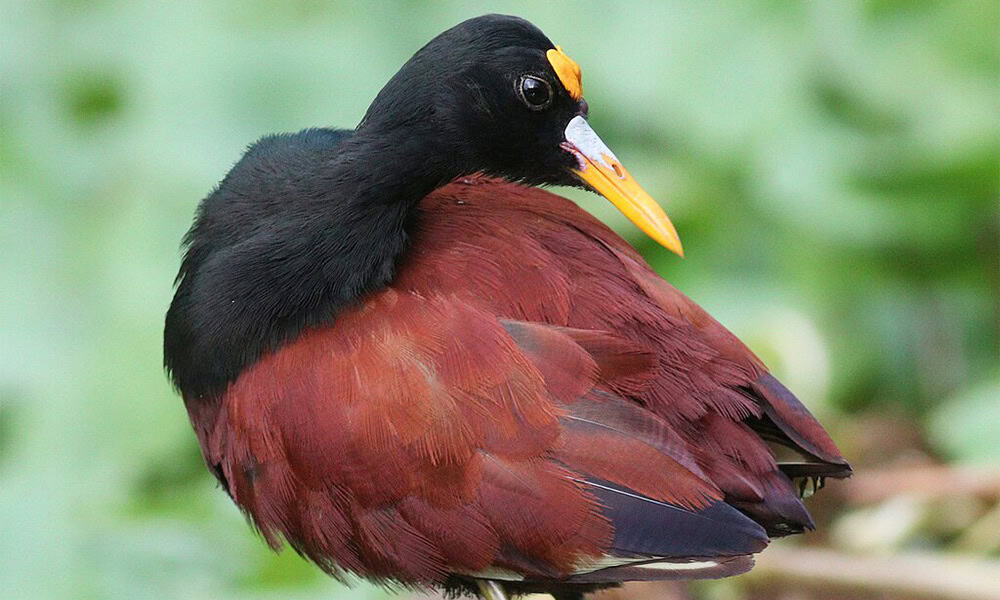
Today we meet the northern jacana, a little water bird with huge feet and an interesting sex life. The northern jacana (Jacana spinosa) is known as the cirujano, mulita, or gallito de agua in Spanish. All of those names are fine, but I like what George Edwards, an English naturalist, came up with he described it in 1743, ‘spur-winged water hen.’
Northern jacanas are pretty little birds. They have a chestnut-maroon body and black heads. They have bright yellow beaks, a yellow shield on their foreheads, and a bright yellow spur on the leading edge of both wings. All of this can be readily observed via binoculars. What could be missed, because most of the time they are somewhat submerged in water, are their enormous feet, or more accurately, extremely long toes. These long toes and toenails allow them to distribute their bodyweight more evenly over floating vegetation, allowing them to walk across lily pads and the like without sinking.
These birds can be found calling loudly around wetlands from Mexico to Panama. They prefer calm, slow-flowing water. In Costa Rica they can be found along ponds, marshes, slow-flowing rivers, and flooded pastures throughout the country. They are particularly abundant in Guanacaste in the Tempisque basin and in the Río Frío area. They patrol the water’s edge and areas with floating vegetation in these environments in search of insects, snails, worms, small fish, and seeds.
Northern jacanas are unusual among birds in that they have a polyandrous breeding system. That means a single female mates with several males in a single breeding season. A female northern jacana has a territory that encompasses the smaller territories of several males. During breeding season, she mates with each male and produces a clutch of eggs for each one. The male jacanas are responsible for building the nest and incubating the clutch of four beautiful brown eggs covered in black scrawls. It is the job of both sexes to defend the territory of the nest from nest predators, which they do using the bright yellow boney spur on their wings.
I did some searching in the literature for some interesting tidbits about northern jacanas in Costa Rica. I found two interesting studies. One looked at which bird species the breeding jacanas were most frequently defending their nests from. There were a bunch of species listed but the most common foe with around 80% of the territorial disputes was the purple gallinule, an innocuous-looking, bright purple bird that apparently has a taste for northern jacana eggs and hatchlings. The second study compared the activity of northern jacanas when they were in flocks of purely jacanas and when they were in mixed flock with other species of birds. They found that jacanas in mixed flocks spent more time foraging and less time scanning for predators, apparently benefitting from the attentiveness of the other species.
Most of my northern jacana interactions came from a single property in Guanacaste. This property had a large crocodile-filled pond in a grassy area with big patches of floating vegetation in it, perfect northern jacana habitat. I recorded many videos with jacanas from the cameras I placed along the water’s edge. Frequently the jacanas would be foraging amongst a group of other species of birds which I never really considered as interesting behavior until I read the study mentioned above. Take a look at a few of my favorite northern jacana videos from that pond below.
About the Author
Vincent Losasso, founder of Guanacaste Wildlife Monitoring, is a biologist who works with camera traps throughout Costa Rica.





