
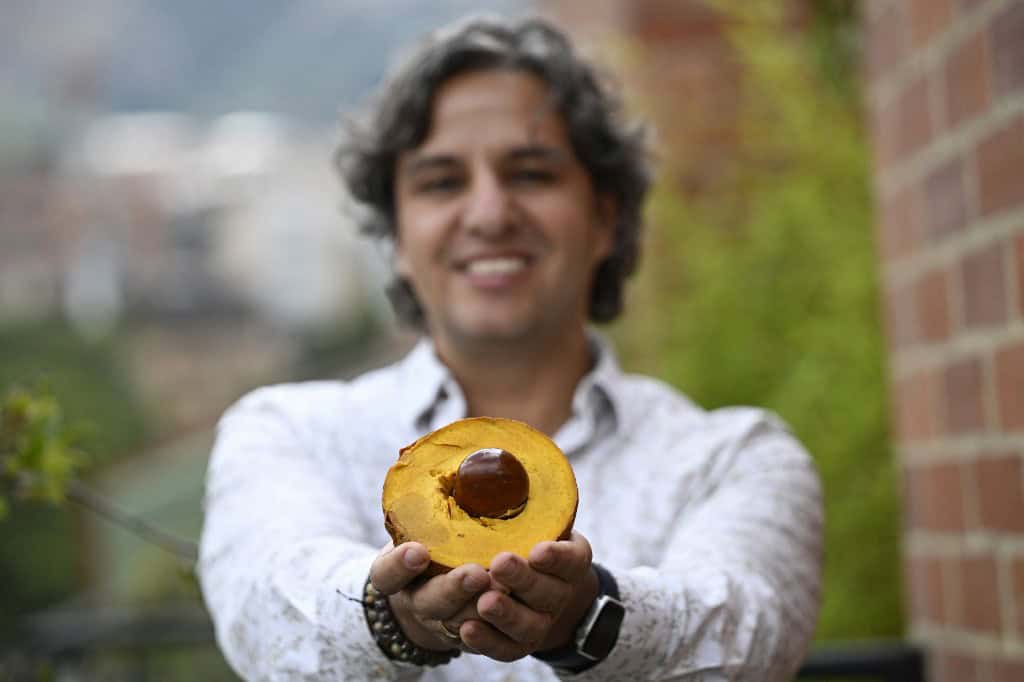
In front of thousands of internet followers, the so-called “lord of native fruits” describes flavors, textures, and possible uses of rare specimens. Gian Paolo Daguer leads a volunteer network to save these delicacies from extinction in Colombia, one of the world’s most biodiverse countries. From his home in Bogotá, the environmental engineer records with a cell phone camera a review of a lucuma, a little-known tropical fruit whose external appearance is similar to a coconut. Inside, it resembles a yellowish avocado and has a slightly sweet taste.
Daguer, 47, has become a reference for a growing circle of lovers of fruits native to Colombia but uncommon in the diet of its inhabitants. Some of them are in danger of extinction due to ignorance about their properties and other factors such as deforestation. On his social networks, the “Fruits of Colombia” project has more than 108,000 followers. Without profit motives, Daguer also leads a network of WhatsApp chats where biologists, farmers, and chefs, among others, share their knowledge and arrange seed exchanges.
It is a “holistic vision where all these different kinds of knowledge converge with an intention to conserve and recover biodiversity and fruits (…) that grow in Colombia,” he says. According to Carolina Castellanos, a biologist at the Humboldt Institute, “Colombia is one of the richest countries in the number of plant species.”
The most recent study by that entity linked to the Ministry of Environment and other organizations determined that there are at least 3,000 “food” species in Colombia, from which humans consume stems, leaves, fruits, or seeds. But at least 10% of them are at risk of disappearing.
Citizen Science
In the framework of COP16 on biodiversity that began in 2024 in the Colombian city of Cali and ended this February in Rome, the International Union for Conservation of Nature (IUCN) warned that 38% of the world’s trees are threatened with extinction. In 2024, the country lost a forest area similar to the surface of Hong Kong (107,000 hectares), mainly due to land grabbing for livestock, coca leaf cultivation, and monocultures such as oil palm.
In small home gardens, plants grow from some of the seeds that Daguer obtains and then distributes. Interested parties request them through social media, he makes arrangements to find them at any geographic point and sends them in envelopes via courier. The intention is to “conserve,” “recover,” “inform and disseminate,” he assures.
The taste was born when he was a child and enjoyed eating fruits during family trips to rural areas. Daguer has an extensive collection of botany books stacked alongside rare specimens of piñuelas, cocorillas, lontar, and pandanus: all fruits with atypical shapes, textures, and flavors.
Although spontaneous, his work reached scientific spheres and was decisive in cataloging a new species: the Quinguejo, a dark berry similar to a blueberry that grows in Nuquí, a paradisiacal town in the department of Chocó (northwest). Until 2024, the small fruit was not “botanically classified.”
Daguer saw it for the first time on social media, found a knowledgeable farmer, and then participated in the National University study that named it in honor of the hamlet where it was found. It is a process of “citizen science” in which “knowledge converges,” he adds.
Eating to Conserve
For biologist Castellanos, these fruits have taken a “back seat” due to imported food or diets outside Colombian ecosystems. In gastronomy, for example, “we all eat the same thing anywhere in the world,” so the diet has become homogenized, she says. The six-decade armed conflict also isolated traditional recipes from places bled by war.
Chef Antonuela Ariza, Daguer’s accomplice, included fruits usually unknown to the palate of Bogotá residents in her restaurant Mini-Mal’s menu. Enthusiastic about the value of Colombia’s natural wealth, in her kitchen she prepares a sauce with sour guava to accompany breaded fish, mayonnaise with camu-camu (similar to grape), Amazonian black chili for shrimp, and a cocktail with copoazú, a whitish fruit related to cocoa, among others.
The idea is to “promote biodiversity, to be able to tell a diner who comes here about a fruit, give them a taste of a new flavor but also to be able to tell them everything that happens around that fruit, the forest where it comes from, the people who take care of it,” she says. Because “what we don’t eat is lost,” she concludes.