

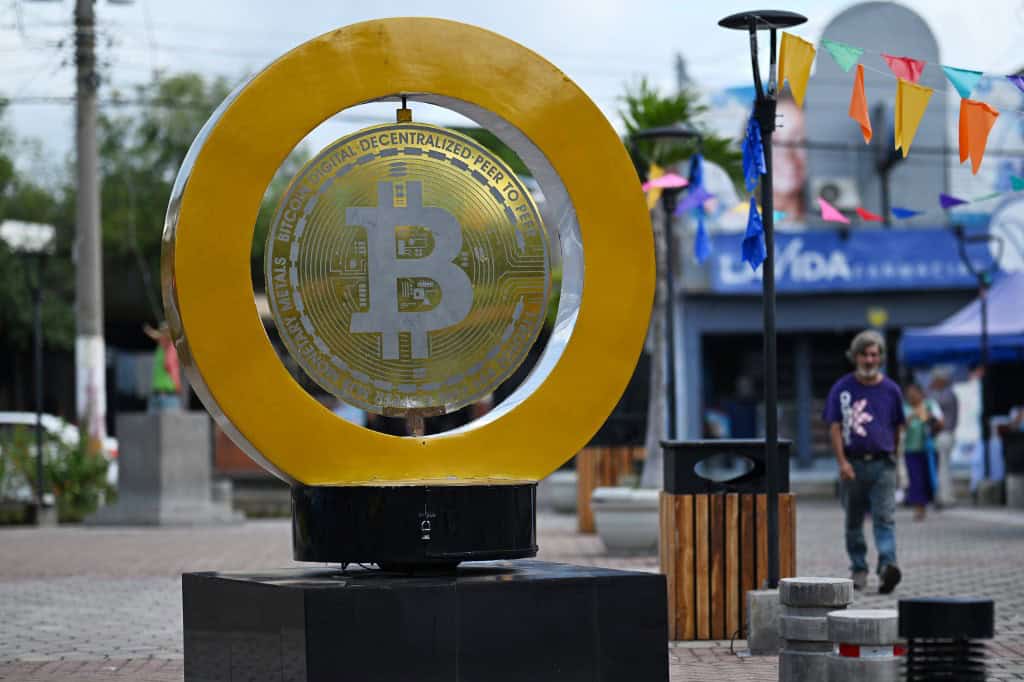
Napoleón Osorio is thrilled to be the first taxi driver in El Salvador to accept payments in bitcoin, as it has transformed his life. However, not everyone shares such joy in El Salvador, the first country in the world to legally circulate bitcoin alongside the U.S. dollar three years ago, thanks to a decision by President Nayib Bukele.
“With bitcoin, my life practically changed, because I was unemployed […] and now I have my own car rental business,” Osorio proudly said with a smile.
He explained that in 2021, John Dennehy, an American who founded the NGO “My First Bitcoin” and resides in El Salvador, encouraged him to start working with cryptocurrency, and today Osorio is a small business owner.
The 39-year-old now oversees 21 colleagues who work under his brand Bit-driver, and with the profits from bitcoin’s rise, he has managed to purchase four vehicles, which he now rents out.
Osorio, who is divorced, says that his earnings have allowed him to pay for his two children’s education, ages 13 and 19, without any financial difficulties.
Cold Wallet
Bukele introduced bitcoin on September 7, 2021, aiming to provide financial inclusion for the 70% of the population who were excluded from the traditional banking system. He also began purchasing cryptocurrency for the state.
Last March, the president stated that El Salvador holds 406.6 million dollars in 5,689 bitcoin, stored “in a cold wallet in a physical vault” in the country. Based on current prices, the country has 5,865 bitcoin, equivalent to 320.3 million dollars, according to the government’s official website.
To encourage bitcoin usage, Bukele created the Chivo Wallet app and offered $30 to each user as a welcome gift. Critics have asked for transparency regarding the total investment made in bitcoin.
However, the adoption of bitcoin as legal tender has hindered El Salvador from securing a $1.3 billion loan from the International Monetary Fund (IMF).
Differences began to ease in August, when the IMF announced a preliminary agreement with El Salvador, though it cautioned that “potential risks” still needed to be addressed.
Additionally, the IMF urged Bukele to implement fiscal adjustments “to place public debt on a sustainable path,” which stood at 82% of GDP by the end of 2023.
A quarter of El Salvador’s GDP comes from family remittances, primarily sent from the United States. However, only 1% of remittances (8.18 billion dollars in 2023) were made using cryptocurrency.
We Offered It as an Option
Despite Osorio’s success and the progress with the IMF, the majority of Salvadorans still do not use cryptocurrency. In a recent interview with Time magazine, Bukele acknowledged that “bitcoin has not had the adoption” he had expected.
“The good thing is that it’s voluntary (…), we offered it as an option, and those who wanted to use it have used it, benefiting from bitcoin’s rise,” the president said.
This week, bitcoin was valued at over $52,000. It reached its peak on March 13, 2024, when it hit $73,616, after nearly bottoming out at $16,189 on November 22, 2022.
It’s Not a Failure
A recent study by the University Institute of Public Opinion revealed that 88% of Salvadorans do not use cryptocurrency. “From the beginning, our 2021 surveys made it clear that this was a largely unconsulted measure, one that the public rejected,” says Laura Andrade, director of the Institute, to AFP.
However, independent economist César Villalona believes that the adoption of cryptocurrency is “not a failure,” though he notes that the president himself removed bitcoin’s “functions” as money.
“Bukele […] said: there will be no salaries in bitcoin, no pensions in bitcoin, no savings in bitcoin, and no pricing in bitcoin. In other words, he stripped it of the three functions of money,” Villalona said.
Fear of the New
The limited use of bitcoin in the country is due to a lack of education on cryptocurrency use, according to Luis Contreras, an instructor at the NGO My First Bitcoin, which has trained around 35,000 people in El Salvador.
“The hardest part of education is the fear of new things, and that leads to a fear of technology (…) the fear of transitioning from the classic money of today’s economy to a completely digital and decentralized currency,” explains the 40-year-old instructor to AFP.





