
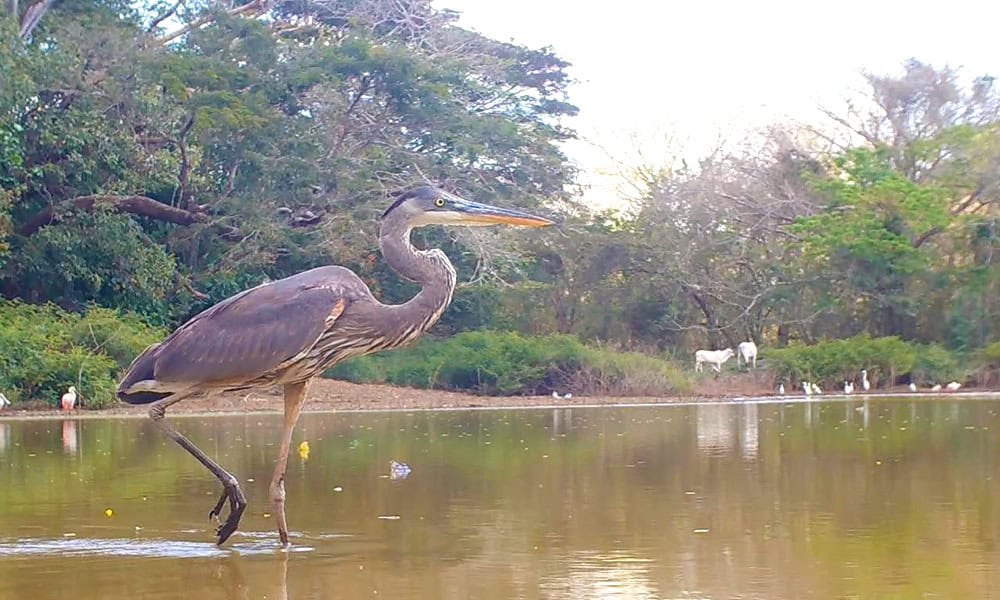
Moving to Costa Rica allowed me to discover and learn about a whole host of new species that I hadn’t been acquainted with before. Birds that I now know well like the long-tailed manakin and Montezuma’s oropendola, were mysteries in need of exploration when I first arrived. On the other hand, there are other species present in this wonderful little country that I already knew quite well.
Great blue herons, for instance, have been delighting me since I was a kid sitting in the backseat of my parent’s car driving by lakes in southern New Jersey. I still get a kick out of seeing them while stamping around in Costa Rica’s wild places.
The great blue heron (Ardea herodias) is known as the garzón azulado or garza ceniza in Spanish. These birds are both big and beautiful. At 52 inches tall and with a wingspan that can reach over 6 feet, the great blue heron is Costa Rica’s largest species of heron. They have long dark legs, long gray necks and a long yellow bill. The word ‘elegant’ comes to mind when you see them.
As one might expect from a bird with this build, great blue herons inhabit wetlands. They’re found around any fresh and saltwater habitat that you can think of including streams, marshes, seashores, lakes, and mangroves. If there’s a watery environment stretching from Canada to northern South America, you have a chance of spotting a great blue heron standing majestically at the water’s edge. (Depending on the time of year. We’ll get into that.)
Great blue herons use their long, skinny legs to wade into the water hoping to use their long, slender necks in a quick, striking motion to spear some aquatic creature with their slim, sharp bill. The aquatic creatures they’re interested in snapping up include anything that’s able to fit down their throats in one swallow. They eat a lot of fish, but they’re also more than happy to scarf down large insects, amphibians, reptiles, crustaceans, and small mammals.
I mentioned that the great blue heron’s range spans over most of the Americas, but the trick is, they aren’t present in all of the habitat all of the time. In North America, depending on which part of the continent they call home, these herons are either migratory or year-round residents. In Costa Rica, the population is mostly migratory, for the most part present from September to May. There are a few subadult individuals that hang out in the land of pura vida all year, specifically in Guanacaste, but most great blue herons return north to breed.
I see great blue herons pretty regularly. They’re easy to spot while flying overhead with their massive bodies and slow wingbeats. They often let out an angry honk when I flush one from its perch while hiking in watery habitats. I really enjoy recording them with my camera traps because I’ve been a lifelong fan and because they inhabit areas that make for beautiful video backgrounds.
I’ve searched through my video databases and selected some of my favorite great blue heron videos, many of which show them interacting with other species in their environment. I hope you enjoy them in the video below.
About the Author
Vincent Losasso, founder of Guanacaste Wildlife Monitoring, is a biologist who works with camera traps throughout Costa Rica. Learn more about his projects on facebook or instagram. You can also email him at: vincent@guanacastewildlifemonitoring.com