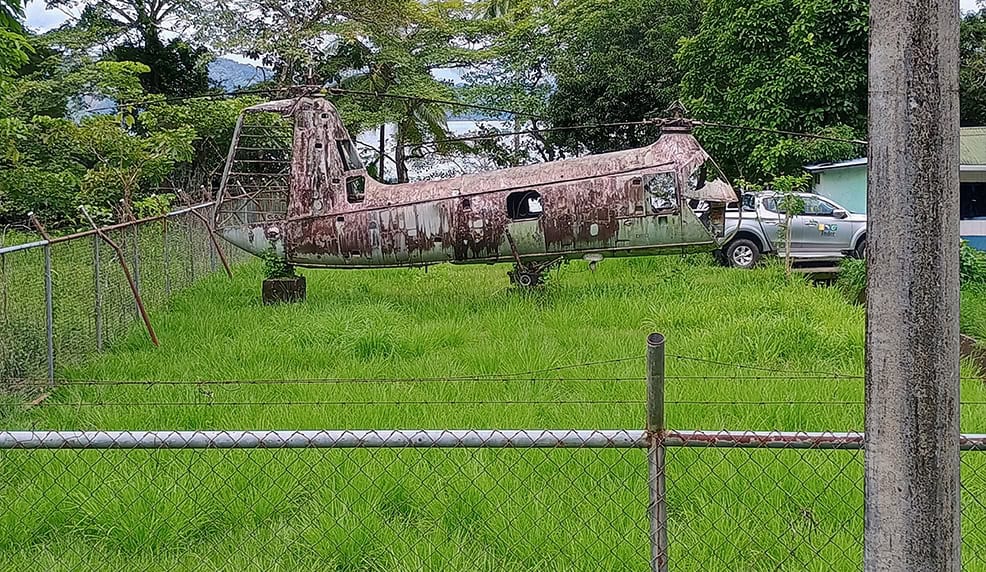
On the shore of Golfo Dulce in the Osa Peninsula, in a tiny town called Rincon, sits an abandoned helicopter. It is the last moldering remnant of what was once a major logging operation. The company was called Osa Productos Forestales (OSF). They bought 45,000 hectares–about a quarter of the Osa, in 1957, carved out a massive compound in the jungle, a spread of offices, company houses and workers quarters, repair areas, huge storage space for the heavy equipment, a medical clinic, massive generators to power it all, two helicopters and an airstrip, and went about logging the area they hadn’t built on.
The presence of OSF in the remote peninsula was the cause of years of conflict between campesinos and loggers. In the 1970s, the government of Costa Rica got involved and sided with the campesinos. They played the expropriation card and threw OSF out of the country.
Whatever the government’s motive, it was an early move toward Costa Rica’s evolution–changing from a place that defined progress by exploiting nature to one that embraced nature and began to realize its potential as a tourism moneymaker. In short order, the establishment of Corcovado National Park and Golfo Dulce Nature Reserve as protected lands was made official by government decree. On the online legal document of the case, the opening page is headlined with the Expropriation declaration, and is followed by:
RODRIGO CARAZO ODIO
PRESIDENTE DE LA REPÚBLICA
Y LOS MINISTROS DE GOBERNACIÓN Y POLICÍA Y HACIENDA
Costa Rica came out with the heavyweights, led by President Rodrigo Carazo. Accompanied by government ministers, the police and the revenue department, he ejected Osa Productos Forestales from Costa Rica and laid claim to all they left behind. The record of the expropriation is presented in the most amazing bureaucratic detail, from the dimensions of the territory taken, through the numerous physical structures and machinery, all the way down to things like gaskets and wrenches, everything categorized and numbered in a document that runs into tens of thousands of words.
For the Osa Peninsula, the changeover from exploitation to protection of resources was beneficial, most would agree. The jobs lost to locals were mostly low paying and hazardous, much like the nearby United Fruit Company, whose use of pesticides exposed hundreds of poorly paid workers to dangerous and unhealthy work conditions. And the peninsula–home to 3 to 4% of the world’s biodiversity–now attracts thousands of visitors annually, supporting a tourist infrastructure that creates numerous jobs for the region.
As for that helicopter–I have driven past it on dozens of occasions and for years thought it had been intentionally damaged by angry locals. The damaged exterior suggested it might have been torched, and I always imagined a mob chasing the gringo exploiters, who made their getaway in the other helicopter while the one remaining was set afire. Alas, the reality is rather dry and boring.
The 40,000 plus hectares were taken through the court system, the Osa Productos Forestales management packed up and left after a couple decades of profitable exploitation, and all that remained, besides the company compound, was a helicopter left behind to be gradually taken by nature, its once sheeny exterior now corroded and pockmarked by the elements.
And the reason it was left behind? It had numerous mechanical problems that were too costly to repair.