
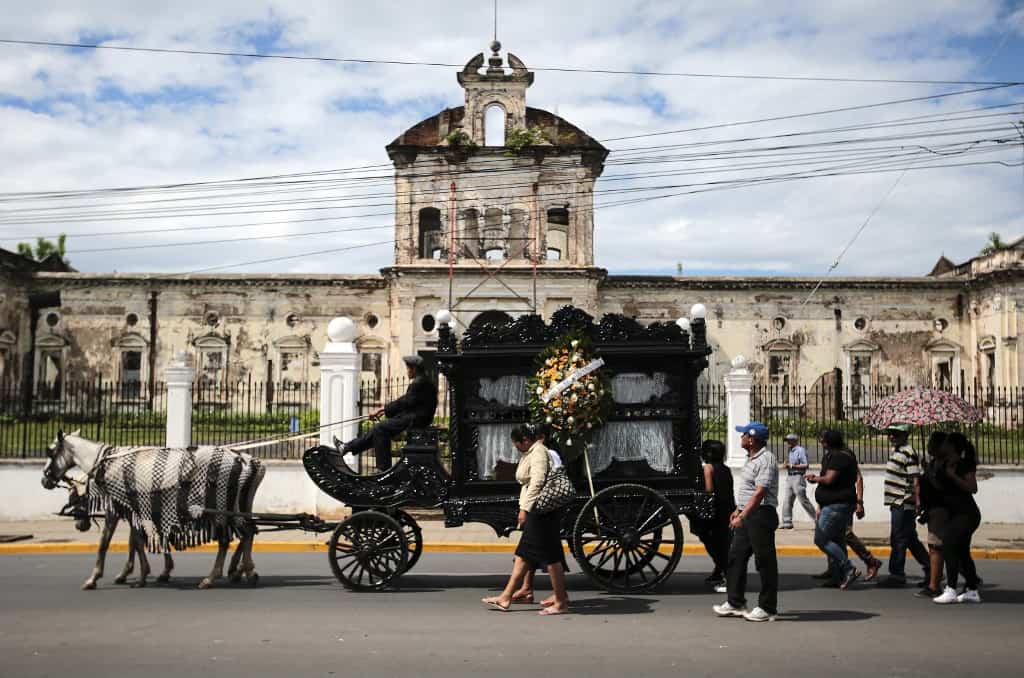
Exhausted after the wake in the early hours, Mariela López leads the procession behind an elegant black horse-drawn carriage towards the cemetery of Granada, a colonial city in Nicaragua where both rich and poor share this tradition dating back to the 19th century.
Her mother lies in the coffin. “We are fulfilling her wish (…) She asked me that, should she pass away, we should take her the traditional way, in a carriage,” says López, 42, with sadness.
During the 7 km journey from her modest home to the cemetery, four musicians, with guitars and trumpets, play melodies her mother had also requested for her funeral.
Situated on the shores of Lake Cocibolca, Granada, 46 km south of Managua, maintains the old custom of funerals with black carriages, carved in wood, decorated with flowers, white curtains in the glass windows, and pulled by two horses covered with a white or dark mesh.
Dressed in a blue suit with grey stripes and a white shirt, embellished with a black beret and tie, Raúl Corea, 41, solemnly holds the carriage reins.
Behind him, about thirty mourners slow down the traffic, but no driver complains. Granadinos also use carriages or berlins as public transport, and for tourists, it’s a must-do ride.
“This type of transport is typical in Granada (…), here it is used by everyone from the poorest to the richest,” says Corea.
He has been working as a carriage driver of this type for 13 years for several funeral homes in Granada.”One is moved to see people cry (…), but in the end, one gets used to it, it’s routine for me,” adds Corea, a slender and short man.
However, he hopes his son Ariel, 15, whom he taught the trade, would do something else in life. The teenager has already had his first procession, called in by a funeral home in an emergency. “Very few people want to do it because it requires patience,” comments Corea.
Miguel Mayorga, 72, owner of the María Auxiliadora funeral home, says that 35 years ago he was making wooden furniture, but began to make coffins to overcome an economic crisis.
He acquired an abandoned carriage from another funeral home, restored it, and now offers the complete service with coffin, flowers, and transfer to the cemetery.
“The carriage is used by the richest, the somewhat rich, and those who have almost nothing; there is no distinction. In carriages, there is no category like there is in coffins (caskets),” where the price depends on the style and quality of the wood, he claims.
Just like in the case of López’s mother, the body of businessman Alfredo Pellas Chamorro, patriarch of the Pellas Group – one of the most powerful in Central America – was taken to the cemetery in a horse-drawn carriage. He died at the age of 97 in 2015.
The transfer in the funeral carriage costs about 40 dollars in local currency, but depending on the coffin and ornamentation, the funeral can cost between about 200 and over 800 dollars.
Although funeral homes have modern hearses, Granadinos want to maintain the tradition, says Carlos Chavarría in front of a church in Granada, after the burial of his elderly father.
“My mother, now my father, and a brother of mine, we have taken them in these carriages,” said Chavarría.
His father’s funeral carriage was driven by Ariel, Corea’s son. When he dies, says Chavarría, he will also travel for the last time through the cobbled streets of Granada in a horse-drawn carriage.