
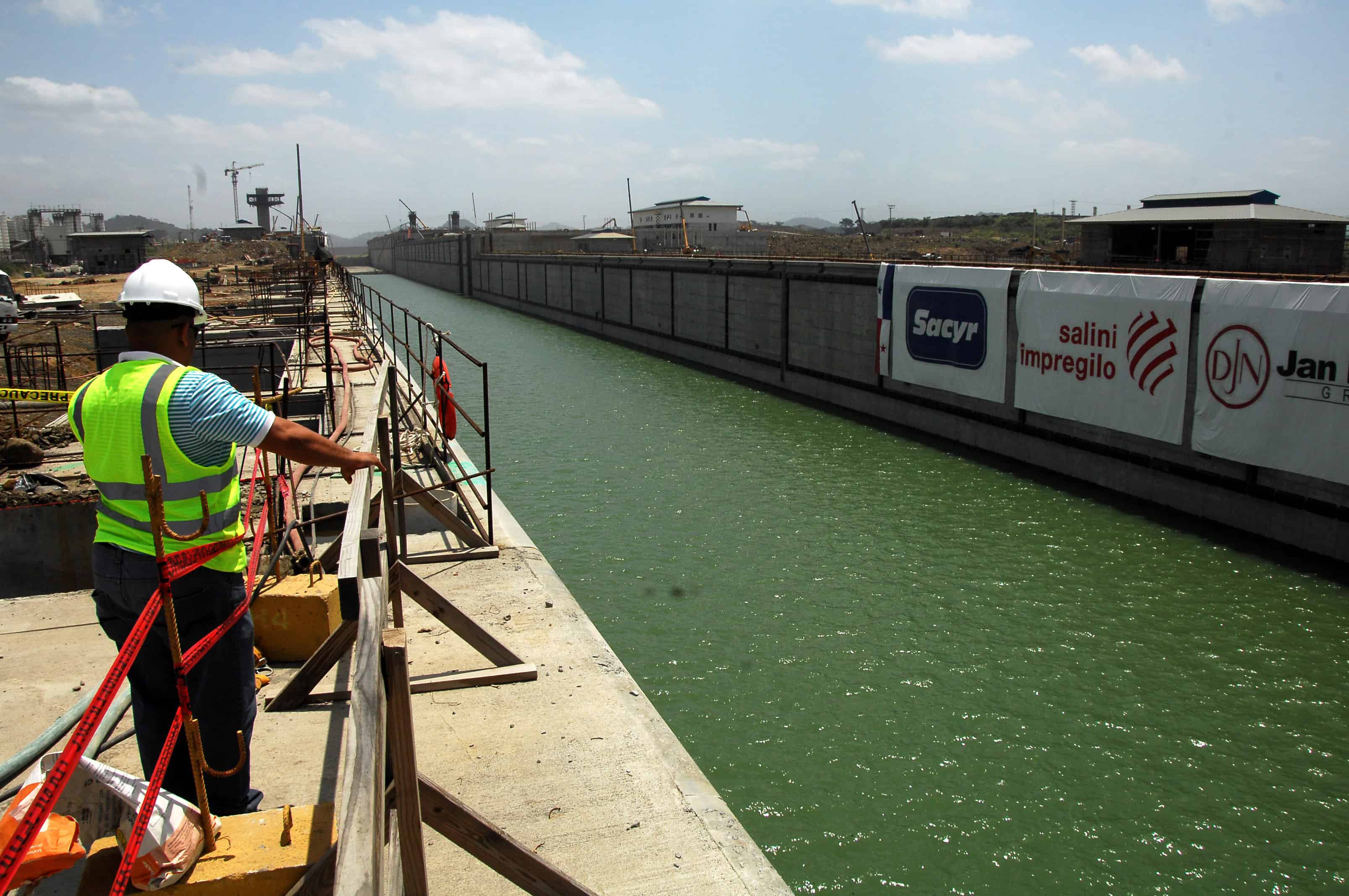
The Panama Canal is desperately searching for water to avoid running dry, as reduced rainfall due to climate change and the El Niño phenomenon threaten to parch the passageway responsible for nearly 6% of global maritime trade.
“The big disadvantage of the Panama Canal, as a maritime route, is the fact that we operate with fresh water, while other sea routes [such as the Suez Canal] use sea water,” Ricaurte Vásquez, the Canal’s administrator, said on Thursday.
Due to the scarcity of rainfall, the Canal has limited the draft of ships, a move predicted to result in a loss of $200 million in its revenue by 2024. Meanwhile, revenue projections for this year are estimated at $4.9 billion, Vásquez indicated.
“We have to find solutions to continue being a relevant route for international trade services. If we don’t adapt, we’re going to fail,” he stated at a press briefing.
Atypical Crisis
A few months ago, the draft was limited to 43 feet (13.11 meters), two less than previously allowed by this route opened by the United States in 1914 and under Panamanian control since December 31, 1999.
“The severity of this crisis is atypical, it’s very high. So we think that from now until September 30 of next year, we should be operating with draft restrictions,” Vásquez said.
From an average of 40 ships crossing each day in 2022, now only 32 pass to save water, the source of energy that moves the ships in the locks. For each ship, 200 million liters are dumped into the sea.
Since 1914, over a million ships have crossed the route, with the main users being the United States, China, Japan, and Chile.
Due to the lower draft, some merchant ships unload hundreds of containers at the Pacific port of Balboa and reload them in Colon (Caribbean) after crossing the Canal.
The containers are transported by train from one coast of Panama to the other, which involves delays but not necessarily higher costs to the shipping companies, as while they have to cover train transportation costs, they pay a lower toll on the Canal because they carry less cargo.
Vásquez mentioned that the merchant ship “Ever Max,” flying the Singaporean flag, used this method this week, which didn’t prevent it from setting the record as the ship with the most cargo that has crossed the route: 17,000 containers after paying $1.5 million in toll.
Other Routes
The administrator stated that “the lack of water, only measured in terms of tolls, already costs a price of 200 million balboas” (dollars) less in revenue in 2024.
If the drought continues and the draft limit persists, the Canal risks losing customers, as shipping companies “may opt for other routes, we know that risk exists,” he pointed out.
“But we believe that if we find them a solution relatively soon, not necessarily that it’s built immediately [the solution], but that the market knows that we’re indeed proceeding with that, long-term concern should be alleviated,” he added.
Three Cities
The lack of rain has also caused an increase in salinity in the water of the interoceanic route, creating other issues.
The Panama Canal’s watershed, formed by Gatun and Alhajuela lakes and several rivers, also supplies water to three cities, including the capital, where half the country’s population lives.
“Every time we open the gate that leads to the sea, sea water mixes with fresh water and the larger the gate […], the greater the volume of salt water that enters the system,” Vásquez pointed out.
“We have to keep that level of salt water within a certain range because the water treatment plants do not have desalination capacity,” he added.
Discarded Option
In the locks, the ships are raised 26 meters above sea level to cross the isthmus and are then lowered upon arrival at the other ocean. The water enters and leaves the huge basins by gravity.
Despite the scarcity of fresh water, the option for the Canal to use sea water is ruled out because it would involve large excavations.
“Suez was much flatter and it was sand. In our case, it’s rock and there’s a not very high mountain range, but there’s a mountain range and that represents the challenge,” Vásquez explained.
In 1881, a first attempt to open a sea-level canal in Panama began, led by Frenchman Ferdinand de Lesseps, the builder of Suez. The work was halted due to technical problems, financial issues, and tropical diseases that killed thousands of workers.
A quarter of a century later, construction was resumed by the United States, who added the locks and took 10 years to complete it.