
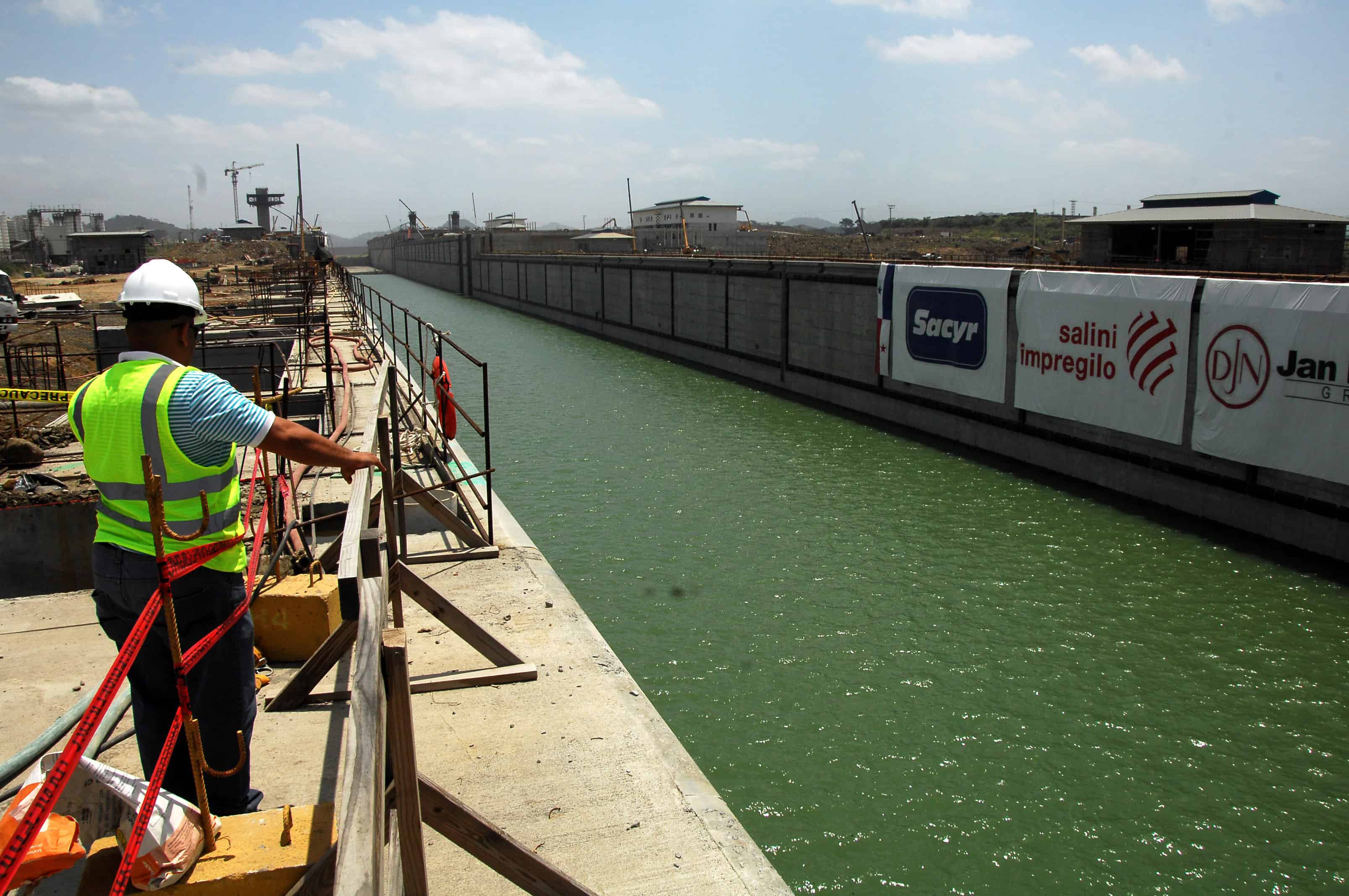
From their vantage point in cranes overlooking the Panama Canal, operators scrutinize the century-old walls of one of its locks as the high-pitched siren of a merchant ship resonates from nearby.
In the middle of a gigantic ditch drained of water, workers scramble to complete maintenance work in one of the chambers, or lanes, of the Pedro Miguel lock, not far from the Pacific Ocean.
Working between the high concrete walls and the enormous gates, amid residual puddles of water and the echoing thrum of huge water pumps, the maintenance team takes advantage of a temporary halt in traffic to renovate facilities that are over a century old.
The 50-mile (80-kilometer) interocean byway was inaugurated by the United States in 1914. Since then, more than a million vessels have transited through, headed from the Pacific to the Atlantic or vice versa.
“These Panama Canal locks are more than 100 years old, and our maintenance plan is designed to extend their life for another 100 years,” said Miguel Lorenzo, vice president of infrastructure and engineering for the canal authority.
Sealing cracks
The canal uses rainwater to move ships through the locks, which work like elevators to raise vessels by up to 85 feet (26 meters) above sea level as they transit across the isthmus’s continental mountain range.
The Pedro Miguel locks have two chambers — each a sort of lane through which some 30 ships pass daily.
Despite the ongoing maintenance, canal traffic continues. With passage through the west chamber halted, the Uog Phoenix oil tanker passes through the east chamber, sounding its siren as it heads toward the Caribbean.
Work in the west chamber is scheduled to last a week, ending May 16, and is budgeted for $2.5 million. During this time, more than 400 people constantly monitor valves, the 65-foot-high (20-meter) walls, and the huge pipes through which water is pumped to raise and lower ships.
The last round of maintenance for the chamber — which is 1,000 feet long and 110 feet wide — came in 2015. The canal has five sets of locks, with 18 chambers.
“The intention is to dry the chamber and have access to all electrical components and equipment” in order to recondition them and extend their operational life, Lorenzo said.
At the same time, “when we dry the chamber, it is our only opportunity to be able to see the concrete walls and seal any fissures, cracks or damage.”
Two gates, each weighing 700 tons, were previously removed and taken to a workshop to repair the steel, change rubber fittings and seals and get a fresh coat of paint — the first in 37 years.
Because the region is currently coping with drought, “it is very important that we have these valves in good condition to conserve water,” said Wilfredo Yau, who oversees maintenance for the Pedro Miguel locks.
He likens the work to stopping the dripping of a faucet in one’s home — but “on a much larger scale.”
Good state of health
Some six percent of all global maritime commerce passes through the Panama Canal, with the United States, China and Japan being the leading users.
In fiscal year 2022, more than 14,000 vessels carrying 518 million tons of cargo transited the canal, providing revenue of $2.5 billion for Panama.
But the dearth of rain has forced the canal to reduce the draft of ships, with the water shortage at least temporarily threatening the future of the vital maritime route.
The canal authority says it invests more than $400 million a year in maintenance projects. Canal managers say each chamber of the locks is rehabilitated every five years, though the 82 gates are reconditioned only every 25 to 30 years.
“The canal was designed as a very robust structure, and that permits us to extend its life through maintenance,” said Lorenzo.
“We are very confident that we have a very well maintained canal in a very good state of health” and able to last, Lorenzo concluded, at least 100 years more.