
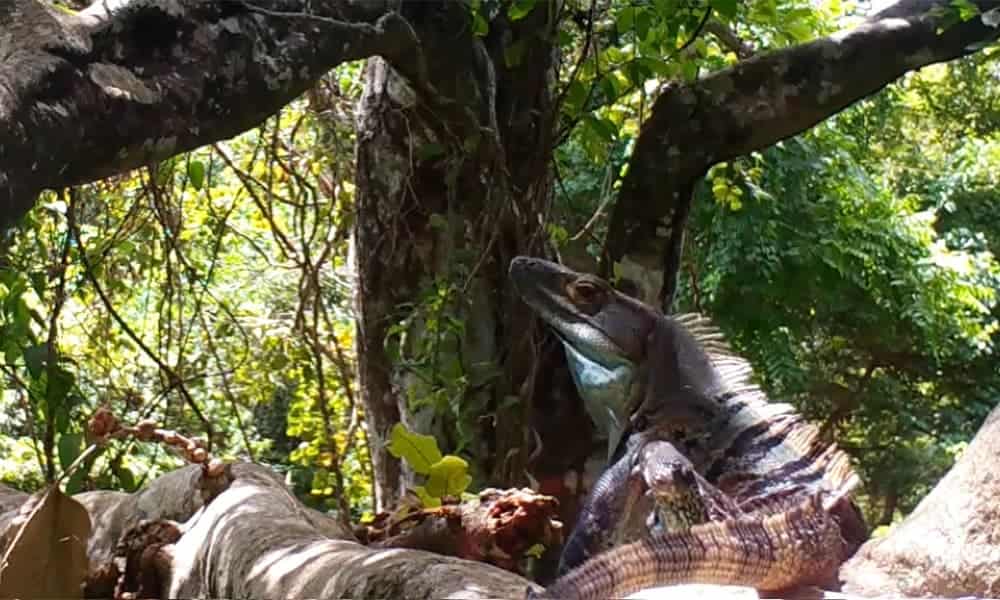
Costa Rica is home to three members of the Iguanidae family, the green iguana (Iguana iguana) – the one most people are familiar with, the black spiny-tailed iguana (Ctenosaura similis) – the one that you probably confuse with the green iguana and the five-keeled spiny-tailed iguana (Ctenosaura quinquecarnata) – the one you’ve probably never heard of.
The star of today’s show is the black spiny-tailed iguana or in Tico Spanish, garrobo (you’ve got to push down that embarrassment and roll that ‘r’). They resemble green iguanas in that they are both giant lizards that are running around Costa Rica.
While the green iguana is distributed on both of Costa Rica’s coasts, the black spiny-tailed iguana is limited to the Pacific side of the country. And where they overlap, there can be some trouble distinguishing the difference between the two.
First, black spiny-tailed iguanas aren’t green. As adults, they are olive/gray/brown/sometimes blue with large black bands running down their back. Adult green iguanas are green. Sometimes. Sometimes they’re orange. Sometimes they’re a dark color that looks very similar to black spiny-tailed iguanas (which doesn’t help). Here’s the worst part, as juveniles both species are bright green and look almost exactly the same.
So coloration isn’t a homerun difference maker in differentiating between the two species. The best way to tell which one you’re looking at is the head shape. Green iguanas have more rounded, stubby heads and black spiny-tailed iguanas have longer, crocodile heads.
Another helpful hint as to which species you’re observing is the location. While both species like to hang out near water, the black-spiny tailed iguana can be also be found in very dry places and seems to be less dependent on being a short sprint away from a body of water.
Black spiny-tailed iguanas are excellent climbers. One of the most common noises I hear as I’m walking along a forested trail checking camera traps is the scratchy claws-on-bark sound of a garrobo skitter-skattering from a limb to the safety of a tree hole.
Sometimes when it’s a large male and he’s feeling feisty, he’ll stop short of running into the hole and opt for a more aggressive maneuver, the threat display.
A garrobo’s threat display is a common one in the world of lizards. He stops, looks deep into your eyes, and bobs it’s head up and down (I imagine while saying things like, ‘You want a piece of this?!’).
When they’re not running for safety or threatening people, black spiny-tailed iguanas are out eating food and getting eaten. They’re omnivorous, so a wide variety of plants and animals are on the menu, though adults eat more vegetation than juveniles.
They’re also an important prey item for a ton of species. I’ve recorded camera trap videos of big adult garrobos being eaten by ocelots, coyotes, and hawks. As juveniles their list of potential predators must be a mile long.
Black spiny-tailed iguanas are frequently the stars of my camera trap videos, and I’m happy to share a few clips with you in the video below.
About the Author
Vincent Losasso, founder of Guanacaste Wildlife Monitoring, is a biologist who works with camera traps throughout Costa Rica. Learn more about his projects on facebook or instagram. You can also email him at: vincent@guanacastewildlifemonitoring.com