

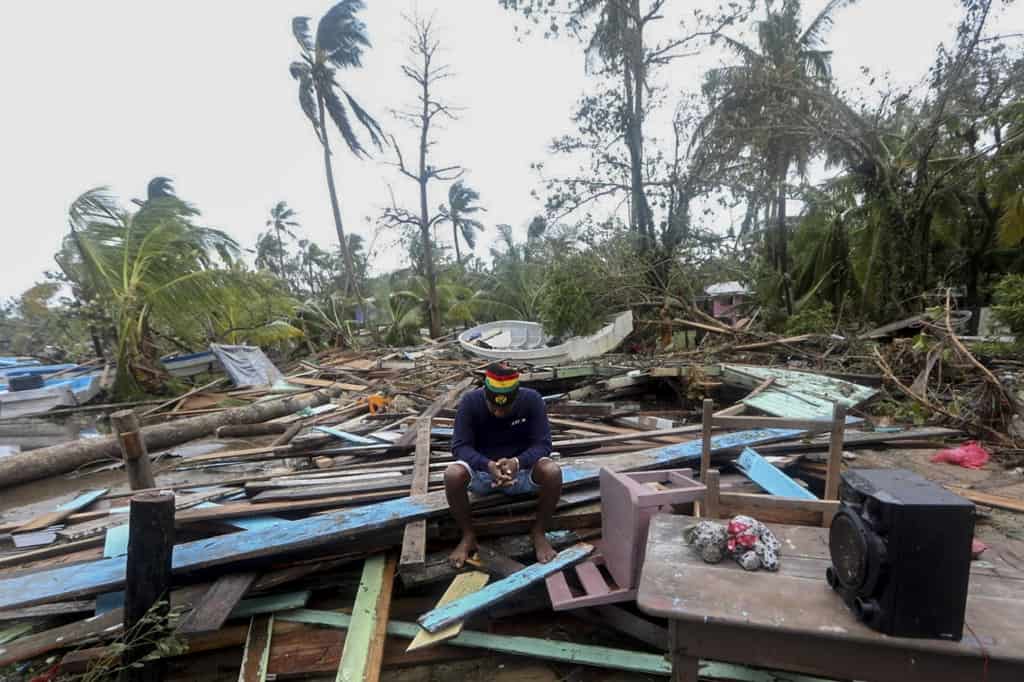
The North Caribbean, one of the poorest regions of Nicaragua, is mired in uncertainty and despair after the double blow of hurricanes Eta and Iota, which sowed death and destruction in Central America.
In this area, populated primarily by indigenous people and Afro-descendants fishers and farmers, residents wonder how they will be able to resume their lives after the devastating cyclones that hit the same area in a matter of two weeks.
“We don’t work in any institution, we live off the wealth of the sea. Now, how are we going to go out to sea? We can’t, because the boats were damaged by the hurricane and even the dock is missing,” said Henry Washington, a fisherman from Bilwi.
“That is why we ask you to support us. I know that other countries send support, but here it does not come,” he added.
“We are only left with the clothes we’re wearing. I don’t know what will happen. I would like them to get me a mattress, a blanket. My house was lost and they gave us shelter because we have nowhere to go,” lamented Diana Moore, 52.
Desolation
After the passage of Iota, which dissipated last Wednesday over El Salvador, hundreds of people who were left homeless in Bilwi crawled among the rubble for anything that could be used to build “una champita” (a little ranch) where they could live.
The victims, including many children, are prey to hunger and cold, while older people who suffer from hypertension, diabetes or other diseases are also vulnerable.
The San Lucas Foundation, an NGO that works with in the Caribbean in the prevention of diseases, fears an outbreak of malaria, which even before the storms affected 400 people each week.
Iota hit Nicaragua on November 17 as a Category 5 hurricane, the highest on the Saffir-Simpson scale, and left a bleak panorama of indigenous communities without food, water, clothing or electricity.
The cyclone was stronger than Eta, which on November 3 hit with its powerful winds of 240 kmh the communities of the North Atlantic Autonomous Region (RAAN), the largest and least populated in the country, with 500,000 inhabitants of the Miskito, Sumos, Branches, Garifuna, Creole and Mestizo ethnic groups.
This region, despite its potential for natural resources and biodiversity, also lags in socioeconomic development. Most of the population drink water from wells or rivers, which were contaminated after the hurricane, and survive on a dollar a day, according to human rights defenders.
Eta left more than 200 dead on the isthmus, while Iota claimed 44 lives, according to the initial count in the region.
Nicaraguan Vice President Rosario Murillo reported last week that 35,490 people remained in shelters — out of a total of 160,000 who were evacuated from coastal communities — but they most will begin to return to their communities.
Without anything
“We stayed on the street. In my family, we are two adults and two children. When Hurricane Eta passed, we made our champita without any help, but Iota blew it away and no one has come to tell us if they are going to help us,” Nadia Webster told AFP.
The only thing that remained of her house facing the sea is the foundation upon which it was buil.
“This was my house,” said the single mother of two children, who lives by marketing seafood that she buys from fishermen — an activity paralyzed by the hurricanes.
After Eta “we had collected some wood and we rebuilt the house, but Iota came and took it back,” lamented Itzel Laco, 25, who sells used clothing and whose merchandise was lost in the hurricane.
Murillo said that the government “is aware” of the serious effects of the families affected by the storms and “to the extent that we have the necessary resources, housing will be guaranteed.”
Iota entered northern Nicaragua and exited through Honduras, leaving roofless houses, trees, and downed power lines on its way.
The Caribbean municipalities of Rosita, Siuna and Prinzapolka were without electricity, water and communications are intermittent.
The government assures that it sent food and material to repair the houses, but those affected deny having received help and blame local officials for biasing their delivery.
“The government sends donations, but they have brought nothing to the people who need it. There is enough provision in the warehouses, but they do not give,” denounced Henry Müller, a fisherman who was unemployed.





