

Sloths are some of the strangest creatures in the world. If you were to describe a generic sloth to someone, your might mention their long limbs and claws, their unusual snouts, and great ability for slow, focused movement. These adaptations might lend them some monkey-like appearance and, indeed, for centuries they were lumped with New World monkeys in a strange, almost comical family tree.
Reality is frequently stranger than fiction, though, and because of molecular analysis sloths were quickly lumped together in an even stranger family tree: the superorder Xenarthra, which includes all living armadillos, anteaters, and yes, sloths!
While quite distinct between each other, Xenarthrans possess some things in common. The first characteristic is their namesake, a xenarthran joint in their vertebrae, which is perfect at giving back support while digging or climbing. Their limb bones and limb circulation is also different from most mammals, aiding in climbing or digging as well. All of these characteristics make a Xenarthra, but some are more closely related than the other. Sloths and anteaters are lumped together as sort of close cousins in their family tree; together they make the order Pilosa, meaning “hairy.”
Within Pilosa, we have two subdivisions: Folivora, meaning leaf-eater, where one would find our friends the sloths; and Vermilingua, meaning worm tongue, where one would find the black anteater. Currently, there are only four species of anteater in the world, fewer than sloths. The biggest is the giant anteater, while the smallest would be the silky anteater. In Costa Rica, there are three species: the giant anteater, the northern tamandua, and the silky anteater.
Anteaters are incredible animals, but they’re also the least studied of the sloth family tree. Little is known about their evolution, and little in the way of fossils have been found, but these prehistoric-looking creatures are truly marvelous.
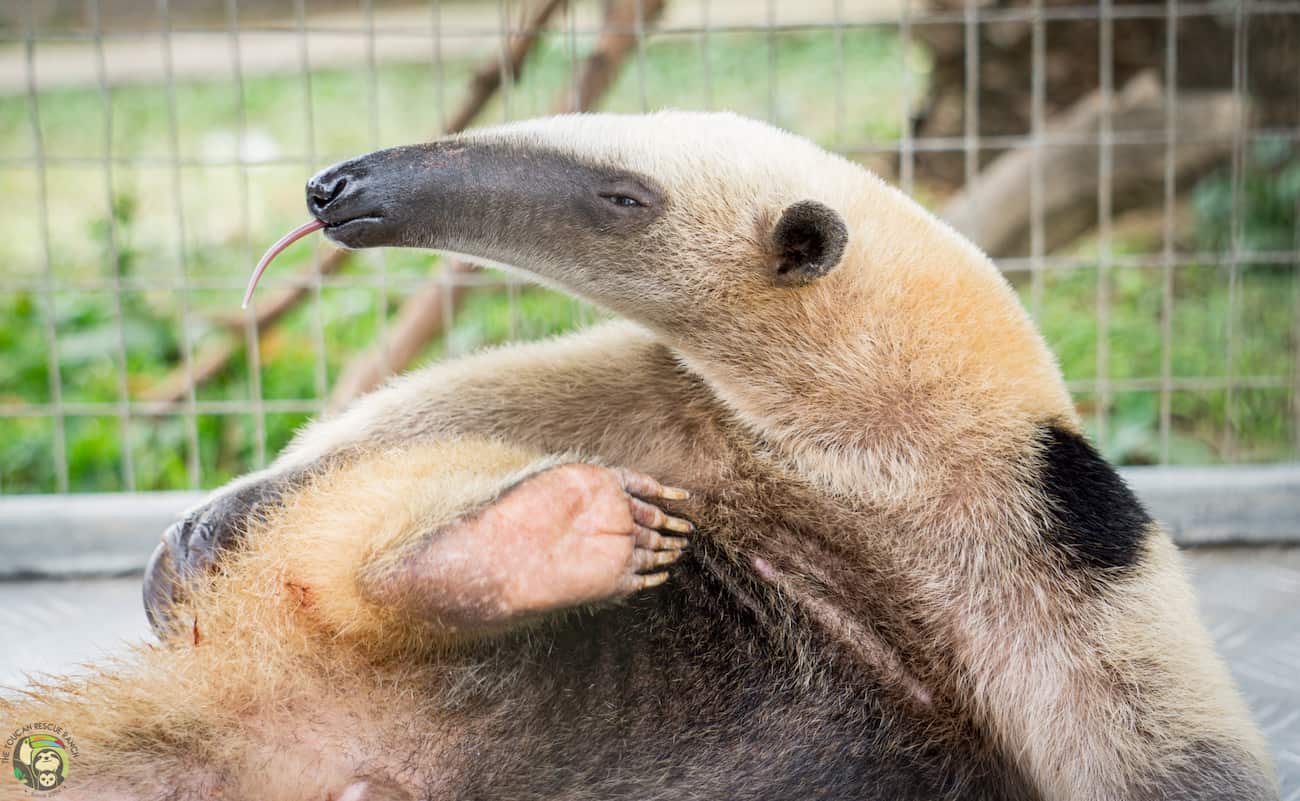
Anteaters have an elongated snouts without teeth. This configuration allows them to have one of the longest tongues in nature. Unlike most mammals, their tongue is tied to an extremely complex Hyoid bone, also known as the tongue, allowing anteaters to keep their large tongues in place and to propel them out of the mouth to eat insects. While the name anteater implies a certain predilection for ants, in reality anteaters can eat different insects depending on their species and size, with giant anteaters and tamanduas preferring ants and termites, while silky anteaters prefer the smaller tree ants and beetles.
One of the most prominent species in Costa Rica is the Northern Tamandua. Tamanduas are fantastic creatures. They are semi-arboreal, spending a good portion of their day among the trees looking for food. Their skin is thick to allow them the ability to eat ants without worrying about the annoying bites, and their ears and eyes are small to steer ants away from them. Tamanduas have exceedingly large and sharp claws in their forepaws. These claws are strong enough to be able to rip apart chunks of termite nests and allow the tamandua to feed. These solitary animals only come in contact with each other to mate, after which they’ll separate. The mother carries her infant child on her back — looking like a backpack.
Human expansion has contributed to the decline of tamanduas and other anteaters in the wild. Sightings of Giant Anteaters, a cryptic but known animal in Costa Rica, have been reduced to almost urban myths at this point with experts assuming that the species might be extinct in the country. Tamanduas, while still relatively common, face risk from dog attacks as well as superstitious people who might see them as bad omens or symbols of witchcraft and harm them because of this.
One of the other common reasons for the admission of anteaters in rescue centers in Costa Rica is car accidents. Sadly, as humans have taken more and more space from the rainforest for our use, we have built highways that cross forests. As semi-arboreal animals, Tamanduas are especially at risk when crossing from one side of the street to the other. Like sloths or monkeys, crossing roads by using the electrical cables may electrocute the anteater, but crossing on the ground exposes them to being run over by cars.
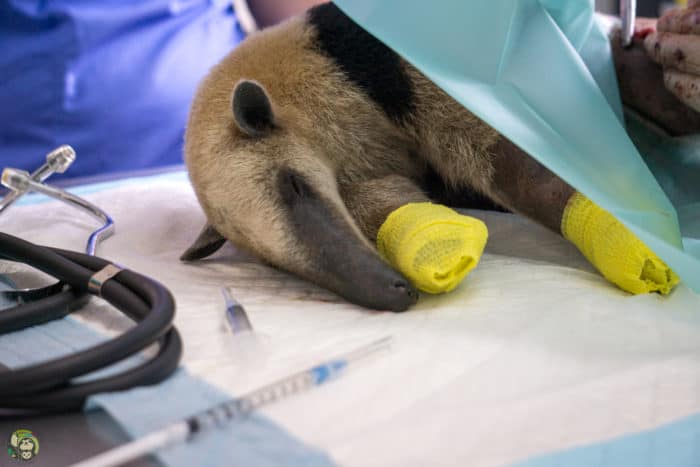
That was the case with Loki, an adult male Tamandua that first arrived at the Toucan Rescue Ranch after being run over. He arrived with a fractured leg and had to face an orthopedic procedure to be able to start to heal. Thankfully, the procedure went well, and Loki now finds himself at Toucan Rescue Ranch recovering and soon will enter rehabilitation to be released.
Anteaters are important members of the animal kingdom, keeping in check the wild populations of insects and making sure that there’s balance in the ecosystem that surrounds them. It is for this reason that we must take care of them and help the ones we still have, so in the future, our children and our children’s children might still be able to say they saw these fascinating animals in the wild!
Here are 5 easy ways you can help tamanduas and other wildlife from being harmed like Loki:
- Obey traffic laws and do not speed. Take extra precaution during dusk, dawn, and at nighttime.
- Ask your local government to install more wildlife highways for safe crossings for both arboreal and land dwellers.
- Keep your pets inside to prevent dog attacks on local wildlife.
- Push your electric provider to provide safe infrastructure for wildlife – this will prevent electrocutions among animals.
- Educate your family, friends, and community about these fascinating animals and how they can help protect them!
— Andrés Sáenz Bräutigam is a Veterinary Medicine Student & TRR Veterinary Assistant & Tour Guide.
This article was produced by The Toucan Rescue Ranch. The Toucan Rescue Ranch specializes in helping wild animals recover so that they can be reintroduced into the wild. For more information or to donate, visit the Toucan Rescue Ranch website.





