

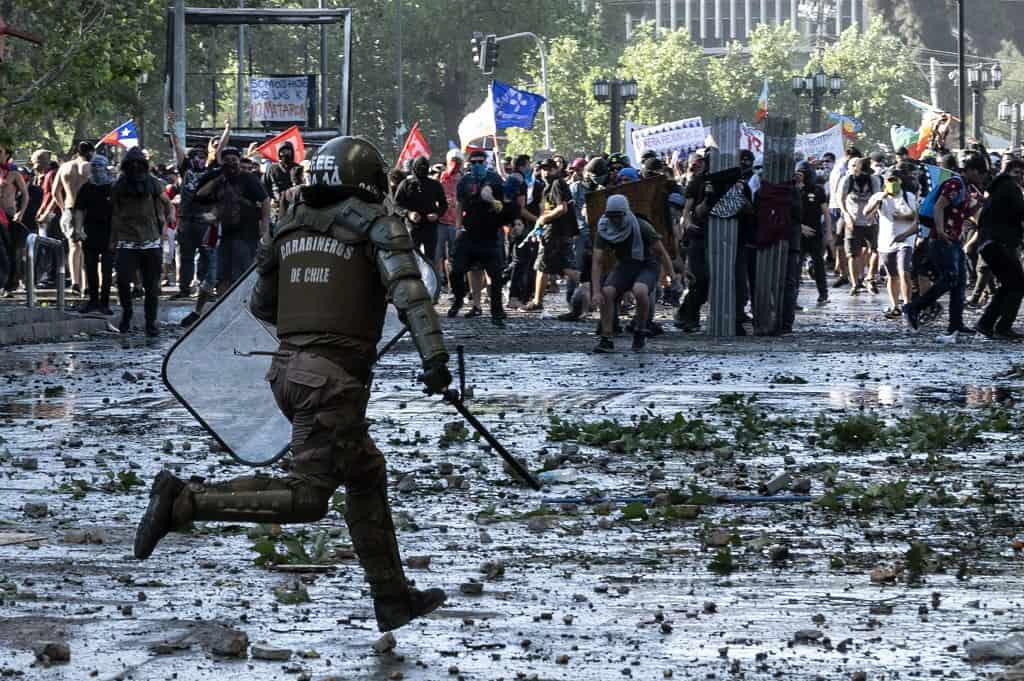
Millions of people turned to the streets of Ecuador, Chile, Bolivia, Colombia, Brazil, Venezuela, Ecuador, Puerto Rico and Honduras in 2019 with social claims, but authorities responded with repressive and often increasingly militarized tactics, says an Amnesty International (AI) report published Thursday.
“The year 2019 brought a new attack on human rights in much of the Americas, with intolerant and increasingly authoritarian leaders who resorted to increasingly violent tactics to prevent people from protesting or seeking security in another country,” said Erika Guevara Rosas, director for the Americas at AI.
The organization emphasized that the repression in Venezuela was especially severe, with security forces of the government of Nicolás Maduro committing “crimes under international law and serious human rights violations, including extrajudicial executions, arbitrary detentions and excessive use of force.”
And in Chile, it detailed that the army and police deliberately wounded protesters, killed at least four people and seriously injured thousands more. According to the report, more than 350 injured people had serious eye injuries.
According to the 96-page document, at least 210 people died in the context of protests in 2019: 83 in Haiti, 47 in Venezuela, 35 in Bolivia, 31 in Chile, eight in Ecuador and six in Honduras.
AI also recognized that governments had adopted aggressive positions regarding migrants, refugees and asylum seekers.
“The region faced at least three serious situations in terms of refuge: Nicaraguan people fleeing to Costa Rica, Venezuelan people who moved mainly to countries in South America, and the countries of the so-called Northern Triangle (El Salvador, Guatemala and Honduras) that crossed Mexico to reach the United States,” the report says.
It noted that the number of people who fled the crisis in Venezuela amounted to almost 4.8 million, an unprecedented figure for Latin America. Peru, Ecuador and Chile, it said, responded with new and restrictive entry requirements.
The agency said that impunity “remains the norm instead of the exception” in cases of human rights violations and crimes of international law and sets as an example the definitive closure of the International Commission against Impunity in Guatemala, an entity attached to the UN that left the country last September after 12 years of operation.





